How to Change the World
My theory is that the best way to change the world is to live your life as if your own sin is the biggest problem in the world. I want to examine wisdom from different times, cultures, and faith traditions that are all getting at this same point.
One caveat before we dive in: I wouldn’t apply this teaching to someone who has just experienced trauma. There are times when the sin and brokenness of the world comes knocking at your door, and you first need time to grieve and find healing. Jesus said he wouldn’t break a bruised reed (Isaiah 42:3). Please receive this as a general principle that will be applicable to most but not every situation.
“Man in the Mirror”- Michael Jackson, 1988
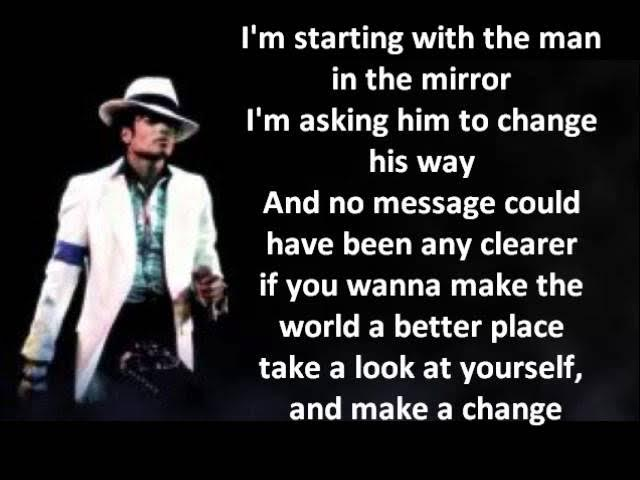
In his 1988 hit song, Michael Jackson sings, “If you wanna make the world a better place, take a look at yourself and then make a change.” There are so many needs and so much brokenness in the world. It can be discouraging to feel like the world is run by corrupt governments and greedy corporations. What can one person do in the face of that much opposition?
Start with yourself, the man in the mirror. Start with what you can control. Maybe you can’t solve your cities homelessness crisis. But maybe you can show kindness and dignity to one homeless person on your way home from work.
“Be the Change”
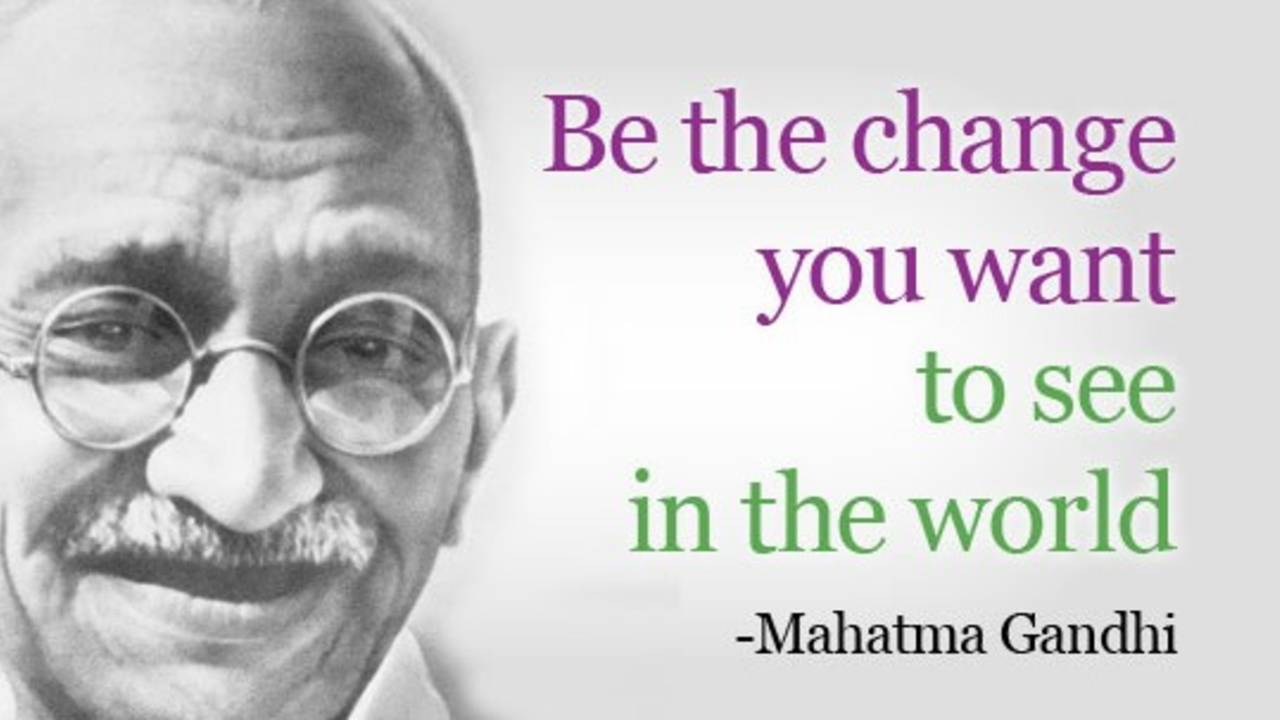
Mahatma Gandhi (1869-1948) is one of the most influential voices on non-violent resistance in history. He was influential both in fighting for civil rights in South Africa and in gaining Indian independence. He famously said, “Be the change you want to see in the world.”
Do you want to see less poverty in the world? Give to the poor.
Do you want to see less racism in the world? Befriend people who don’t look like you.
Are you tired of corrupt politicians? Run for office.
We all have to ask ourselves, “What do I want? and What am I willing to sacrifice to get it?”
“I am.”
There is a popular story where a newspaper sent out an inquiry to famous authors, asking the question, “What’s wrong with the world today?” To which G.K. Chesterton responded,
“Dear Sir,
I am.
Yours, G.K. Chesterton.”
Living in the early 20th century you might expect him to say something along the lines of war, poverty, drunkenness, factory conditions, or the poor education of the masses. But I think Chesterton is both humble enough and wise enough to first look at his internal problems rather than the external problems. I think this is where activists can go wrong. They perhaps rightly point out the wrongs and injustices that exist in the world, but can turn prideful and self-righteous if they don’t also take serious where they fall short.
In the book How People Change, Paul Tripp says, “Whenever you believe that the evil outside you is greater than the evil inside you, a heartfelt pursuit of Christ will be replaced by a zealous fighting of the ‘evil’ around you. A celebration of the grace that rescues you from your own sin will be replaced by a crusade to rescue the church from the ills of the surrounding culture.” We can end being overly critical of others when we forget that we are sinners saved by grace alone.
The Plank and the Speck
Lastly, we’ll consider Jesus’ words from the sermon on the mount:
“Do not judge, or you too will be judged. For in the same way you judge others, you will be judged, and with the measure you use it will be measured to you.
“Why do you look at the speck of sawdust in your brother’s eye and pay no attention to the plank in your own eye? How can you say to your brother, ‘Let me take the speck out of your eye,’ when all the time there is a plank in your own eye? You hypocrite, first take the plank out of your own eye, and then you will see clearly to remove the speck from your brothers eye” (Matthew 7:1-5).

A few things stand out: First, God will judge us by the same standards we judge others. This should cause all of us to pause and consider how we think about others.
Second, we are to take the plank out of our own eye first. Jesus doesn’t say that is all that we do. He still calls us to remove the speck from our brother’s eye, but only after we have removed the plank from our own eye. But what does that mean?
I think the plank is our own sin and the speck is the sins of others. Our sin should be so in our face (no pun intended) that we can’t avoid it. So often we get this illustration backwards. We think we are the ones with the speck in our eye while everyone else has the big plank. We say things like, “I would never do that . . .” “Can you believe what she said?” “At least I’m not as bad as . . .”
Deal with your own stuff first, then you can clearly see what others are going through with a sense of love and compassion. Nobody likes having sawdust in their eye. It is unloving to let someone continue in a destructive behavior, but when we fail to approach them with humility and gentleness we often do more harm than good. How might this play out in the real world?
A Hypothetical Example
Let’s say you are in a meeting and a coworker blatantly disrespects you. What do you do? Do you lash out in the moment? Gossip about what happened? Bury your anger and pretend it wasn’t a big deal? Passive-aggressively hint that something is bothering you for the next year or so? Get the incident on film and post it to social media so that he might be shamed or even cancelled? Or do you take the plank out of your eye by self-reflecting?
Maybe you start with noticing your anger. Anger itself isn’t sinful, but it points to what is important to us. Then you might consider what exactly triggered that response. Did you feel threatened or embarrassed? Did it remind you of an incident or relationship from your past?
As you go down this path you might discover that you actually have an anger problem and are hyper-critical of those around you. Or maybe you take yourself too seriously because deep down you believe that your worth as a person comes from what you do and how others think about you.
After doing this work, you can look at the situation clearly to address your coworker. You could say something like, “When you said what you said in the meeting it made me feel ________. I’m sure that wasn’t what you intended, but I would appreciate if you would be more considerate in the future. I want our team to stay unified, and your comments created unhealthy friction.”
Doesn’t that seem more productive than anything listed in the first paragraph? Maybe the coworker realizes that he resorts to sarcasm when he is under stress as a self-protection mechanism. After noticing the problem he can take steps to fixing it.
Final Thoughts
From the King of Pop to the King of Kings, the message is consistent: start with yourself. Live as if your own sin is the greatest problem in the world. Only then will you be able to make a difference in the world. Imagine how marriages, friendships, families, and organizations might look different when individuals stop blaming others and circumstances and take ownership for the wrongs they do and the good that they leave undone.
 Cultural Eulogy