Rethinking Your Narrative: Unlocking Potential
In his book Mind Your Mindset, Michael Hyatt’s main idea is that “[Many] challenges people face— in fact, nearly all of them— are essentially (1) based in the brain and (2) evident in the stories we tell ourselves about reality.”
The stories we tell ourselves inform how we see the world and act within it, including how we pursue our goals. Our narratives determine what goals we set and how successful we are in achieving them. Storytelling is a function of how our brains conceive and represent reality, and our results depend to a large degree on how good our storytelling is.
Hyatt argues that when our stories leave us in a rut, we need to rethink our thinking by adopting a different vantage point. We must examine the stories our brain is telling, and imagine better, more empowering narratives. To do this we must:
First, identify your problem and your story about it. Improvement begins with awareness. Many of the invisible scripts we live are holding us back, and we might not even know it. You might have unexamined stories about money, people of different backgrounds, or what your are capable of achieving. For example, a story someone might tell themselves is, “I can’t get out of debt because I am not good with money.” This will likely turn into a self-fulfilling prophecy.
Second, interrogate the story. Many of the stories we tell ourselves are flawed. We need to separate what’s factual from what’s merely opinion, inference, conjecture, and the like. Take the phrase “I’m not good with money.” You can interrogate that by asking, “Why do you say that? Have you done any research? Read any books or articles? Asked any friends or mentors? Tried anything to improve? If you haven’t taken any steps, how can you say you are bad at money?” In this stage you have to challenge your assumptions to separate what is helpful and what is holding you back.
Third, imagine a more empowering story. Once we’ve exposed our faulty stories, we can use our brain’s natural ability to rewire itself to find new paths and solutions. Continuing with the money example, what if instead of “I’m not good with money” you said, “I have struggled with money in the past, but money is a skill I am committed to master.”
I think Henry Ford’s quote rings true, “Whether you think you can or think you can’t, you’re right.” Obviously, this isn’t absolutely true. There are plenty of sports teams and businesses who believed that they would succeed but didn’t. However, the belief that they would succeed gave them a fighting chance.
Kairos Circle
Hyatt’s framework of Identify, Interrogate, and Imagine pairs nicely with Mike Breen’s Kairos Circle.
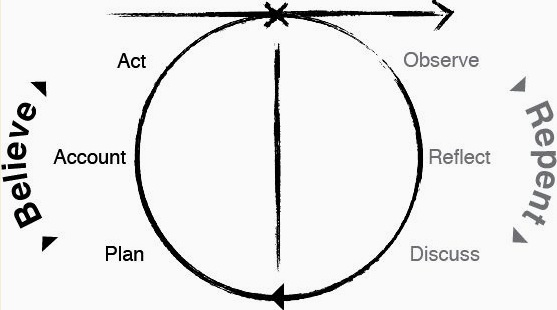
In the image above, the arrow represents time. You are going about your life when a significant moment occurs (the X). The moment could be an emotional response, a tragic event, a meaningful conversation, or reading something profound. When the significant moment arrives, we have a choice. We can ignore it and keep doing what we are doing, or we can enter the learning circle.
The first step is to observe. Gather the facts. What happened? What did you feel? This fits with identifying your current narrative.
The next step is to reflect. This is where you ask “why?” and “how” questions. When you reflect you go under the surface. The purpose is to move from a false narrative to one that is truer. However, we can’t do this alone, we must discuss. We need other people to speak truth, love, and wisdom. Everybody has blind spots, so having a trustworthy person to speak with is crucial. The purpose of observing, reflecting, and discussing is to ultimately move you from a false belief to a true one. The Greek word “repent” means to change one’s mind. We must turn from false mindset about God or the world and turn to what is true.
I will use a scene from the Kung-Fu Panda to illustrate.
Master Shifu tells Master Oogway that notorious kung-fu villian, Tai Lung, escaped from prison (kairos moment). Although it is the Dragon Warrior’s destiny to defeat him, Shifu doesn’t believe that Po the panda is really the Dragon Warrior because he was unlike anyone he ever trained. Po must have been chosen by accident. He tried to control the situation by forcing Po to quit. Oogway tells Shifu that there are no accidents, and that Shifu must give up the illusion of control in order to fulfill his destiny. This is the moment when Oogway gets Shifu to imagine a better story:
Shifu: A peach cannot defeat Tai Lung!
Oogway: Maybe it can. If you are willing to guide it. Nurture it. Believe in it.
Shifu moved from a false narrative to a better narrative and that changed everything. He realized that Po had potential, but he would need to train him differently in order to unlock it. Oogway helped Shifu identify his limiting belief, interrogate its validity, and imagine a better way.
What about you? What stories are you currently living? How are they holding you back from the life God has for you?
 Cultural Eulogy