The Telos of Fight Club
Today is the movie Fight Club‘s 25th anniversary. Fight Club is a movies that I never get tired of watching. It’s perspective on masculinity, consumerism, and purpose in life challenges me think more deeply. There are many things about this film that I could write about (and probably will in the future), but today I will consider what this movie shows about telos.
Telos is a Greek word meaning “goal, end, or purpose.” According to James K. A. Smith in the book “You are What You Love”, “Our telos is what we want, what we long for, what we crave. It is less an ideal that we have ideas about and more a vision of ‘the good life’ that we desire. It is a picture of flourishing that we imagine in a visceral, often-unarticulated way—a vague yet attractive sense of where we think true happiness is found.”
All of us have a vision of “the good life” that determines what we do and how we do it. We have an idea of what would make life better for us, and we build our lives around that end (consciously or unconsciously). I turn now to consider the telos of the narrator and Tyler Durden. I am not endorsing either of their views, I am simply using them as examples.
The Narrator’s Telos
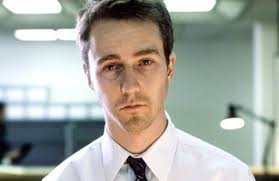
After his condo blew up and all of his possessions were destroyed, the narrator (Ed Norton) and Tyler Durden (Brad Pitt) went to a bar for drinks. He laments to Tyler, “When you buy furniture you tell yourself, ‘That’s it. That’s the last sofa I’m gonna need. Whatever else happens, I have that sofa problem handled.’ I had it all. I had a stereo that was very decent. A wardrobe that was getting very respectable. I was close to being complete.“
The narrator felt like something was missing in his life. He had lost faith in God. When his parents divorced he lost faith in family. After the bloodshed of the 20th century he also lost faith in people. He had no meaningful relationships. He suffered from insomnia, likely from the existential angst he felt. He only found relief by attending support groups for people with terminal illnesses. While he was there, he used a fake name. He existence was basically anonymous. The only way to make the feeling of emptiness go away was to buy the right things. How did he pay for those things? He worked many hours at a morally ambiguous company. His life was an endless cycle of working and buying.
His telos was having the right possessions, and that dictated how he spent his time. He thought he could work enough to then buy his way into contentment, but it still left him empty. The things he owned, ended up owning him.
Tyler Durden’s Telos

Tyler Durden’s vision of the good life is quite different. He says, “In the world I see – you are stalking elk through the damp canyon forests around the ruins of Rockefeller Center. You’ll wear leather clothes that will last you the rest of your life. You’ll climb the wrist-thick kudzu vines that wrap the Sears Tower. And when you look down, you’ll see tiny figures pounding corn, laying strips of venison on the empty car pool lane of some abandoned superhighway.”
Tyler was “enlightened.” He sensed the meaninglessness and directionlessness of modern society. He saw that society was smothering people’s’ souls. In hunter/gatherer societies, there was a clear challenge of obtaining enough food to survive. Modern man (generally speaking) doesn’t have that problem. Affluence left people feeling empty. What was his solution? Tear it all down.
He began by starting fight club, a place where men can unleash their suppressed aggression. From there he recruited members to join project mayhem. Project mayhem was a terrorist organization that committed many acts of violence and vandalism. All of this culminated in a plan to blow up credit card buildings to erase the debt record so everything would reset to zero.
Tyler wanted chaos. He thought that by tearing down society, individuals would be free. “It is only after we’ve lost everything that we are free to do anything.” For Tyler, society was so bad that going back to a time before modern technology was the only answer. He worked tirelessly to bring about the world’s destruction.
What is Your Telos?
What about you? What is your vision of the good life? What do you believe will make everything better? For some it is being respected, for others it is being loved. Maybe yours is having a great career and status, or looking a certain way, or being at ease. If you are struggling to discern you telos, start by examine your emotions, how you spend your time, and how you spend your money.
According to the Westminster Shorter catechism, “The chief end of man is to glorify God, and to enjoy him forever.” The telos for which God created us was to be in union with him. We were made to know, love, trust, and obey God. Jesus said that the greatest command is to love God and to love your neighbor. Jesus made a way for us to be in union with God by dying on the cross for our sins. Because of the sin that lives in us and the complexity of our world, we will always have mixed desires. A good first step is to name what you want and why. To do so, finish these three sentences: “I want to live in a world where . . .” “so that . . .” “Therefore, I will . . .” This article goes into more depth.
 Cultural Eulogy