Struggling to Pray? Remember THIS

One thing I love about being a dad is teaching my son about God in a way that he will understand. After following Christ for a while we tend to take things for granted or make things needlessly complicated. But it’s impossible to do this with small children.

Prayer is one area that we make needlessly complicated. You might wonder if you are saying the right thing or praying enough or if your prayers are “working.” The good news is that God already knows what we need (Matthew 6:8), cares deeply for us (1 Peter 5:7), and is never annoyed by our prayers (Luke 18:1).

Here are three types of prayers to get you started:

  • Thank You
  • Help
  • I‘m Sorry

You just have to remember THIS!

Thank You

A frequent dinner question my wife and I ask our son is, “What made you happy today?” We take what he tells us and turn it into a prayer. “God, thank you for friends. Thank you for scooters. Thank you for the park.”

Even when things are bad, there is at least one thing you can thank God for. “Thank you for breath in my lungs. Thank you that you care about me. Thank you that I have a bed, even though I don’t have it in me to get out of it today.”

We can give thanks for who God is and for what he has done.

Help

“Helper” is a frequently used to describe God in the Old Testament. “We wait for the LORD; he is our help and shield” (Psalm 33:20). In John’s Gospel, Jesus uses the word paraclete to describe the Holy Spirit. It is translated “Counselor,” “Comforter,” “Advocate,” and “Helper” (John 14:16, 14:26, 15:26, 16:7). Jesus also tells us that we can do nothing apart from him (John 15:5).

God wants us to acknowledge our need for his help. He is a good Father who knows how to give good gifts to his children. We pray for ourselves and intercede on behalf of others. You can pray things like:

“Help me to be loving and kind today. Give me wisdom and strength to do your will. Please help my friend who has cancer. Help them to know you are near.”
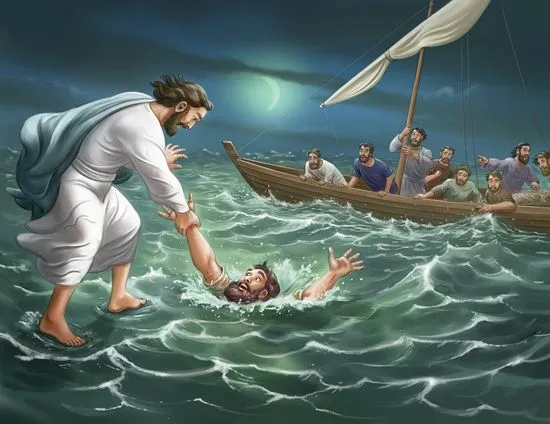
“Lord, help me!” (Matthew 14:30)

I’m Sorry

Confession and repentance is perhaps the most important aspect of the Christian life. Martin Luther penned in his 95 Theses that the entire life of a believer is to be one of repentance. Both Jesus and John the Baptist preached to “Repent and believe the good news!” John (not John the Baptist) tells us “If we confess our sins, he is faithful and just and will forgive us our sins and purify us from all unrighteousness. If we claim we have not sinned, we make him out to be a liar and his word is not in us” (1 John 1:9-10).

Jesus paid the penalty for all of our sins when he died on the cross. That is why John says that God is just, not merciful, to forgive our sins when we confess them. It is just of God to forgive that which has already been paid. We can be honest with God about our sin without fear of rejection. It’s not like he will be surprised by what we say. These prayers can look something like:

“Father, I’m sorry that I lashed out in anger today. I’m sorry for the ways that I live like I don’t need you. I’m sorry that I’m so often inconsiderate of others. I’m sorry for the good things that I didn’t do today. I’m sorry that I so often forget to spend time with you.”

Concluding Thoughts

Theses prayers are not rigid categories. There will often be overlap. For example, “Father, thank you for blessing me with children. Help me to love, protect, and steward them well. I’m sorry for when I forget that they are a gift from you and get frustrated with them. Thank you that you are the true Father that they need. Help them to put their faith in you.”

“Thank you . . .”

“Help . . .”

“I’m Sorry . . .”

Remember THIS. Change your life.

Teach Us to Pray

Prayer is often difficult. It is hard to make time for it, hard to stay focused, and hard to know what to say. When Jesus’ disciples asked him to teach them how to pray, he gave them the Lord’s Prayer (Luke 11:1-4).

Another prayer tool I have learned is called the ACTS model. ACTS stands for:

  • Adoration: What is a characteristic of God that you appreciate?
  • Confession: In what ways are you falling short of God’s standard for you?
  • Thanksgiving: What good has God already done for you?
  • Supplication: What do you want/need God to do for you?

In the following, I will show how the Lord’s Prayer and ACTS prayer can be blended. The process involves meditating on each phrase of the Lord’s Prayer and reflecting on what it means for our lives. In each phrase I will state what is true about God, where I fall short, why I am thankful, and what I want God to do.

“Our Father in Heaven”

  • Adoration: “You have given us the Spirit of adoption, by whom we cry ‘Abba! Father!’ You are a great and merciful Father. By your grace you have turned orphans, rebels, and enemies into sons and daughters and co-heirs with Christ.”
  • Confession: “But so often I don’t live like a son. I am the younger son who wants your stuff, but not a relationship with you. I am the older son who believes that I can earn your love if I do enough good things (Luke 15).
  • Thanksgiving: “I thank you for your grace. By your grace I can boldly approach your throne, completely accepted as your child. Thank you that I am yours and you are mine forever.”
  • Supplication: “There are many who do not call on you as Father. They are stuck in their sins and have no concept of your love and compassion. Would you open their eyes to see your goodness and receive you as their true Father?”

“Hallowed Be Your Name”

  • Adoration: “Holy, holy, holy, is the Lord God Almighty. There is no one like you. Let your name be honored as holy.”
  • Confession: “So often I treat you as common. I forget how holy and great you are. I try to make a name for myself rather than glorifying your name.”
  • Thanksgiving: “Thank you that through Jesus you made a way for sinners to be in your presence. You are unapproachable, yet in Christ you made it so we could approach you.”
  • Supplication: “I want to see more people worship you and lifting your name on high. Would you change hearts so they praise your holy name?”

“Your Kingdom Come, Your Will Be Done”

  • Adoration: “Your kingdom is not of this world. It is pure, true, and just. Your kingdom is a priceless pearl. Your will is good, pleasing, and perfect. Your thoughts are not my thoughts and your ways are not my ways. Your plan is so much higher than I could ever comprehend.”
  • Confession: “I often don’t live according to your kingdom. I am selfish. I neglect the needy. I don’t speak the truth in love. I don’t seek your face as I should. I want my own will to be done. I don’t believe that your plans for me are good.”
  • Thanksgiving: “Thank you that you delight to give us the kingdom. Thank you that your will cannot be thwarted.”
  • Supplication: “Would your kingdom of light and love push against the kingdom of sin and darkness both in the world and in my heart? Would you help me to trust that your ways are better than mine? Let your will be done in and through me.”

“Give Us This Day Our Daily Bread”

  • Adoration: “You are a good Father who gives good gifts to your children. The earth is yours and everything in it. All things are dependent on you. You are the Creator of everyone and everything.”
  • Confession: “Forgive me when I live like I don’t need you. When I am ungrateful for the good gifts you provide. When I feel entitled to more than you’ve given. When I envy those with more than me.”
  • Thanksgiving: “Thank you for the good gifts you provide. You have provided jobs. You provided skilled workers to produce and serve food. Every day that I have enough to eat is a miracle, for which I am grateful.”
  • Supplication: “Please provide what I need. I also lift up those who are suffering and don’t know where their next meal is coming from. Give them their daily bread too.”

“Forgive Us, As We Also Have Forgiven Others”

  • Adoration: “You are gracious and compassionate, slow to anger, abounding in love and faithfulness, maintaining love to thousands of generations, and forgiving wickedness, rebellion, and sin. You know all things, yet you cast my sins into the sea of forgetfulness.”
  • Confession: “My sins are many and are ever before me. I haven’t loved you with my whole heart or loved my neighbor as myself. I also hold grudges even though love keeps no record of wrongs.”
  • Thanksgiving: “Thank you that because Jesus died on the cross, there is forgiveness of sins. ‘The wages of sin is death,’ and Jesus paid it all. Thank you for your priceless sacrifice.”
  • Supplication: “Bring to mind my sins and how I am falling short. Forgive me, Father. Give me the love and grace to forgive those who have wronged me. Help those who are far from you find forgiveness.”

Lead Us Not into Temptation, but Deliver Us from the Evil One

  • Adoration: “You are the good shepherd. You lead us beside still waters. You protect us in the valley of the shadow of death. You are stronger than evil. You are our shield, our fortress, and our deliverer. Lord, you are a mighty warrior.”
  • Confession: “I confess how often I lead myself into temptation. I get distracted from the path you called me to walk and befriend evil. I forsake your wisdom and the Spirit within me. I don’t live out the freedom you bought for me with Christ’s blood.”
  • Thanksgiving: “Thank you that you have given your Holy Spirit and your Word to lead us and guide us. Thank you that Jesus defeated sin and death when he rose from the dead. Thank you that by trusting in Jesus we share in your victory.”
  • Supplication: “Lead us, guide us, and protect us. Satan is like a roaring lion, seeking to devour. Help us to stand firm and trust in you. May we not be overcome with evil, but overcome evil with good.”

For Yours Is the Kingdom, and the Power, and the Glory Now & Forever. Amen

Lent Reflections: Mortality

“Remember you are dust, and to dust you will return.”

This is the phrase that churches all around the world told their parishioners on Ash Wednesday. Ash Wednesday kicks off the Lenten season, the 40ish days from Ash Wednesday to Easter Sunday. According to a handout from my church, the aim of Lent is threefold:

  1. To meditate on our mortality, sinfulness, and need of a savior.
  2. To renew our commitment to daily repentance, both during Lent and all of life.
  3. To remember with confidence and gratitude that Christ has conquered death and sin.

With that in mind, I want to offer a sobering reflection on mortality.

A Tale of Two Pictures

The photo above shows my great-grandfather Clarence (“Pa”) with his three brothers William, Robert, and Frank. Pa was born on May 27th, 1928 and Frank was born December 29th, 1931. So, this picture must have been taken between 1932-1933. We see children with all their lives ahead of them, brothers who would all grow into adults with careers and loved ones, and experience many joys and disappointments.

The picture below shows the same brothers roughly 30 years later. At this time, Pa would have been married, had two sons, and a grandson either just born or coming soon.

I never knew Uncle Bill or Uncle Bob. They died before I was born. I am grateful that I had a relationship with Pa. I know that there aren’t many people who have met their great-grandparents, let alone remember them. Pa past away December 05, 2006 at the age of 78.

On that day, Frank, the baby from the first picture, became an only child. Uncle Frank buried his three brothers. He too joined them in death in February of 2020.

The Sad Reality

These pictures point to the truth beneath every picture: eventually one person will have lost every other person and be the last one living.

Every school or team picture.

Every wedding photo.

Every family picture at Christmas.

Every selfie with my wife and son.

There will come a day when all but one will remain. And then the one will become zero.

Consider the passage of time in the pictures below.

God willing, one day my dad will be the one holding his great-grandchild.

“As a father has compassion on his children, so the LORD has compassion on those who fear him. For he knows what we are made of, remembering that we are dust. As for man, his days are like grass- he blooms like a flower of the field; when the wind passes over it, it vanishes, and its place is no longer known” (Psalm 103:13-16).

“So remember your Creator in the days of your youth: Before the days of adversity come, and the years approach when you will say, ‘I have no delight in them’ . . . For the mere mortal is headed for his eternal home, and mourners will walk around the street; before the silver cord is snapped, and the gold bowl is broken, and the jar is shattered at the spring, and the wheel is broken into the well; and the dust returns to the earth as it once was, and the spirit returns to God who gave it. ‘Absolute futility,’ says the Teacher. ‘Everything is futile.” (Ecclesiastes 12:1-8).

Memento Mori.

Remember that you will die.

You are dust, and you will return to dust.

May we carefully number our days so that our hearts become wise.

The Case Against “Should”

“Should” is a weird word. We all use it multiple times a day, yet I struggle to define it. According to dictionary.com, “should” is an auxiliary verb meaning “must; ought (used to indicate duty, propriety, or expediency).” It can also be used to express an expectation: “They should be here soon,” or express a correction: “That semicolon should be a comma.”

Outside of giving or asking for advice, I think “should” should be avoided. The way we use that word today is often not helpful, and different vocabulary would serve us better. Here are some problems with “should.” It is non-commital, not actionable, isn’t honest, and it produces a vague feeling of guilt. Let’s explore these more deeply.

It is Non-Commital

How often have acquaintances said, “We should hang out sometime,” and then never hang out? By saying “we should hang out” you get the feeling that you are a caring and friendly person without having to put in any effort to follow through. Imagine a man says to his date, “We should get married.” Ladies, would you consider that a satisfying proposal? I think not.

Instead of saying “should” you could say, “I want to hang out with you, is there a good time when we could get together?” This phrasing takes for granted that the other person would want to get together with you. If you are less sure of the relationship you could ask, “Do you want to hang out?” This is more vulnerable and allows for the possibility of being rejected, but it is more likely to result in hanging out with a friend.

It is not an Action Verb

I often hear people say, “I should do X more.” It could be praying, calling loved ones, going to the gym, etc. However, just because you know that something would be good for you doesn’t mean that you will do it.

What would happen if you substituted “should” with “I need to . . .” “I want to . . .” “I will . . .” or “I get to . . .”?

“Need” indicates necessity. If you aren’t doing what you say you need, is it really necessary to you? “Want” indicates desire. Why wouldn’t you do what you want? “Will” indicates a commitment to action. It is still possible for people to break their commitments, but making a verbal commitment makes it more likely that you will follow through. “Get to” reframes your thinking from an obligation to an opportunity. “I get to pray,” sounds more positive than “I should pray.”

It is not Honest

Often when people say things like, “I should go to the gym,” what they are really saying is, “I know going to the gym would be good for me, but I really don’t want to go.” There is an internal conflict between wanting to be more fit and staying cozy. We all have conflicting desires. There is a battle between the flesh and the Spirit, and between what I want now and what will be better for me in the future. By naming the lesser desire its power over you weakens.

Consider the phrase, “I should pray more.” What is the unspoken “but” at the end of the sentence? “I should pray more, but I don’t know how, I don’t have time, I don’t believe it will do anything for me, etc.” By naming the hesitation you can then make a plan to move forward.

It Produces a Vague Feeling of Guilt or Regret

One of the ways “should” is helpful is in learning from mistakes. For example, “I should have made a reservation instead of just showing up at the restaurant.” It can express regret in such a way that you can make a better decision in the future.

However, it is unhelpful when disconnected from a specific action. Phrases like, “I should be doing more,” “I should be farther along than I am,” or “I should be more like that person,” make us feel a vague sense of guilt and shame. I believe it is better to feel a specific feeling of guilt. For example, if you said, “I need to complete these three tasks this week,” and you didn’t do them, you can feel guilty specifically about not doing what you needed. This is more productive than a vague feeling of not doing enough.

A counselor named Chip Dodd calls “should” the language of toxic shame. He says S.H.A.M.E. stands for “Should Have Already Mastered Everything.” We become contemptuous of our shortcomings and our neediness. We can’t accept ourselves for who we are, so we declare what we should be instead.

Whenever you catch yourself saying, “I should . . .” ask yourself “Why?”. Why should you be stronger? Why should you look for a new job? Why should you be farther along? When we ask these questions we get to the heart of our desire. We see what is, what can be, and then decide a next step to get to where you want to go.

Remove “should” from your vocabulary and change your life.