The Case Against “Should”
“Should” is a weird word. We all use it multiple times a day, yet I struggle to define it. According to dictionary.com, “should” is an auxiliary verb meaning “must; ought (used to indicate duty, propriety, or expediency).” It can also be used to express an expectation: “They should be here soon,” or express a correction: “That semicolon should be a comma.”
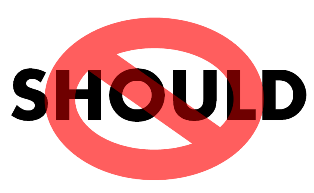
Outside of giving or asking for advice, I think “should” should be avoided. The way we use that word today is often not helpful, and different vocabulary would serve us better. Here are some problems with “should.” It is non-commital, not actionable, isn’t honest, and it produces a vague feeling of guilt. Let’s explore these more deeply.
It is Non-Commital
How often have acquaintances said, “We should hang out sometime,” and then never hang out? By saying “we should hang out” you get the feeling that you are a caring and friendly person without having to put in any effort to follow through. Imagine a man says to his date, “We should get married.” Ladies, would you consider that a satisfying proposal? I think not.
Instead of saying “should” you could say, “I want to hang out with you, is there a good time when we could get together?” This phrasing takes for granted that the other person would want to get together with you. If you are less sure of the relationship you could ask, “Do you want to hang out?” This is more vulnerable and allows for the possibility of being rejected, but it is more likely to result in hanging out with a friend.
It is not an Action Verb
I often hear people say, “I should do X more.” It could be praying, calling loved ones, going to the gym, etc. However, just because you know that something would be good for you doesn’t mean that you will do it.
What would happen if you substituted “should” with “I need to . . .” “I want to . . .” “I will . . .” or “I get to . . .”?
“Need” indicates necessity. If you aren’t doing what you say you need, is it really necessary to you? “Want” indicates desire. Why wouldn’t you do what you want? “Will” indicates a commitment to action. It is still possible for people to break their commitments, but making a verbal commitment makes it more likely that you will follow through. “Get to” reframes your thinking from an obligation to an opportunity. “I get to pray,” sounds more positive than “I should pray.”
It is not Honest
Often when people say things like, “I should go to the gym,” what they are really saying is, “I know going to the gym would be good for me, but I really don’t want to go.” There is an internal conflict between wanting to be more fit and staying cozy. We all have conflicting desires. There is a battle between the flesh and the Spirit, and between what I want now and what will be better for me in the future. By naming the lesser desire its power over you weakens.
Consider the phrase, “I should pray more.” What is the unspoken “but” at the end of the sentence? “I should pray more, but I don’t know how, I don’t have time, I don’t believe it will do anything for me, etc.” By naming the hesitation you can then make a plan to move forward.
It Produces a Vague Feeling of Guilt or Regret
One of the ways “should” is helpful is in learning from mistakes. For example, “I should have made a reservation instead of just showing up at the restaurant.” It can express regret in such a way that you can make a better decision in the future.
However, it is unhelpful when disconnected from a specific action. Phrases like, “I should be doing more,” “I should be farther along than I am,” or “I should be more like that person,” make us feel a vague sense of guilt and shame. I believe it is better to feel a specific feeling of guilt. For example, if you said, “I need to complete these three tasks this week,” and you didn’t do them, you can feel guilty specifically about not doing what you needed. This is more productive than a vague feeling of not doing enough.
A counselor named Chip Dodd calls “should” the language of toxic shame. He says S.H.A.M.E. stands for “Should Have Already Mastered Everything.” We become contemptuous of our shortcomings and our neediness. We can’t accept ourselves for who we are, so we declare what we should be instead.
Whenever you catch yourself saying, “I should . . .” ask yourself “Why?”. Why should you be stronger? Why should you look for a new job? Why should you be farther along? When we ask these questions we get to the heart of our desire. We see what is, what can be, and then decide a next step to get to where you want to go.
Remove “should” from your vocabulary and change your life.
 Cultural Eulogy