Love or Fear
I came across a quote by John Lennon that said, “There are two basic motivating forces: fear and love.” I don’t fully agree with his conclusion, but I still think that this observation is profound. Consider, why do people work hard at their job? Some work hard because they love what they do and are loving others by what they create. Others work hard out of fear of failure, fear of disappointing their boss, or out of fear of not having enough.
I think it is useful to simplify what we do in life into two motivations. A reflection question I’ve been asking myself is, “Is love driving me right now or is fear?” If I can’t honestly say “love,” then I know I need to adjust my course. To move from fear to love takes courage. Courage is not fearlessness, rather it is taking loving action even when you feel afraid.
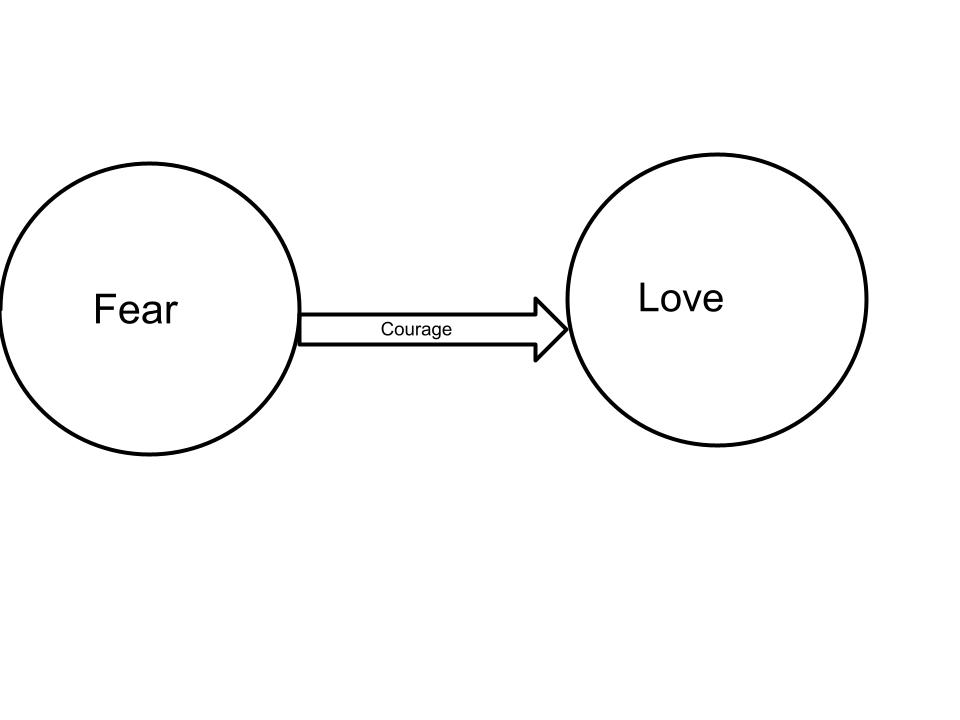
Lennon’s quote seems in line with the bible. First John 4:18 says, “There is no fear in love. But perfect love drives out fear because fear has to do with punishment. The one who fears is not made perfect in love.” This verse suggests that love and fear are incompatible, but what does John mean what he says fear? “Fear has to do with punishment . . .” The fear that John is talking about is fear of standing before God’s judgement. He says in v. 17 that if we live in love as Jesus did, we will have confidence in the day of judgement. When we do good for others out of fear that God will punish us, we make our good deeds about ourselves and not the other person.
My critique of Lennon’s quote is that there are things in life such as hunger, thirst, or sexual lust don’t fit into the love/fear binary. I don’t think the root of hunger has to be a love for living or a fear of starving. Hunger can just be hunger. Also, I don’t think fear and love are always mutually exclusive, but first let me define my terms.
Love, Fear, Desire
Fear is an emotional and physical response to perceived danger or threat (real or imagined). Everybody feels fear, the question is, will fear keep you from living the life God has for you?
I define love as desiring the good of another. Love is often accompanied by feelings of joy and delight, but also opens the door to heartbreak. We can choose love even when we don’t feel like it.
We feel desire whenever we want or feel like we are lacking. It is the force that drives us to act. We can think of desire as the drive to meet your internal wants and needs. Desire is neither inherently good nor bad. Factors such as the magnitude of the desire, the object of the desire, and the means by which you fulfill the desire will determine whether it is right or wrong. We also have competing desires within us. For example, the desire to get fit and the desire to stay on the couch.
In his book You Are What You Love, James Smith explains how desire (eros) with love (agape) are connected yet distinct. “In its truest sense, eros signals a desire and attraction that is a good feature of our creaturehood. Instead of setting up a false dichotomy between agape and eros, we could think of agape as rightly ordered eros: the love of Christ this is shed abroad in our hearts by the Holy Spirit is a redeemed, rightly ordered desire for God. You are what you desire.” Aligning our desires to God’s will is the lifelong work of following Jesus.
There may be some situations in which love, fear, and desire are all present. A man might be attracted to a woman (desire). Maybe he also realizes that being with him will help her to flourish and become more who God created her to be (love). But, at the same time, he his terrified that she will reject him (fear). Below is a graphic that shows how love, fear, and desire can overlap.
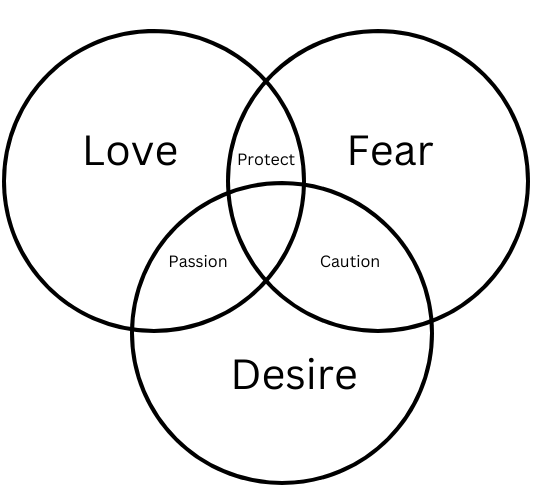
Imagine a hungry hunter who is stalking a bear. He is motived by his desire to kill the bear and harvest it’s meat for food, but he should also be keenly aware that the bear could easily maul him to death (fear). His best course of action will be to proceed with caution. Now imagine that the same hunter has his ten year old son with him. When they come across the bear the father will put himself between his son and the bear to protect him. After he kills the bear, they have a feast and rejoice together in the spoils of their labor. Out of love for his family and his desire to eat, the hunter faced his fear.
I think everyone should work to answer: “What do I want? Who do I love? and What am I afraid of?” We so often go through life without seriously considering why we do what we do. Examining which motivations drive us is a great starting place to living a meaningful and intentional life.
“There are two basic motivating forces: fear and love. When we are afraid, we pull back from life. When we are in love, we open to all that life has to offer with passion, excitement, and acceptance. We need to learn to love ourselves first, in all our glory and our imperfections. If we cannot love ourselves, we cannot fully open to our ability to love others or our potential to create. Evolution and all hopes for a better world rest in the fearlessness and open-hearted vision of people who embrace life.”
John Lennon
 Cultural Eulogy