17 Lessons from 1 Peter on Suffering

I am studying 1 Peter and have been blown away by how often he addresses suffering. In just 5 chapters, Peter mentions suffering roughly twenty times. The Bible has much more to say about suffering. Books like Job and Ecclesiastes, Psalms 13 & 18, Genesis 37-45, and 2 Corinthians 11:16-33 are other great places to explore suffering. The focus of this post will be the 17 things Peter teaches us about suffering. We will explore Christ’s suffering, general truths about suffering, and what suffering accomplishes in us.

1. Christ’s Suffering Was Foretold

“The prophets . . . searched intently and with the greatest care, trying to find out the time and circumstances to which the Spirit of Christ in them was pointing when he predicted the sufferings of the Messiah . . .” (1 Peter 1:10-11).

Peter likely has Isaiah 53 in mind. Isaiah 53 describes a suffering servant who was despised and rejected, was pierced for our transgressions, and heals us by his wounds. Jesus’ crucifixion was man’s attempt to thwart God’s plan, but it all happened to fulfill the Scriptures (John 19:24).

2. Christ Suffered in Front of His Friends

“I appeal as a fellow elder and a witness of Christ’s sufferings . . .” (1 Peter 5:1).

Many friends and family (including his mother) witnessed Jesus being tortured and killed. Peter denied Jesus, witnessed his death, and was restored to leadership after Jesus rose from the dead. Imagine how seeing both the suffering and the resurrected glory would have shaped Peter’s outlook on life.

3. Christ Suffered to Bring Us to God

“For Christ also suffered once for sins, the righteous for the unrighteous, to bring you to God. He was put to death in the body but made alive in the Spirit” (1 Peter 3:18).

Romans 6:23 tells us that the wages of sin is death. Our sin brings separation from a holy God, but God provided his righteous Son to die so that we might have our sins paid for and be reconciled to him.

4. Christ’s Sufferings Bring Glory

“He predicted the sufferings of the Messiah and the glories that would follow” (1 Peter 1:11).

“But rejoice inasmuch as you participate in the sufferings of Christ, so that you may be overjoyed when his glory is revealed” (1 Peter 4:13).

There is no Easter without Good Friday. There is no resurrection without the crucifixion. Paul tells us in Romans 8:17 sharing in Christ’s suffering is necessary for sharing in his glory. The cross always comes before the crown.

5. Christ Teaches Us How to Suffer

“Christ suffered for you, leaving you an example, that you should follow in his steps. ‘He committed no sin, and no deceit was found in his mouth.’ When they hurled their insults at him, he did not retaliate; when he suffered, he made no threats. Instead, he entrusted himself to Him who judges justly. ‘He himself bore our sins’ in his body on the cross, so that we might die to sin and live for righteousness; ‘by his wounds you have been healed.’ For ‘you were like sheep going astray,’ but now you have returned to the Shepherd and Overseer of your souls” (1 Peter 2:22-25).

Jesus does so much more for us than provide an example of how to live. He died in our place so that we could be welcomed by the Father. Yet, the way he lived, loved, and sacrificed points us to the best way to live. Jesus was falsely accused, but he didn’t defend himself. He was doubted, betrayed, mocked, abandoned, and mercilessly beaten. In all this he said, “Father, forgive them for they don’t know what they are doing.” Maybe I don’t need to defend and justify myself so much when I receive criticism. Maybe I can trust that God will make things right when I experience the rejections and disappointments of life.

6. Some Suffering is Just

“How is it to your credit if you receive a beating for doing wrong and endure it?” (1 Peter 2:20).

“If you suffer, it should not be as a murderer or thief or any other kind of criminal, or even as a meddler . . .” (1 Peter 4:15).

There are times when suffering comes from our foolish and sinful actions. A painful punishment or consequence is what we deserve for our actions. If you park illegally, you get a ticket. If you commit a crime, you go to jail. These are examples of suffering that are just. There are also times when our sinful actions result in pain in grief. There are times when we reap what we sow, but our sin isn’t the only reason for our suffering.

7. Some Suffering is Unjust

“For it is commendable if someone bears up under the pain of unjust suffering because they are conscious of God . . . if you suffer for doing good and you endure it, this is commendable before God” (1 Peter 2:19-20).

There are also instances when you do the right thing and are still punished. Imagine an employee who gets fired for refusing to lie about the amount of inventory they sold. They did the right thing, and lost their livelihood. That is unjust. There are other examples of people who are wrongfully accused or wrongfully imprisoned for crimes they didn’t commit. Others are victims of the cruelty of others. Bad things happen to good people. The guilty prey on the innocent.

8. Some Suffering is From the Devil

“Your enemy the devil prowls around like a roaring lion looking for someone to devour. Resist him . . . because you know that the family of believers throughout the world is undergoing the same kind of sufferings” (1 Peter 5:8-9).

It is unclear how much power the devil has to cause suffering. Perhaps Peter attributed the persecution he was facing from the pagan emperor to the devil’s influence? It is also the case that the entirety of creation has been groaning since Satan tempted Adam and Eve to disobey God. Satan inflicted Job with sores that covered his entire body. Not all suffering comes from the devil, but we would be foolish to deny the impact evil forces have on the world.

9. Some Suffering is God’s Will

“For it is better, if it is God’s will, to suffer for doing good than for doing evil” (1 Peter 3:17).

There is a sense in which everything happens because of the will of God. God is sovereign over the good and bad, the big and the small. Humans are also free to make to make our own choices, whether good or bad. It is not God’s will that people sin against him. He hates our sin and is grieved by it, yet God uses sinful choices to accomplish his purposes. For example, Judas made the choice to betray Jesus. The religious leaders made the choice to condemn him. Pilate choose convenience instead of justice. And yet, Christ died on the cross to fulfill God’s plan of redemption and restoration. I don’t know why God allows suffering, but I know he is not indifferent to the cries of his people.

10. You are Blessed When You Suffer for Doing Right

“Even if you should suffer for what is right, you are blessed” (1 Peter 3:14).

“If you are insulted for the name of Christ, you are blessed . . .” (1 Peter 4:14).

In the Beatitudes (Matthew 5:3-12) Jesus turns our idea of blessedness on its head. He describes as blessed those who are poor in spirit, mourners, meek, merciful, peacemakers, persecuted, and insulted. Jesus speaks of a reward in heaven for those who endure (Matthew 5:12). Perhaps there are other spiritual blessings we experience when we suffer for doing right. Maybe there is an awareness of God’s character that we can’t experience any other way.

11. Suffering for Christ is an Honor

“If you suffer as a Christian, do not be ashamed, but praise God that you bear that name” (1 Peter 4:16).

There is no shame in suffering as a Christian. It is a miracle whenever anybody becomes a Christian. When someone becomes a Christian, God brings dead faith to life. We are transferred from the kingdom of darkness to the kingdom of light. From the kingdom of hell to the kingdom of heaven. God made a way for us to be saved from an eternity apart from Him. Jesus suffered an infinite cost to bring us to the Father. God deems us worthy to join in his redemption plan for the world. To suffer for his sake is an honor.

12. Suffering Refines Our Faith

“Though now for little while you may have had to suffer grief in all kinds of trials. These have come so that the proven genuineness of your faith– of greater worth than gold, which perishes even though refined by fire— may result in praise, glory, and honor when Jesus Christ is revealed” (1 Peter 1:6-7).

Gold is refined when it is placed in extreme heat. At a high enough temperature the dross and impurities are burned away, leaving only the pure gold. Similarly, suffering refines our faith. Our faith is always imperfect. It is mixed with doubts, fears, and self interests. Suffering is a means by which God “burns” away our doubts and idols so we can trust him more deeply.

13. Suffering Sanctifies Us

“Therefore, since Christ suffered in his body, arm yourselves also with the same attitude, because whoever suffers in the body is done with sin” (1 Peter 4:1).

Depending on your heart posture, suffering can either lead you deeper into sin, or it can break sin’s power in your life. There are times when suffering makes us bitter, resentful, or leads us to pursue sinful escapist behaviors. There are other times when suffering allows us to see that the pleasures of this world are fleeting, and causes us to yearn with greater intensity for eternity.

14. Suffering Tests Us

“Dear friends, do not be surprised at the fiery ordeal that has come to test you . . .” (1 Peter 4:12).

We find out who we really are through suffering. Suffering doesn’t so much build character, but reveal it. Suffering exposes our hearts in ways little else can. No matter the cause of suffering, we can see the ways we actually trusting in God, and the ways we are putting our hope in other things.

15. Suffering is Normal

“Dear friends, do not be surprised at the fiery ordeal that has come to test you, as though something strange were happening to you” (1 Peter 4:12)

In this verse Peter tells his readers not to be surprised, and that the fiery ordeal is not something strange. Suffering is common. We should expect it. Our surprise at suffering often hurts as much as the suffering itself. We think, “How could something like this happen to me?!” Life in general, and a life of love in particular always brings suffering. Suffering is normal.

16. Suffering is Communal

“Your enemy the devil prowls around like a roaring lion looking for someone to devour. Resist him . . . because you know that the family of believers throughout the world is undergoing the same kind of sufferings” (1 Peter 5:8-9).

We can stand firm in the faith because we know that believers around the world are facing the same kind of sufferings. In 1 Corinthians 10:13 Paul writes, “No temptation has overtaken you except what is common to mankind.” The word “temptation” can also be translated “trial.” We are not alone in our suffering. Others have also experienced suffering. Moreover, Jesus himself was tested in every way that we were, yet he did not sin (Hebrews 4:15). Your suffering is unique to you, but you are not alone in your suffering.

17. God Will Restore Us After We Suffer

“And the God of all grace, who called you to his eternal glory in Christ, after you have suffered a little while, will restore you and make you strong, firm, and steadfast” (1 Peter 5:10).

No suffering lasts forever. It is generally true that the suffering we experience now will one day subside. Grief eventually turns to joy. Mourning eventually turns to dancing. However, there are some exceptions. Maybe you have a chronic illness or some other “thorn in the flesh” that will remain with you until you die. In that case, keep in mind the hope of eternity with Christ. There will be a day when Jesus will wipe away every tear. There will be no more death, mourning, crying, or pain. One day he will heal every wound and right every wrong. Stand firm. Restoration is coming!


Life Direction Questions: Knowing and Finding What You Seek

What are you looking for? What are you looking at?

These two vision questions can tell you almost everything you need to know about the direction and quality of your life. “What are you looking for?” tells you what you hope for in the future. “What are you looking at?” tells you how you are living in the present. Let’s dive in.

What Are You Looking For?

This is the first question Jesus asked his would-be disciples (John 1:38). Were they looking for a magician? A job? A meal for the night? A teacher? A Messiah? Jesus’ question went straight to their heart.

Psalm 121 declares, “I lift my eyes towards the mountains. Where will my help come from? My help comes from the LORD, the Maker of heaven and earth” (Psalm 121:1-2). Notice how the Psalmist connects vision and hope. He lifts his eyes and waits for a Savior.

Jesus tells us to seek (look for) first the kingdom of God (Matthew 6:33) rather than chasing trivial things like food, clothing, and shelter.

What do you hope for? What is your telos, the thing that pulls you forward in life? What do you think will make everything better? When you picture “the good life,” what do you see? What goals are you pursuing?

If my vision of the good life is that everyone thinks that I am smart, how might that impact my life? I will probably stay up to date on topics of conversation. I might have some quotes in mind from reputable people. Maybe I keep my mouth shut when I don’t know the answer, rather than risk seeming foolish. I’ll probably be hesitant to enter into unknown areas. I hope you can see that this good life vision is seriously lacking. I need to look higher.

Everyone has a greatest good that they are striving for. It is impossible not to. The quality of your life is largely determined by what good you pursue. According to Henry David Thoreau, “In the long run men only hit what they aim at. Therefore, though they should fail immediately, they had better aim at something high.” What should we aim at?

The Westminster Catechism teaches that the chief [purpose] of humanity is to glorify God and to enjoy him forever. People were created to make much of God. To love him, trust him, obey him, and treasure him. We are to find our ultimate identity in God alone.We commit idolatry when we build our lives on anything other than Christ.

I previously wrote that the one either builds their life on God, or they find their worth in their performance, possessions, or reputation. You are what you do, you are what you have, you are what others think of you. If you look for ultimate value in created things you will always be disappointed.

What might our lives look like if we continually ask ourselves, “Will this glorify God?”

What Are You Looking At?

Vision is a big factor in most areas of life. It was crucial in every sport that I played.

In baseball, whether in the field or at bat, you always have to keep your eye on the ball. “See ball, hit ball.”

In basketball, you need to have your eyes up when you’re dribbling to make the correct pass. On defense, you need to see ball and see man.

Defensive backs, get in trouble when their eyes are in the backfield. They get fooled by play-action or don’t see the receivers because they get stuck watching the quarterback. Quarterbacks need a good tackle to protect their blind side. Defensive lineman watch the football and don’t move until it does.

Almost 30% of car crashes are caused by distracted driving. Their eyes were not on the road.

We live in an attention economy where companies profit off of our attention. The more time you spend on a given app or website, the more money the company makes off of you.

What we look at also impacts mental health. Research has shown a correlation between increased screen time and increased levels of depression, anxiety, and other mood disorders. One study found that adolescents who spend more than five hours per day on digital devices are 70% more likely to have suicidal thoughts or actions than those who spend less than an hour a day.

The quality of your life is determined by how you invest your time and attention. The quality of your relationship goes down if you are looking at your phone instead of your loved ones. Am I looking at the bible or social media? Am I looking at good books or the TV? Am I looking at my work or scrolling news sites?

In The Ruthless Elimination of Hurry, John Mark Comer writes, “What you give your attention to is the person you become. Put another way: the mind is the portal to the soul, and what you fill your mind with will shape the trajectory of your character. In the end, your life is no more than the sum of what you gave your attention to.” What we look at is an indication of what we most value. I give my attention to news sites because I want to be knowledgeable (or feel morally superior by seeing what the other side just did). I end up binge-watching TV shows because I desire entertainment and closure. I look up sports scores because I emotionally share in the successes and failures of my favorite teams.

What we look at gives us a clue to what we are looking for. We must be diligent to train our eyes to focus on the right thing at the right time. Our lives depend on it.

“Fixing our eyes on Jesus, the pioneer and perfecter of faith. For the joy set before him he endured the cross, scorning its shame, and sat down at the right hand of the throne of God” (Hebrews 12:2).

The Shape of the Gospel

A friend of mine once told me that the Christian life is a series of life, death, and resurrection stories.

Things start off well enough, then get really bad before ending up in a better place than when you started. The shape of life looks something like this:

This theme shows up again and again in Scripture.

Creation

  • Life: God created the world and it was very good (Genesis 1:31).
  • Death: Sin entered the world and now creation groans (Genesis 3:17-19 & Romans 8:18-22).
  • Resurrection: God will restore all things in the new heavens and new earth (Revelation 21:1-4 & 22:1-5).

Abraham

  • Life: Abraham lived in his father’s house until he was 75 (Genesis 11:26-12:4).
  • Death: God called him to leave home, live as a nomad, and wait 25 years until God provided a son (Genesis 15:1-5, 16:1-5, & 17:1-2).
  • Resurrection: Abraham and Sarah rejoice in Isaac’s birth in their old age (Genesis 21:1-6).

Jacob

  • Life: Had a strained relationship with his father and brother Esau, but was favored by his mother (Genesis 25:23-34).
  • Death: Jacob fled from Esau after stealing his blessing, was cheated by his Uncle Laban for 15 years, and dislocated his hip wrestling with God (Genesis 27:1-32:32).
  • Resurrection: Had 12 sons, was renamed Israel, and reconciled with Esau (Genesis 32:27-33:20).

Joseph

  • Life: Was his father’s favorite son and had a beautiful coat (Genesis 37:1-11).
  • Death: Over a period of thirteen years Joseph was beaten by his brothers, thrown into a pit, sold into slavery, falsely accused of sexual misconduct, and was thrown into prison (Genesis 37:12-36, 39:1-41:40).
  • Resurrection: Joseph was freed from prison to be Pharaoh’s advisor. He was given a royal robe and saved his family (and millions more) from starvation (Genesis 41:41-45:28).

Moses

  • Life: Was raised by Pharaoh’s daughter (Exodus 2:1-10 & Acts 7:17-22).
  • Death: Killed a man then lived in the wilderness as a shepherd for 40 years (Exodus 2:11-22 & Acts 7:23-30).
  • Resurrection: Moses returned to Egypt to deliver his people from slavery and speaks face to face with God (Exodus 3-14).

Hebrews

  • Life: Were slaves in Egypt for 400 years.
  • Death: Wandered in the wilderness for 40 years.
  • Resurrection: Entered the promised land.

Job

  • Life: Was a righteous and wealthy man (Job 1:1-5).
  • Death: Job lost all of his children, his wealth, and his health. He was so depressed he cursed the day he was born (Job 1:6-3:26).
  • Resurrection: Job came to a deeper understanding of God’s character and received twice the amount of possessions (Job 42:1-17).

David

  • Life: Was anointed by Samuel to be the next king, won fame through his military exploits (1 Samuel 16-17).
  • Death: David ran from King Saul as the king sought to kill him (1 Samuel 18-31).
  • Resurrection: David became King in Jerusalem and brought peace and stability to the land (2 Samuel 5-6).

Psalm 23

  • Life: Lack nothing, green pastures, quiet waters, refreshed soul (Psalm 23:1-3).
  • Death: Valley of the Shadow of Death (Psalm 23:4).
  • Resurrection: Dwell in the house of the LORD forever (Psalm 23:6).

Jonah

  • Life: The word of the Lord came to Jonah (Jonah 1:1).
  • Death: Jonah ran from God and ended up in the belly of a fish for 3 days (Jonah 1:3-2:9).
  • Resurrection: The fish vomited up Jonah and he preached to the city of Nineveh leading to repentance (Jonah 2:10-3:10).

Jesus (Part 1)

  • Life: Jesus lived a sinless life.
  • Death: He was betrayed and rejected by his friends, was mocked, beaten, and crucified.
  • Resurrection: He rose from the dead on the third day.

Jesus (Part 2)

  • Life: Jesus was one with God in heaven (Philippians 2:6).
  • Death: Jesus was born of Mary, lived, and died on the cross (Philippians 2:7-8).
  • Resurrection: Jesus ascended into heaven and is seated at the right hand of the Father (Philippians 2:9-11).

Saint Paul

  • Life: Advanced in Judaism beyond his contemporaries, was zealous for the traditions of his ancestors (Galatians 1:13-14).
  • Death: Paul encountered Jesus, fell off his high horse (literally), and was blind for 3 days (Acts 9:1-9).
  • Resurrection: “But whatever were gains to me I now consider loss for the sake of Christ. What is more, I consider everything a loss because of the surpassing worth of knowing Christ Jesus my Lord” (Philippians 3:7-8).

God’s Promise to Those in Christ

As we see, almost every hero in the bible experienced a season in the wilderness or in the pit. The wilderness and pit are places of suffering, loneliness, and waiting. There is always a humbling before exaltation. Sometimes we humble ourselves. Other times life humbles us.

If things are going well for you now, praise God! But know that these times don’t last forever.

If you are in the pit, take heart! God promises, not only to bring you out of the pit, but to put you on higher ground. Although, sometimes we have to wait until the next life for God to do that.

Also, I admit that the image above is a bit too simple. It shows the overall trend of life, but fails to capture all of the highs and lows that we will experience. The Christian life looks more like the Dow Jones from the last 100 years:

We see many ups and downs, but the trajectory over the long run is up. Our problem is that we lack the perspective to see what the outcomes will be. In the chart, we see a massive decline from 1966-1983. But from 1983-1999 there was massive growth, ending with more than double the 1966 amount. I can imagine many people being so discouraged in the early 80’s that they took their money out of the stock market. But if they would have held on a little bit longer, they would have quadrupled their investment.

It is the same for us. Sometimes life feels so hard and disappointing that it takes everything in us to not give up. We might even resonate with Job’s wife when she told her husband to “Curse God and die!” (Job 2:9).

I don’t know how long your valley will last, but I promise that it won’t last forever. God also promises that he will never leave you or forsake you. He is with you, grieving and groaning on your behalf.

Because Jesus rose from the dead, those who believe in him will also be raised with him. “Where, oh death is your victory? Where, oh death, is your sting?” If you are in the valley, remember that a resurrection is coming.

A resurrection is coming.

My Favorite Christmas Passage

There are a lot of great passages that speak of our Savior’s miraculous birth and the joy and light that he brings. For example, “Behold, the virgin shall conceive and bear a son, and shall call his name Immanuel” (Isaiah 7:14). Or,

“For to us a child is born, to us a son is given; and the government shall be upon his shoulder, and his name shall be called Wonderful Counselor, Mighty God, Everlasting Father, Prince of Peace” (Isaiah 9:6). Or these from the Gospel of Luke:

 “For unto you is born this day in the city of David a Savior, who is Christ the Lord” (Luke 2:11). “And you will have joy and gladness, and many will rejoice at his birth” (Luke 1:14)

These verses are great, however, I rarely hear people talk about Philippians 2 at this time of year. Paul writes in his letter to the Philippians, “Adopt the same attitude of that of Christ Jesus, who, existing in the form of God, did not consider equality with God as something to be exploited. Instead he emptied himself by assuming the form of a servant, taking on the form of humanity . . .” (Philippians 2:5-7).

Those who have been Christians for a while can become so familiar with the Christmas story that it no longer shocks them. Yet these verses should shock us.

Word Became Flesh

Jesus is God and he became a baby.

The immortal became mortal.

The all-knowing became totally ignorant.

The all-powerful became completely dependent.

The omnipresent occupied a single time and space.

The unchanging God had to grow up and undergo puberty.

The Word of God didn’t know how to talk.

The creator of the universe made tables and chairs.

Death

Not only did Jesus come to earth, he also suffered and died. Paul continues, “And when he had come as a man, he humbled himself by becoming obedient to the point of death- even to death on a cross” (Philippians 2:7-8).

The King of Kings became obedient.

The source of love was hated.

The source of joy was grieved.

The source of peace faced conflict.

The Beloved Son was rejected by the Father and his people.

Eternal life was killed.

Glorification

The great news of Jesus is that death could not defeat him. Because he was obedient to the Father in all things, “God highly exalted him and gave him the name that is above every, so that at the name of Jesus every knee will bow . . . and every tongue will confess that Jesus Christ is Lord, to the glory of God the Father” (Philippians 2:9-11). This is the way of Jesus.

A crown of thorns comes before the crown of heaven.

Suffering comes before glory.

Humility comes before exaltation.

Those who lose their lives gain it.

Jesus gave everything for the love of God and mankind. What would your life be like if you had that same mindset? What if you thought more about what you can give before what you could get? How would that impact your work? Your finances? How you spend your free time? Your relationships?

How can your mindset become 1% more Christ-like? What is one step you can take today?

The Telos of Fight Club

Today is the movie Fight Club‘s 25th anniversary. Fight Club is a movies that I never get tired of watching. It’s perspective on masculinity, consumerism, and purpose in life challenges me think more deeply. There are many things about this film that I could write about (and probably will in the future), but today I will consider what this movie shows about telos.

Telos is a Greek word meaning “goal, end, or purpose.” According to James K. A. Smith in the book “You are What You Love”, “Our telos is what we want, what we long for, what we crave. It is less an ideal that we have ideas about and more a vision of ‘the good life’ that we desire. It is a picture of flourishing that we imagine in a visceral, often-unarticulated way—a vague yet attractive sense of where we think true happiness is found.”

All of us have a vision of “the good life” that determines what we do and how we do it. We have an idea of what would make life better for us, and we build our lives around that end (consciously or unconsciously). I turn now to consider the telos of the narrator and Tyler Durden. I am not endorsing either of their views, I am simply using them as examples.

The Narrator’s Telos

After his condo blew up and all of his possessions were destroyed, the narrator (Ed Norton) and Tyler Durden (Brad Pitt) went to a bar for drinks. He laments to Tyler, “When you buy furniture you tell yourself, ‘That’s it. That’s the last sofa I’m gonna need. Whatever else happens, I have that sofa problem handled.’ I had it all. I had a stereo that was very decent. A wardrobe that was getting very respectable. I was close to being complete.

The narrator felt like something was missing in his life. He had lost faith in God. When his parents divorced he lost faith in family. After the bloodshed of the 20th century he also lost faith in people. He had no meaningful relationships. He suffered from insomnia, likely from the existential angst he felt. He only found relief by attending support groups for people with terminal illnesses. While he was there, he used a fake name. He existence was basically anonymous. The only way to make the feeling of emptiness go away was to buy the right things. How did he pay for those things? He worked many hours at a morally ambiguous company. His life was an endless cycle of working and buying.

His telos was having the right possessions, and that dictated how he spent his time. He thought he could work enough to then buy his way into contentment, but it still left him empty. The things he owned, ended up owning him.

Tyler Durden’s Telos

Tyler Durden’s vision of the good life is quite different. He says, “In the world I see – you are stalking elk through the damp canyon forests around the ruins of Rockefeller Center. You’ll wear leather clothes that will last you the rest of your life. You’ll climb the wrist-thick kudzu vines that wrap the Sears Tower. And when you look down, you’ll see tiny figures pounding corn, laying strips of venison on the empty car pool lane of some abandoned superhighway.”

Tyler was “enlightened.” He sensed the meaninglessness and directionlessness of modern society. He saw that society was smothering people’s’ souls. In hunter/gatherer societies, there was a clear challenge of obtaining enough food to survive. Modern man (generally speaking) doesn’t have that problem. Affluence left people feeling empty. What was his solution? Tear it all down.

He began by starting fight club, a place where men can unleash their suppressed aggression. From there he recruited members to join project mayhem. Project mayhem was a terrorist organization that committed many acts of violence and vandalism. All of this culminated in a plan to blow up credit card buildings to erase the debt record so everything would reset to zero.

Tyler wanted chaos. He thought that by tearing down society, individuals would be free. “It is only after we’ve lost everything that we are free to do anything.” For Tyler, society was so bad that going back to a time before modern technology was the only answer. He worked tirelessly to bring about the world’s destruction.

What is Your Telos?

What about you? What is your vision of the good life? What do you believe will make everything better? For some it is being respected, for others it is being loved. Maybe yours is having a great career and status, or looking a certain way, or being at ease. If you are struggling to discern you telos, start by examine your emotions, how you spend your time, and how you spend your money.

According to the Westminster Shorter catechism, “The chief end of man is to glorify God, and to enjoy him forever.” The telos for which God created us was to be in union with him. We were made to know, love, trust, and obey God. Jesus said that the greatest command is to love God and to love your neighbor. Jesus made a way for us to be in union with God by dying on the cross for our sins. Because of the sin that lives in us and the complexity of our world, we will always have mixed desires. A good first step is to name what you want and why. To do so, finish these three sentences: “I want to live in a world where . . .” “so that . . .” “Therefore, I will . . .” This article goes into more depth.

Why The Good Place’s Good Place Isn’t That Good

I really like The Good Place. It is smart, funny, and poses interesting questions about morality and the human condition. The premise of the show is that Eleanor Shellstrop (Kristen Bell) dies and goes to “the Good Place.” However, she soon finds out that someone made a mistake and she doesn’t belong. She then tries to learn how to be a good person by learning moral philosophy from her soulmate, Chidi (William Jackson Harper). Will she ever be good enough to earn her place in the good place? Are things really what they appear to be? I will skip most of the plot points and focus on the final two episodes. There will be spoilers ahead if you have yet to see this series.

The Problem with the Good Place

When our heroes finally get to the real good place, we see that things aren’t quite what they expected. They quickly learn that because any desire can be met at any moment, they turn into “happiness zombies” who are numb to everything. For example, one man said, “Can I get coke?” (receives it instantly). “No, a water. No, a lamp. No, a cat. No, a spaceship. No, one huge Junior Mint. No, a coke.” Being able to get anything you want whenever you want doesn’t lead to satisfaction. Hypatia of Alexandria (Lisa Kudrow) added, “On paper, this is paradise. All your desires and needs are met. But it is infinite. And when perfection goes on forever, you become this glassy-eyed mush person.”

Another example is from Jason (Manny Jacinto). His ultimate dream was to race monkeys in go-karts, but that got boring quickly. Jason reported, “I mean, monkeys and go-karts was fun for a while. Then I was like, ‘Oh, you know what’d be cool? Hippos and go-karts.’ And I was like, ‘Yo, what about Draculas with jet packs?’ I did, like, fifty combos, and then I just kinda wanted to hang out with you guys again.”

Hypatia responded, “That’s it in a nutshell. ‘Cause you get here and you realize that anything’s possible, so you do everything, and then you’re done. But you still have infinity left. This place kills fun and passion and excitement and love, ’till all you have left are milkshakes.”

The Solution

The apparent problem of the good place is that it goes on for eternity. ” They argue that what makes a vacation special is that it eventually ends. Similarly, they “fix” the afterlife by giving everyone the opportunity to end their existence. They can walk through a magical door and their soul will no longer exist as a single entity, but will be scattered throughout the universe (similar to the Buddhist idea of Nirvana). The only way to make the good place tolerable is to have the option to commit soul suicide.

My Thoughts

The problem with the good place is not that it goes on for eternity, but that there is no God. This show correctly demonstrates that any eternity without a God who can completely satisfy our souls is hell. Ecclesiastes 3:11 tells us that God placed eternity in our hearts. We were created for God. Even if you removed all of the bad things from your life (or afterlife) and had access to any pleasure at any time, you still wouldn’t be satisfied.

But the bible describes a God who is all-satisfying. Jesus said, “Whoever drinks from the water that I will give him will never get thirsty again. In fact, the water I will give him will become a well of water springing up in him for eternal life” (John 4:14). Christians get a taste of this on earth, but it will be fully realized in the new heavens and new earth. “Look, God’s dwelling is with humanity, and he will live with them. They will be his peoples, and God himself will be with them and will be their God. He will wipe away every tear from their eyes. Death will be no more; grief, crying, and pain will be no more, because the former things have passed away” (Revelation 21:3-4).

Jesus offers the life that will never die. Because God is unimaginably great and beautiful, we never have to fear being bored in heaven. There will be a sense of peace, joy, and contentment that we always longed for but could never quite grasp on earth. Our souls will finally be home.

Words from a Wooden Beam

The four gospels record seven phrases that Jesus said from the cross. Crucifixion leads to death by suffocation, so any word spoken by Jesus must have been delivered with great difficulty. Given how hard it would have been to speak, Jesus was likely very intentional about the words he chose. We would be wise to pay attention to these words. I will list the phrases Jesus said and share why they are significant for us today.

“Father, forgive them, for they do not know what they are doing.” (Luke 23:34)

Jesus commanded his followers to love their enemies and pray for those who persecute them (Matthew 5:44). Jesus practiced what he preached. We see the incredible love of Christ in that he is more concerned for the souls of those torturing him than he is about nails going through his hands and feet. Jesus isn’t crying out for justice against or salvation from his adversaries, instead he asks that they would be forgiven.

Key Point: Jesus’ love and forgiveness are greater than we can imagine. Christ died to save sinners, including those who committed the sin of nailing an innocent man to a cross. Your sin is not too big for Jesus to forgive.

“Truly I tell you, today you will be with me in paradise.” (Luke 23:43)

As Jesus was hanging from the cross, the crowd, soldiers, and the other criminals began to mock him. One criminal insulted him by saying, “If you are the Messiah, save yourself and us!” But the other criminal recognized that Jesus was innocent while he was receiving a just punishment for his wicked actions. He told Jesus, “Remember me when you come into your kingdom” (Luke 23:42).

The men who were crucified alongside Jesus were likely revolutionaries and murderers. Jesus declared that this murderer is welcomed into heaven, not because of anything he did, but because his heart was repentant and there was a genuine love for Jesus in that moment.

Key Point: There is life after death, and as long as someone is living there is hope of turning to Jesus. No one is too far gone.

“Woman, here is your son. Here is your mother.” (John 19:26-27)

Jesus looked down from the cross to see his mother and the disciple whom he loved (John). I can only imagine the look of sorrow Mary must have had on her face. Having to see her beloved son beaten, tortured, and now bloody and bruised struggling for every last breath. Then you make eye contact and hear him speak, “Here is your son.” And to John he said, “Here is your mother.” Jesus wanted his mom to know that she would be taken care of and that she wouldn’t be alone. He tasked John with supporting his widowed mother and told Mary to love and care for John as she once did for him.

Key Point: The Christian family is deeper than blood. People receive a new identity when they come to Jesus. Our spiritual DNA is forever altered, connecting us to believers from all over the world. To be a spiritual parent, spiritual child, or spiritual sibling carries with similar joys and challenges as physical relationships.

“Father, into your hands I commit my spirit.” (Luke 23:46)

In this verse Jesus quoted Psalm 31:5. If you read the rest of the Psalm, you will see David declaring that God is his refuge and shelter and asking God to deliver him from his enemies. David cried out:

Be merciful to me, Lord, for I am in distress;
    my eyes grow weak with sorrow,
    my soul and body with grief.
My life is consumed by anguish
    and my years by groaning;
my strength fails because of my affliction,
    and my bones grow weak.
Because of all my enemies,
    I am the utter contempt of my neighbors
and an object of dread to my closest friends—
    those who see me on the street flee from me.
 I am forgotten as though I were dead;
    I have become like broken pottery.
 For I hear many whispering,
    “Terror on every side!”
They conspire against me
    and plot to take my life.

But I trust in you, Lord;
    I say, “You are my God.”

I imagine Jesus resonated deeply with these words. Perhaps he would have said them out loud if he had strength to do so.

Key Point: Jesus turned to God in prayer when he was at his lowest, we should do the same.

“My God! My God! Why have you forsaken me?” (Mark 15:34 & Matthew 27:46)

Jesus quoted the opening line of Psalm 22. The rest of the psalm describes a man surrounded by enemies (v .12), mocked about God saving him (vv. 7-8), having a dry mouth (v. 15), having pierced hands and feet (v. 16), and people casting lots for his clothes (v. 18). Jesus experienced all of these things too, so it makes sense that he would cry out this psalm.

This verse is also significant from a theological perspective. The price of sin is separation from God. Although Jesus never sinned, he paid the price of our sin and felt the rejection and disapproval of the Father. For this reason, when we believe in Christ, there is no chance of God rejecting us.

Tim Keller wrote, “There is no greater inner agony than the loss of a love relationship. We cannot imagine, however, what it would be like to lose not just a human relationship that has lasted for some years but the infinite love of the Father that Jesus had known from all eternity. The separation would have been unbearable.” 1

Key Point: Jesus was forsaken by the Father so that we could be accepted by the Father. Because Jesus was forsaken, we can receive this promise, “Never will I leave you; never will I forsake you” (Hebrews 13:5).

“I am thirsty.” (John 19:28)

On the surface this looks pretty straightforward. Jesus is in agony with the hot sun beating down on him. It would make sense that he would feel thirsty.

However, Jesus also taught that those who come to him in faith would never be thirsty, but would experience water springing up for eternal life (John 4:14, 6:35, 7:37-38). Jesus was cut off from the streams of eternal life. His thirst was both physical and spiritual.

Key Point: Jesus experienced spiritual thirst so that thirsty sinners might believe, receive forgiveness, and find satisfaction in him.

“It is finished.” (John 19:30)

There are perhaps no sweeter words in the bible. Jesus completed everything his Father called him to do. He lived a perfect life, fulfilling the law. He trained a leadership team to take his place. He healed the sick, cast out demons, and raised the dead. He suffered and wept, and now realizing that he had accomplished God’s purpose for his life, he bowed his head and gave up his spirit.

By dying on the cross, Jesus absorbed all the wrath of God that we deserve. He drank every drop from that terrible cup. For those who have come to Jesus in faith, there is no wrath left for us.

Key Point: Jesus finished the work of making sinners right with God. Jesus paid it all, there is nothing we can contribute to pay off our debt. Sure, we all still have work to do, but the main battle has already been won. It is finished!

  1. Keller, Timothy. 2015. Walking with God Through Pain and Suffering p.120 ↩︎

How to Change the World

My theory is that the best way to change the world is to live your life as if your own sin is the biggest problem in the world. I want to examine wisdom from different times, cultures, and faith traditions that are all getting at this same point.

One caveat before we dive in: I wouldn’t apply this teaching to someone who has just experienced trauma. There are times when the sin and brokenness of the world comes knocking at your door, and you first need time to grieve and find healing. Jesus said he wouldn’t break a bruised reed (Isaiah 42:3). Please receive this as a general principle that will be applicable to most but not every situation.

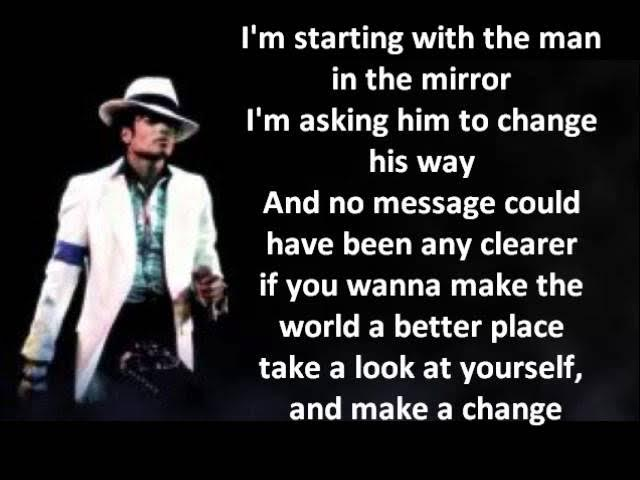
“Man in the Mirror”- Michael Jackson, 1988

In his 1988 hit song, Michael Jackson sings, “If you wanna make the world a better place, take a look at yourself and then make a change.” There are so many needs and so much brokenness in the world. It can be discouraging to feel like the world is run by corrupt governments and greedy corporations. What can one person do in the face of that much opposition?

Start with yourself, the man in the mirror. Start with what you can control. Maybe you can’t solve your cities homelessness crisis. But maybe you can show kindness and dignity to one homeless person on your way home from work.

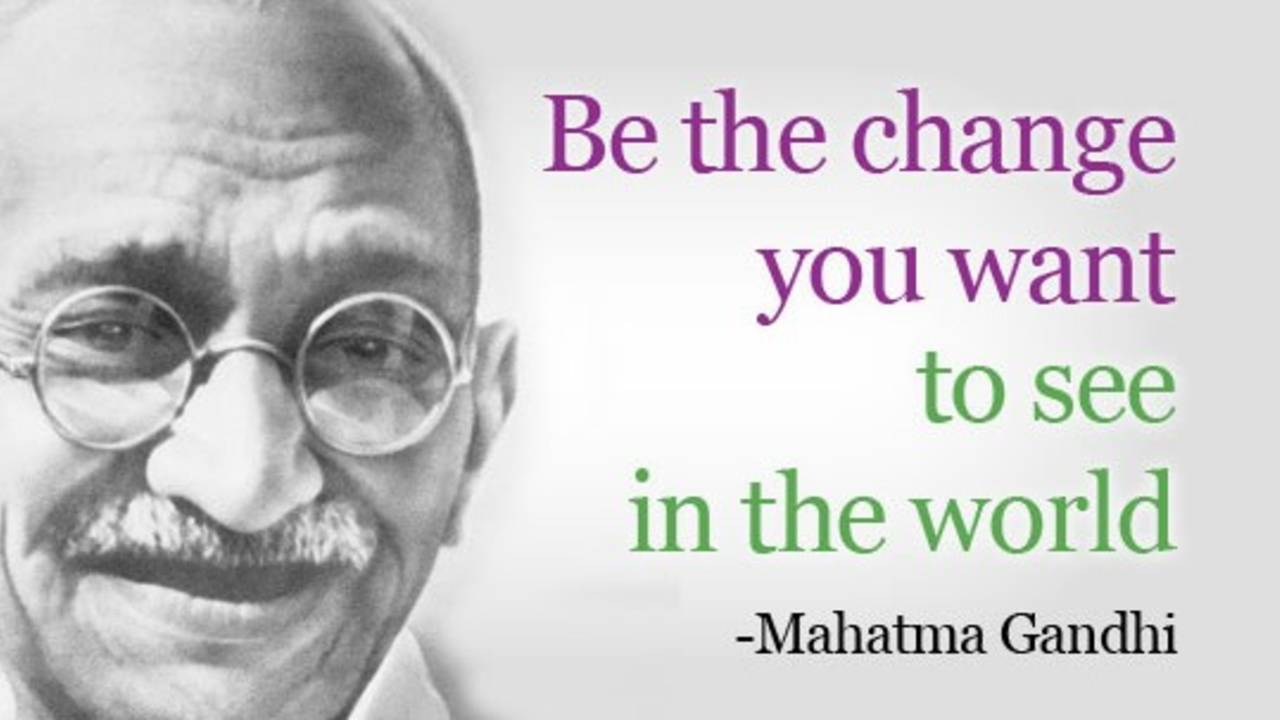
“Be the Change”

Mahatma Gandhi (1869-1948) is one of the most influential voices on non-violent resistance in history. He was influential both in fighting for civil rights in South Africa and in gaining Indian independence. He famously said, “Be the change you want to see in the world.”

Do you want to see less poverty in the world? Give to the poor.

Do you want to see less racism in the world? Befriend people who don’t look like you.

Are you tired of corrupt politicians? Run for office.

We all have to ask ourselves, “What do I want? and What am I willing to sacrifice to get it?”

“I am.”

There is a popular story where a newspaper sent out an inquiry to famous authors, asking the question, “What’s wrong with the world today?” To which G.K. Chesterton responded,

“Dear Sir,

I am.

Yours, G.K. Chesterton.”

Living in the early 20th century you might expect him to say something along the lines of war, poverty, drunkenness, factory conditions, or the poor education of the masses. But I think Chesterton is both humble enough and wise enough to first look at his internal problems rather than the external problems. I think this is where activists can go wrong. They perhaps rightly point out the wrongs and injustices that exist in the world, but can turn prideful and self-righteous if they don’t also take serious where they fall short.

In the book How People Change, Paul Tripp says, “Whenever you believe that the evil outside you is greater than the evil inside you, a heartfelt pursuit of Christ will be replaced by a zealous fighting of the ‘evil’ around you. A celebration of the grace that rescues you from your own sin will be replaced by a crusade to rescue the church from the ills of the surrounding culture.” We can end being overly critical of others when we forget that we are sinners saved by grace alone.

The Plank and the Speck

Lastly, we’ll consider Jesus’ words from the sermon on the mount:

“Do not judge, or you too will be judged. For in the same way you judge others, you will be judged, and with the measure you use it will be measured to you.

“Why do you look at the speck of sawdust in your brother’s eye and pay no attention to the plank in your own eye? How can you say to your brother, ‘Let me take the speck out of your eye,’ when all the time there is a plank in your own eye? You hypocrite, first take the plank out of your own eye, and then you will see clearly to remove the speck from your brothers eye” (Matthew 7:1-5).

A few things stand out: First, God will judge us by the same standards we judge others. This should cause all of us to pause and consider how we think about others.

Second, we are to take the plank out of our own eye first. Jesus doesn’t say that is all that we do. He still calls us to remove the speck from our brother’s eye, but only after we have removed the plank from our own eye. But what does that mean?

I think the plank is our own sin and the speck is the sins of others. Our sin should be so in our face (no pun intended) that we can’t avoid it. So often we get this illustration backwards. We think we are the ones with the speck in our eye while everyone else has the big plank. We say things like, “I would never do that . . .” “Can you believe what she said?” “At least I’m not as bad as . . .”

Deal with your own stuff first, then you can clearly see what others are going through with a sense of love and compassion. Nobody likes having sawdust in their eye. It is unloving to let someone continue in a destructive behavior, but when we fail to approach them with humility and gentleness we often do more harm than good. How might this play out in the real world?

A Hypothetical Example

Let’s say you are in a meeting and a coworker blatantly disrespects you. What do you do? Do you lash out in the moment? Gossip about what happened? Bury your anger and pretend it wasn’t a big deal? Passive-aggressively hint that something is bothering you for the next year or so? Get the incident on film and post it to social media so that he might be shamed or even cancelled? Or do you take the plank out of your eye by self-reflecting?

Maybe you start with noticing your anger. Anger itself isn’t sinful, but it points to what is important to us. Then you might consider what exactly triggered that response. Did you feel threatened or embarrassed? Did it remind you of an incident or relationship from your past?

As you go down this path you might discover that you actually have an anger problem and are hyper-critical of those around you. Or maybe you take yourself too seriously because deep down you believe that your worth as a person comes from what you do and how others think about you.

After doing this work, you can look at the situation clearly to address your coworker. You could say something like, “When you said what you said in the meeting it made me feel ________. I’m sure that wasn’t what you intended, but I would appreciate if you would be more considerate in the future. I want our team to stay unified, and your comments created unhealthy friction.”

Doesn’t that seem more productive than anything listed in the first paragraph? Maybe the coworker realizes that he resorts to sarcasm when he is under stress as a self-protection mechanism. After noticing the problem he can take steps to fixing it.

Final Thoughts

From the King of Pop to the King of Kings, the message is consistent: start with yourself. Live as if your own sin is the greatest problem in the world. Only then will you be able to make a difference in the world. Imagine how marriages, friendships, families, and organizations might look different when individuals stop blaming others and circumstances and take ownership for the wrongs they do and the good that they leave undone.