Putting God to the Test

The author of Hebrews defines faith as “confidence in what we hope for and assurance for what we do not see” (Hebrews 11:1). You don’t need faith for what you already see, that is just sight. Faith is trusting in God even when things don’t look right or when we can’t see what the outcome will be.

Another definition of faith I have been pondering is “putting God to the test.” This might sound strange if you are more familiar with the bible. When Jesus was tempted by Satan in the wilderness one of the ways he responded was by quoting Deuteronomy 6:16, “Do not put the Lord your God to the test” (Matthew 4:7). If Jesus explicitly tells us not to put God to the test, why would I argue that putting God to the test is actually an expression of faith?

I will start by showing how it is wrong to put God to the test, then show how it is right to put God to the test, and conclude with some ways you could apply this to your life.

When Testing God is Wrong

For the second temptation of Christ, Satan took Jesus to the highest point in the temple in Jerusalem and said, “If you are the Son of God throw yourself down. For it is written, ‘He will command his angels concerning you, and they will lift you up in their hands, so that you will not strike your foot against a stone'” (Matthew 4:5-6).

This is where Jesus responded, “It is also written, ‘Do not put the Lord your God to the test.'”

Why would this have been wrong for Jesus to jump? Didn’t he trust that God would protect him until his time was at hand? I think there are a couple reasons why jumping would have been wrong.

First, God the Father already proclaimed the identity of “beloved son” over Jesus (Matthew 3:17). Satan was trying to make Jesus prove his sonship rather than trusting the Father’s words. If you take God at his word, you won’t need to push the boundaries. This is similar to Satan’s temptation of Adam and Eve, “Did God really say . . .?” (Genesis 3:1). Adam and Eve tested whether or not they would die after eating the forbidden fruit.

Imagine you went to a wedding where the wife told the husband that she would love him and stick by him no matter what. Then the husband wanted to see if she really meant it. Will she stay if I stop helping around the house? Will she stay if I cheat on her? Will she stay if I become abusive? This is not how you treat someone you love. It is one thing for the husband to be honest about his shortcomings and quite another thing to intentionally push the boundaries of what his wife can endure.

Second, Satan is trying to get Jesus to go beyond what the Father called him to do. Jesus did not frequent the big cities. He did most of his ministry in small towns, attracting crowds of poor and desperate people. He often did things to avoid the praise of people. He said that he only came to earth to do the will of his Father. God never called Jesus to make himself a spectacle. Rather, God called Jesus to serve, bring restoration and healing, and ultimately die on the cross for the sins of humanity. Jesus knew that Satan’s temptation was beyond what God called him to do.

An example from my life where I foolishly put God to the test was my senior year of high school. I was new to my faith and didn’t have much guidance, so I attempted to do both football and cross country in the same season. I reasoned that it shouldn’t be possible for anyone to do both sports, so if I succeeded I would have used that as evidence for God’s strength and power.

Unsurprisingly, this experiment failed after a couple weeks. My body could not handle the strain because it was never meant to. In hindsight I should have realized that God made me to play football and invested my energy into doing the best I could on the field and loving my teammates and coaches. I didn’t test God by thinking, “God isn’t real unless he empowers me to do both sports.” But I did think that God needed my help to let others see his greatness (which he didn’t). I didn’t trust that God would work through my simple obedience. I believe I would have had a bigger impact if I was more intentional with those who were already in my sphere of influence, rather than trying to have God turn me into Superman.

Testing God is wrong when it takes the place of trusting God. Testing God is right when it is a means of trusting God.

When Testing God is Right

About 25% of the book of Genesis is devoted to Abraham. God called Abraham to leave his family and town and go to the land that God would show him. Abraham had many inspiring examples of faith, and some significant moral failures. After 25 years of waiting, God miraculously gave Abraham a son, through whom the whole world would be blessed.

However, Genesis 22 states, “Some time later God tested Abraham.” He told him, “Take your son, your only son, who you love — Isaac– and go to the region of Moriah. Sacrifice him there as a burnt offering on a mountain I will show you.”

And Abraham obeyed.

He and Isaac climbed the mountain, Isaac carrying the wood and Abraham carrying the knife and fire. After building an altar, Abraham tied up his beloved son and raised the knife to slay his child . . .
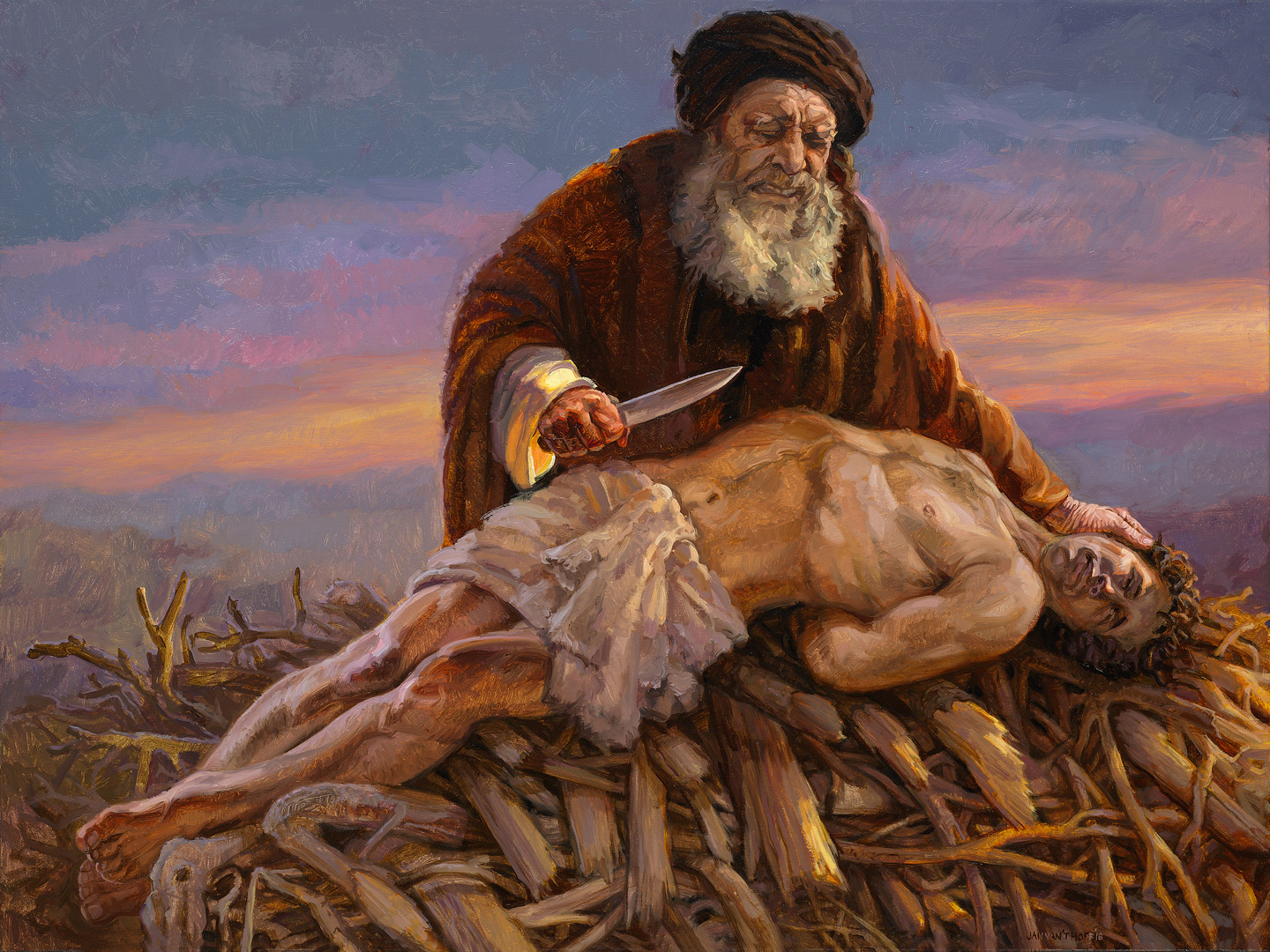
The text states that God tested Abraham, but I think Abraham was also testing God.

God clearly promised that the covenant would be established through Isaac as an everlasting covenant for his descendents after him (Genesis 17:19). Abraham is holding two things in tension. On the one hand, Isaac is the one through whom the blessing of the whole world was to come. On the other hand, God commanded Abraham to kill his son. There were only four options for this tension to be resolved:

  1. Abraham refuses to obey God.
  2. God lets Isaac die, thus showing that he does not keep his promises (thus not worthy of our worship).
  3. Abraham goes through with killing Isaac, then God raises him from the dead.
  4. God prevents Abraham from killing his son and provides a substitute (which is what happened).

Abraham was testing God to stay true to his promise even if it meant doing the impossible (raising the dead). Abraham was obedient to the point of giving up what he loved most because he believed that God was trustworthy.

Notice, the only reason Abraham went through with the sacrifice was because God commanded him. He did not attempt to sacrifice his son to see if God would stop it. That would have been putting God to the test in the negative way we discussed above.

To summarize, testing God is wrong when it takes the place of trusting God. But, testing God is right when it is a means of trusting God. Below are some examples of how this type of faith can be lived out today.

Positive Examples of Putting God to the Test

  • Giving generously, trusting that God will provide you with everything you need (Mat 6:25-34).
  • Sharing the gospel with a hardened atheist, trusting that God has the power to change any heart (1 Tim 1:15).
  • Persevering when things seem unbearable because God promised to work things out for good for those who love him (Rom 8:28).
  • Forgiving someone rather than seeking revenge because you trust in God’s divine justice (Rom 12:19).
  • Sharing a hard truth with someone because it is impossible to please God and people (Gal 1:10).
  • Praying even when you don’t feel like it, trusting that God hears and cares (1 Peter 5:7).
  • Taking a professional risk, resting in the fact that you’re worth is not found in success.
  • Sticking with those who are wandering in their faith, because the God who began a good work in them will carry it on to completion (Phil 1:6).
  • Many Christians throughout the centuries have been martyred because they trusted that eternal life in God’s paradise was worth more than the world could offer them.

Imagine a man who was considering going skydiving. How would we know that he had faith that his parachute would open?

Only if he jumps. He can talk all he wants about how great the parachute is, but until he jumps out of the plane and puts it to the test, he doesn’t really trust it. It is the same with God. We might say we trust him, but until we jump out of the plane and take part in risky obedience, our words are empty. “Faith without works is dead (James 2:17).

May God give us this type of faith!

The Kingdom of God is like a Golden Snitch

I love the Harry Potter books and movies. My wife and I watch all 8 movies every year and frequently listen to the audiobooks before going to bed. Even if HP isn’t your thing, I hope you stick with me. Jesus often taught using parables. Following in my Rabbi’s footsteps, I want to show you how the kingdom of God is like a Golden Snitch.

Understanding Quidditch

Quidditch is a popular game in the wizarding world, consisting of seven team members on flying brooms. There are 3 Chasers, 2 Beaters, 1 Keeper, and 1 Seeker. The Chasers control the Quaffle, trying to throw it through one of three hoops which are guarded by the Keeper. Whenever the Quaffle goes through a hoop, the scoring team is awarded 10 points. The Beaters are the enforcers on the team. They protect the Chasers and Seeker from the two flying Bludgers, and also attempt to direct the Bludgers at the opposing team. The Seeker’s job is to find and catch the golden Snitch, a small golden ball that moves incredibly fast. The game ends when the Seeker catches the Snitch. By catching the Snitch, his team is awarded 150 points.

So, How is this like the kingdom of God?

1. The Value of the Snitch

First, the Snitch the most valuable object in the game. A team could be down by 14 goals and still win the game if the Seeker finds the Snitch.

Jesus tells us to seek first the kingdom of God (Matthew 6:33), and compares the kingdom of God to a man who found a fine pearl, and in his joy sold everything he owned to possess it (Matthew 13:44-46). There are a lot of things in life that we can and ought to seek. If we don’t look for a job, we won’t be able to provide for ourselves. If you don’t seek a spouse you will never have children. But seeking God’s kingdom is more important than any of these.

2. In the Game, but Not of It.

Second, the Seeker is in the game, but he is not playing the same game as the other six team members. Seekers are concerned with the Snitch and never attempt to score with the Quaffle or stop the other team from scoring.

Paul told Timothy, “No one serving as a soldier gets entangled in civilian affairs, but rather tries to please his commanding officer” (2 Timothy 2:4). There are many games that the world plays: get the most power, have the most status, sleep with the most women, accumulate the most money, to name a few. If we want to be seekers of God’s kingdom, we can’t focus on the “quaffles” around us. We all live in the world, but when you become a follower of Christ, your primary citizenship is in heaven (Philippians 3:20).

It is so easy to get distracted, but we must always recenter on the true Snitch.

3. Slow and Steady

Third, looking for the Snitch isn’t efficient. For most of the game the Seekers are sort of flying around aimlessly. It appears that they aren’t contributing to the rest of the team, but the work they are doing is vital to achieving the end result.

Jesus valued people that society did not. He spent time with children and said that the kingdom of God belonged to those who were like children (Matthew 19:14). He often withdrew to quiet places to pray even when people were begging for his attention. He spent most of his time in small villages and didn’t have much of a presence in the big city. His closest followers were uneducated, blue-collar guys rather than religious elite. Wouldn’t it make more sense to go after those with influence instead?

God’s kingdom functions differently than the world. The kingdom of God is like a mustard seed. It starts as a tiny seed, but one day will grow and spread and become the largest plant in the garden (Mark 4:30-32). Because God is patient and gracious, he often transforms us and others more slowly than we would like. This slow work allows roots to grow deep into the soil so that it can bear the weight of growth and the storms of life.

Fun fact, the average apple tree takes 4-5 years before it produces any fruit. It makes sense for spiritual fruit to behave similarly.

Conclusion

What are you looking for?

What do you desire most?

Everybody is pursuing something, but not everybody has articulated what it is they seek. Many of us end up on the conveyor belt following society’s expectations, or we float about from one dopamine hit to another without giving it much thought.

God made you unique and he made you for a purpose. I pray that you would find the purpose and passion that God wired in you, and then give you the courage and diligence to chase after that with all your heart.

How to Change the World

My theory is that the best way to change the world is to live your life as if your own sin is the biggest problem in the world. I want to examine wisdom from different times, cultures, and faith traditions that are all getting at this same point.

One caveat before we dive in: I wouldn’t apply this teaching to someone who has just experienced trauma. There are times when the sin and brokenness of the world comes knocking at your door, and you first need time to grieve and find healing. Jesus said he wouldn’t break a bruised reed (Isaiah 42:3). Please receive this as a general principle that will be applicable to most but not every situation.

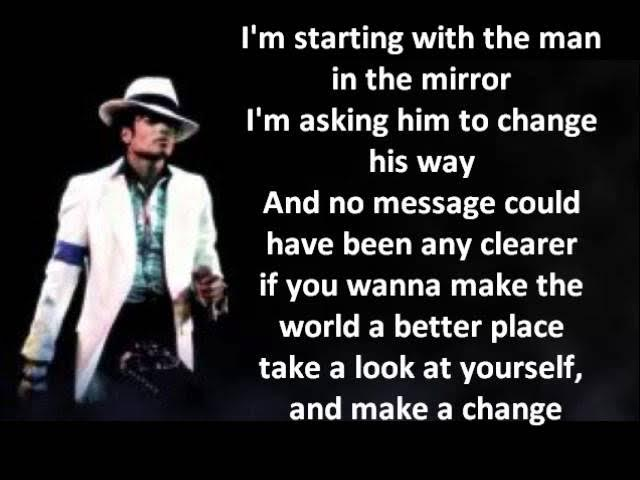
“Man in the Mirror”- Michael Jackson, 1988

In his 1988 hit song, Michael Jackson sings, “If you wanna make the world a better place, take a look at yourself and then make a change.” There are so many needs and so much brokenness in the world. It can be discouraging to feel like the world is run by corrupt governments and greedy corporations. What can one person do in the face of that much opposition?

Start with yourself, the man in the mirror. Start with what you can control. Maybe you can’t solve your cities homelessness crisis. But maybe you can show kindness and dignity to one homeless person on your way home from work.

“Be the Change”

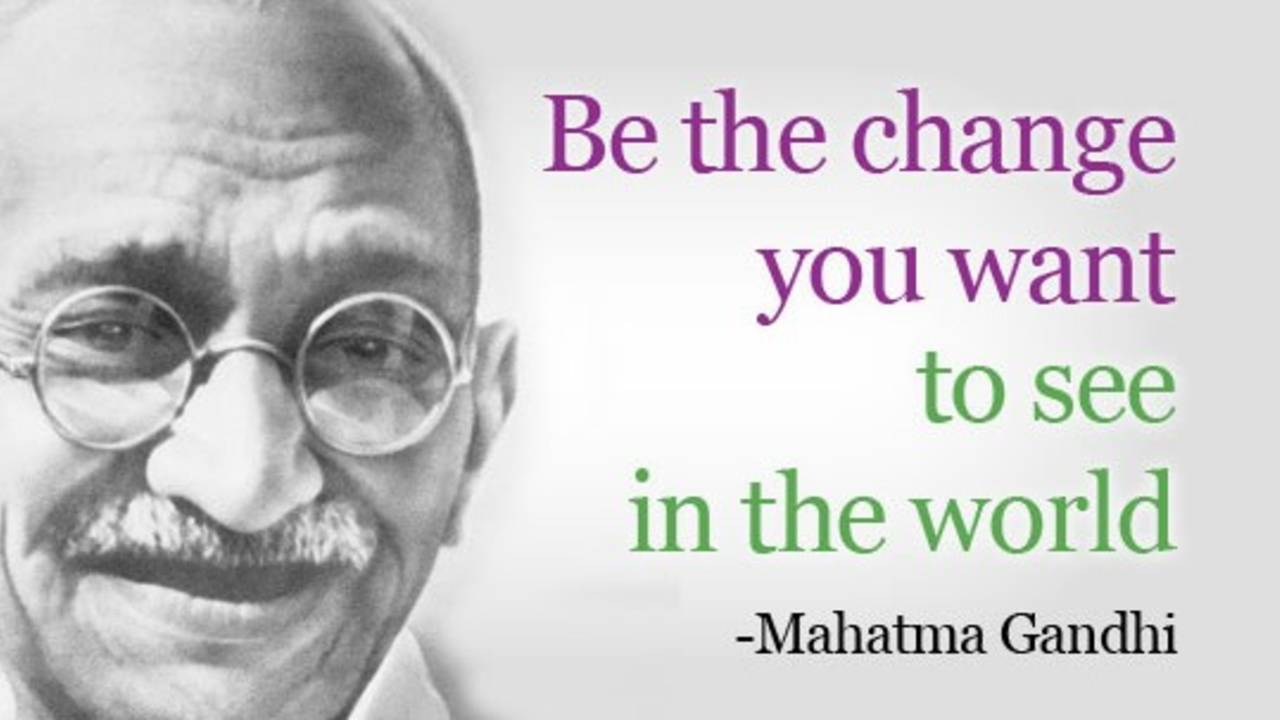
Mahatma Gandhi (1869-1948) is one of the most influential voices on non-violent resistance in history. He was influential both in fighting for civil rights in South Africa and in gaining Indian independence. He famously said, “Be the change you want to see in the world.”

Do you want to see less poverty in the world? Give to the poor.

Do you want to see less racism in the world? Befriend people who don’t look like you.

Are you tired of corrupt politicians? Run for office.

We all have to ask ourselves, “What do I want? and What am I willing to sacrifice to get it?”

“I am.”

There is a popular story where a newspaper sent out an inquiry to famous authors, asking the question, “What’s wrong with the world today?” To which G.K. Chesterton responded,

“Dear Sir,

I am.

Yours, G.K. Chesterton.”

Living in the early 20th century you might expect him to say something along the lines of war, poverty, drunkenness, factory conditions, or the poor education of the masses. But I think Chesterton is both humble enough and wise enough to first look at his internal problems rather than the external problems. I think this is where activists can go wrong. They perhaps rightly point out the wrongs and injustices that exist in the world, but can turn prideful and self-righteous if they don’t also take serious where they fall short.

In the book How People Change, Paul Tripp says, “Whenever you believe that the evil outside you is greater than the evil inside you, a heartfelt pursuit of Christ will be replaced by a zealous fighting of the ‘evil’ around you. A celebration of the grace that rescues you from your own sin will be replaced by a crusade to rescue the church from the ills of the surrounding culture.” We can end being overly critical of others when we forget that we are sinners saved by grace alone.

The Plank and the Speck

Lastly, we’ll consider Jesus’ words from the sermon on the mount:

“Do not judge, or you too will be judged. For in the same way you judge others, you will be judged, and with the measure you use it will be measured to you.

“Why do you look at the speck of sawdust in your brother’s eye and pay no attention to the plank in your own eye? How can you say to your brother, ‘Let me take the speck out of your eye,’ when all the time there is a plank in your own eye? You hypocrite, first take the plank out of your own eye, and then you will see clearly to remove the speck from your brothers eye” (Matthew 7:1-5).

A few things stand out: First, God will judge us by the same standards we judge others. This should cause all of us to pause and consider how we think about others.

Second, we are to take the plank out of our own eye first. Jesus doesn’t say that is all that we do. He still calls us to remove the speck from our brother’s eye, but only after we have removed the plank from our own eye. But what does that mean?

I think the plank is our own sin and the speck is the sins of others. Our sin should be so in our face (no pun intended) that we can’t avoid it. So often we get this illustration backwards. We think we are the ones with the speck in our eye while everyone else has the big plank. We say things like, “I would never do that . . .” “Can you believe what she said?” “At least I’m not as bad as . . .”

Deal with your own stuff first, then you can clearly see what others are going through with a sense of love and compassion. Nobody likes having sawdust in their eye. It is unloving to let someone continue in a destructive behavior, but when we fail to approach them with humility and gentleness we often do more harm than good. How might this play out in the real world?

A Hypothetical Example

Let’s say you are in a meeting and a coworker blatantly disrespects you. What do you do? Do you lash out in the moment? Gossip about what happened? Bury your anger and pretend it wasn’t a big deal? Passive-aggressively hint that something is bothering you for the next year or so? Get the incident on film and post it to social media so that he might be shamed or even cancelled? Or do you take the plank out of your eye by self-reflecting?

Maybe you start with noticing your anger. Anger itself isn’t sinful, but it points to what is important to us. Then you might consider what exactly triggered that response. Did you feel threatened or embarrassed? Did it remind you of an incident or relationship from your past?

As you go down this path you might discover that you actually have an anger problem and are hyper-critical of those around you. Or maybe you take yourself too seriously because deep down you believe that your worth as a person comes from what you do and how others think about you.

After doing this work, you can look at the situation clearly to address your coworker. You could say something like, “When you said what you said in the meeting it made me feel ________. I’m sure that wasn’t what you intended, but I would appreciate if you would be more considerate in the future. I want our team to stay unified, and your comments created unhealthy friction.”

Doesn’t that seem more productive than anything listed in the first paragraph? Maybe the coworker realizes that he resorts to sarcasm when he is under stress as a self-protection mechanism. After noticing the problem he can take steps to fixing it.

Final Thoughts

From the King of Pop to the King of Kings, the message is consistent: start with yourself. Live as if your own sin is the greatest problem in the world. Only then will you be able to make a difference in the world. Imagine how marriages, friendships, families, and organizations might look different when individuals stop blaming others and circumstances and take ownership for the wrongs they do and the good that they leave undone.

What Drives an Adventure Stories?

What compels a hero to act? As far as I can tell, the hero in an adventure story tends to be motivated by one or a combination of these three objectives:

  1. Seek Treasure
  2. Defeat Evil
  3. Survive Danger

This came to mind when thinking about the motivations of the characters in The Hobbit and the characters from Lord of the Rings. Bilbo and the dwarves set out from the Shire to reclaim their gold and home (seek treasure). Frodo and Sam left the Shire in order to destroy the ring of power, and thus destroy Sauron (defeat evil). At first I thought these might be the only two motives, but then I thought about movies like Cast Away or The Day After Tomorrow or the book Robinson Crusoe in which the main characters are trying to survive the horrible predicament they find themselves in (I guess one could argue that they are seeking life and trying to prevent death, but I think having survival as its own category makes more sense). Here is how it plays out in some other movies:

Some Examples

In Pirates of the Caribbean: Curse of the Black Pearl Jack Sparrow told William Turner, “Not all treasure is silver and gold.” Will’s treasure was Elizabeth Swan. He would do anything to rescue her, even give his own life. Jack’s treasure was a ship, which symbolized freedom. Captain Barbosa and his crew, on the other hand, sought to break the curse that they had endured for many years.

In Gladiator Maximus has all three motives. By surviving gladiatorial combat, he seeks his freedom and plots to defeat the wicked Emperor Commodus.

Similarly, Harry Potter seeks various things in the novels: the sorcerer’s stone, Ginny from the Chamber of Secrets, all of the tasks in the Triwizard Tournament, a prophecy, and horcruxes. In the process he faces plenty of danger as he pursues his ultimate goal of defeating Voldemort.

The treasure in whodunits is the truth. Hopefully by finding out “whodunit” the detective also defeats the killer.

In the Iliad the Greeks seek to recover Helen and defeat the Trojans. In the Odyssey, Odysseus and his crew try to get home.

The rebels in Star Wars set out to defeat the evil Empire.

In Die Hard John McClane tries really hard not to die (hence the name), but he also attempts to stop the terrorists.

The kids in The Sandlot recover a baseball signed by Babe Ruth.

In the world of sports the offense seeks points while the defense attempts to stop their opponents.

Why Should You Care?

I think there are at least two reasons why you should care. First, it allows you to get a sense of the overall story arc. You can then judge for yourself whether or not the motives that drive the main characters are compelling. It also helps you keep the big picture in mind when you a plot becomes convoluted. Sometimes characters go on so many side quests that the audience can lose sight of what they are really trying to accomplish.

Second, these categories can help us live out our own stories. If you wake up and imagine that you are the hero of a story, what would you do? What good are you seeking? Money? Love? Friendship? Approval? Comfort? Success? I have used this mindset when on the treadmill. Whatever goal distance I have for the day, I imagine that there is treasure on the other side. This mindset can also help you discern whether or not the things you are doing are getting the results you want.

On the other hand, what evil are you trying to defeat? Maybe it is conquering a sink full of dishes or overcoming an illness. Maybe you are working to overcome an internal struggle or addiction. Mastering the dragon within is often our biggest obstacle.

As we get older we tend to lose our childlike wonder. Days start to feel monotonous and the grind of life with our never-ending to-do lists can wear us down. Understanding the hero’s motivations can help you reframe your tasks as steps on a quest and can add a sense of grandeur to the day.

It is also useful to know that there are seasons when you will be in survival mode. If you find yourself facing a tragedy, it is okay for your goals to take a backseat for a time while you process and heal. Just as Frodo took time to recover in Rivendell, so do we need room to heal when tragedy strikes. If not, we won’t have the strength to pursue the quests we set out to accomplish.

Remember, if you want to get the gold, you have to face the dragon. We live in a world of both abundant treasure and abundant evil. May we have the courage to get out of the Shire.

What is Work?

What is the essence of what work? What are we actually doing when we do stuff? Is it simply the stuff we have to do to keep living or is it something more? Pastor Tim Keller defines work as, “Rearranging the raw materials of a particular domain to draw out its potential for the flourishing of everyone.” God created the world, but he gave humans the responsibility of stewardship. For example, God created the trees out of which humans created tables and chairs. He created iron ore and humans mined and shaped it into tools.

I will argue that all good work consists of confronting chaos to create life-giving order. In doing so we image God in the world. Let’s start with the first page of the bible to see how that works.

God Confronts the Chaos

Before creation, God existed alone with chaos. “The earth was formless and empty, darkness was over the surface of the deep, and the Spirit of God was hovering over the waters” (Genesis 1:2). Out of this chaos God spoke the earth into existence so that it was filled with light and life. God blessed the humans saying, “Be fruitful and multiply; fill the earth and subdue it. Rule over the fish in the sea and the birds in the sky and over every living creature that moves on the ground (Genesis 1:28). God placed the humans in the Garden of Eden so that they could work it and watch over it (Genesis 2:15). Work was always a part of the human condition. We were made to work and represent God with our creativity and effort, cultivating plants and animals so that they flourish.

However, Adam and Eve sinned, and God cursed the ground and frustrated human work. Chaos re-entered the world. “Cursed is the ground because of you; through painful toil you will eat food from it all the days of your life. It will produce thorns and thistles for you, and you will eat the plants of the field. By the sweat of your brow you will eat your food” (Genesis 3:17-19). This is the world we inhabit. Work is often hard and frustrating. Things fall apart. People deceive and disappoint. Deals fall through. Tragedy strikes when we least expect it. Even though work is not what it once was, the charge to work and watch over the earth and to be fruitful and multiply still stand. I turn now to consider what it looks like to confront chaos today.

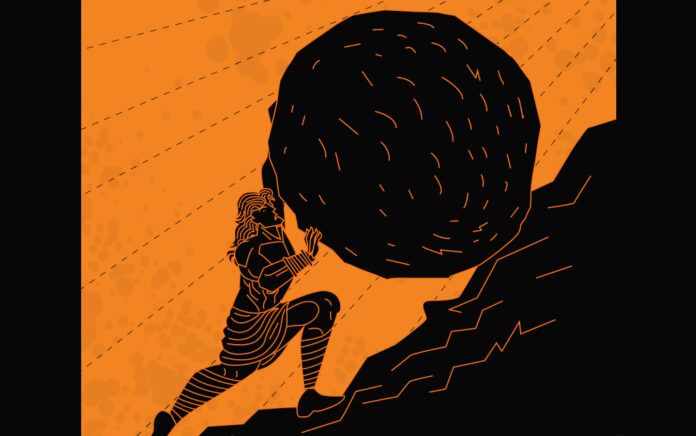
Sisyphus was cursed by the gods to eternally push a boulder up a mountain, only for it to roll down again. This is how many people think of work and the burdens of life.

The Forms of Chaos

Chaos can be negative, positive, or neutral. Below are some forms of chaos:

Chaos to ConfrontWork to DoLife-Giving Order
DirtyClean UpClean
Out of PlaceOrganizeOrganized
Where you areTransportationWhere you want to be
Sick/injuredHealingWell
PotentialBring ForthActual
WildDisciplineTame
NatureBuildCivilization
ThreatProtective MeasuresSecurity
EvilRepentGoodness
UglyRenovateBeautiful
UnknownLearn/ExploreKnown
Negative EmotionFeel/ProcessPositive Emotion
Inefficient SimplifyEfficient
ConfusionClear CommunicationClarity

A teacher or coach work to cultivate the potential in children. A detective will gather evidence to solve mysteries and catch bad guys. A landscaper cuts grass and trims trees to make a yard look beautiful. A truck driver takes objects of value from one place to another. Customer service reps walk with their customers through confusion in order to bring clarity and peace of mind. An artist takes ordinary items and transforms them to invoke awe and wonder. Indiana Jones explored many places to recover items of great value.

A useful thought experiment is asking, “What would happen if I didn’t do my work?” Where would the world be if all janitors quit? What would happen if I stopped changing my son’s diapers? What would happen if I stopped making meals or washing clothes? What would happen if farmers stopped planting and harvesting? As Elon Musk once said on the Joe Rogan Podcast, “If you don’t make stuff, there is no stuff.” “The one who is lazy in his work is brother to a vandal” (Proverbs 18:9). “Because of laziness the roof caves in, and because of negligent hands the house leaks (Ecclesiastes 10:18). If we don’t do our work of confronting chaos, people suffer and die.

When Order Isn’t Life-Giving

As mentioned, chaos isn’t always bad and order isn’t always good. For example, nature is both a beautiful sunset overlooking a mountain lake, and it is a lion that wants to eat you. Similarly, order isn’t always life giving. I think of TV detective Adrian Monk who had debilitating OCD and a fear of germs (among other things). His desire for cleanliness and security cut him off from most love and joy in life. Unhealthy chaos is anarchy, but unhealthy order is tyranny.

Consider the chaos of the unknown. If we never explore ideas or places outside of what we already know, we remain stagnant and become ignorant and arrogant. We need to encounter things we don’t know in order to expand our realm of understanding. If not, you will never try new foods, go new places, or meet new people. That is no way to live.

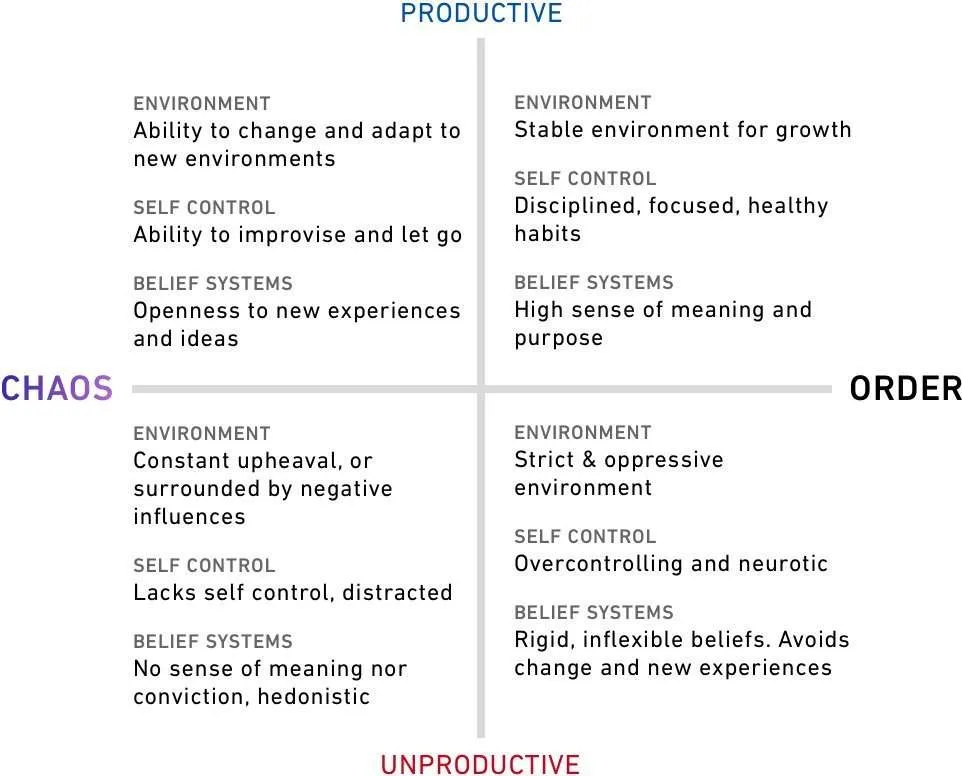
Below is a helpful chart that gives examples of chaos and order in its productive and unproductive forms:

If you find yourself in the lower left quadrant, you should introduce order. If you are in the lower right quadrant, you should introduce some healthy chaos. If you are in the top, you will constantly need wisdom to know whether you need to “stick to your guns” or to be open to other ideas. “There is a time to tear down (chaos) and a time to build (order)” (Ecclesiastes 3:3). We need to wisdom to know which to do at the proper time.

The End of Work

Not all work is good work. Imagine two chemists working in a lab. Both are meticulous in measuring out the proper elements, diligent in timing and temperature, in order to create a high-quality product. However, one of them was making medicine while the other was making meth. They may have been doing the same activity, but the end result was opposite. One chemist made something that heals (life-giving order) while the other made something that destroys (destructive chaos).

When it is all said and done, the end of all work needs to be love. During Minnesota winters, we love our neighbors by shoveling and salting the sidewalks. If we don’t people can get badly hurt. I change diapers so that my son can stay healthy and comfortable. I’m writing this so that you might be informed and encouraged. Work becomes destructive when people are motivated by greed, pride, people-pleasing, or fear.

Jesus’ main commands were to repent and believe in the gospel (Mark 1:15) and to love God and love others (Matthew 22:36-40). A key way we love others is through our work. “For we are God’s handiwork, created in Christ Jesus to do good works, which God prepared in advance for us to do” (Ephesians 2:10). When we do our work well we honor God and bring goodness to the lives of others.

What is the chaos you need to confront today?

Decluttering God’s Way

The last couple years I have been getting into the minimalism movement. The Minimalists put out great content, Joshua Becker has many thoughtful insights on his website, and Marie Kondo has a series on Netflix that shows how tidying up can legitimately change lives. All of these people and more have given me practical steps for owning less, organizing, and making space for what matters most in life. However, I only recently saw how minimalism and tidying up connects directly to God. Let’s go back to the first words of the bible.

“In the beginning God created the heavens and the earth. Now the earth was formless and empty and darkness was over the surface of the deep, and the Spirit of God was hovering over the waters” (Genesis 1:1-2).

The Problem of Chaos

In the beginning there was only God and chaos (symbolized by darkness and the waters). Chaos is disorder and the unknown. It contains great potential, but it can also drown you. How does this apply to our homes and possessions? What does it mean for a home to be in chaos? Clutter, mess, and disorder.

William Morris, an English textile designer in the 1880’s said, “Have nothing in your houses that you do not know to be useful or believe to be beautiful.” That is how I would define clutter. Anything in your life that is not useful or beautiful. Similarly, the Minimalists define clutter as anything that doesn’t add value to your life.

According to an ABC News article, cluttered homes lead to increased stress, decreased focus and productivity, and more unhealthy eating. As Tyler Durden said in Fight Club, “The things you own end up owning you.” Just looking at the picture above stresses me out, but often rooms in my house don’t look much better. How can we imitate God in bringing order out of the chaos of our homes?

Separate into Broad Categories

“And God said, ‘Let there be light,’ and there was light. God saw that the light was good, and he separated the light from the darkness” (Genesis 1:3-4). On day one of creation God separated light from darkness. On day two he separated the sky and the sea. On day three he separated the sea from the land.

Step one for dealing with the clutter of your home is to separate your possessions into broad categories. Maybe you separate items by room. For example, if dishes are in your bedroom, that is a good indicator that chaos is winning. Marie Kondo’s method is to go through clothes first, then books, then paper, then miscellaneous household items, and finally sentimental items. You feel the effects of when things are not in their proper place, so putting things into broad categories is a great first step in creating order out of chaos.

Separate According to Their Kinds

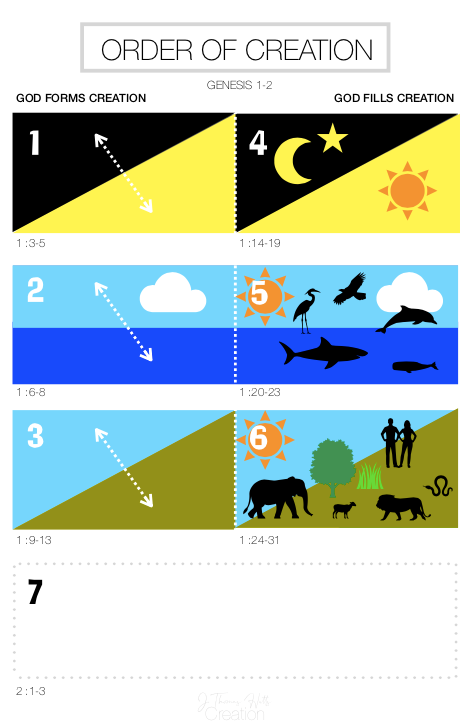
After God separated the land from the sea, he created vegetation: plants bearing seed according to their kinds and trees bearing fruit with seed in it according to their kinds (emphasis added). The phrase “according to their kinds” is used ten times in Genesis 1. God made different birds and fish “according to their kinds,” and all sorts of land animals “according to their kind.” On days 1-3 of creation God created the realm/category and on days 4-6 he filled each realm (see the image below).

In your home, after you broadly separate your possessions, you can then differentiate more specifically. In the bathroom you could put together hair products (brush, hair dryer, hair spray, and hair ties), mouth products (toothbrush, tooth paste, mouth wash, and floss), and healing products (bandages, Ibuprofen, and other OTC medicines). You can separate your shirts from your pants, your pots from your pans, your toys from your blankets, and jewelry from old receipts. I recently did this with my son’s toys as we were unpacking boxes in our new apartment. I put all of the stuffed animals together, all the toy vehicles together, all of his books on the bookshelf, and all of his clothes in a pile separate from the toys. I was able to differentiate his stuff “according to their kinds,” but there is still one more step.

Separate the Sheep from the Goats

Matthew 25:31-33 states, “When the Son of Man comes in his glory . . . all the nations will be gathered before him, and he will separate them one from another, just as a shepherd separates the sheep from the goats. He will put the sheep on his right and the goats on his left.” The sheep are blessed and inherit God’s Kingdom while the goats are cursed and set apart for destruction.

I don’t mean to trivialize God’s judgement. It is something we should all take more seriously. However, for the sake of this post I want to apply the principle of sheep and goats to our possessions. We ought to distinguish between what is useful, valuable, and a blessing from what is just taking up space and keeping us from the most important things. Here are some questions to help you discern what is valuable (Many of these come from the book Love People, Use Things by Joshua Fields Milburn and Ryan Nicodemus):

  • How much is enough? Be specific. How many shirts? Mugs? Plates? Book?
    • Pare down to whatever number you decide.
  • If this object was to spontaneously combust, would you feel relieved?
    • If yes, you can feel freedom to remove it.
  • Have you used this in the past 90 days? Will you use it in the next 90 days?
    • You are already not using it, why not make the break-up official?
  • What are you afraid of?
    • Are you afraid of disappointing someone or not having enough? There is power in pressing into your fears.
  • Is there someone else who can use this more than me?
    • It is better to give than to receive (Acts 20:35).
  • Does this item spark joy? (From Marie Kondo)
    • If it doesn’t give you joy, why hold on to it?
  • If I were shopping now, would I buy it?
    • If you wouldn’t buy it again, you probably don’t need it now.

Go through all of your things and discern what is adding value to your life (sheep) and what is not (goats). The goal is to make space in your life for what matters most. The less you own, the less you have to manage, the more time and energy you are able to invest elsewhere. Here is a article of how to start the decluttering process.

We often think of our stuff as an extension of ourselves, which makes it difficult to de-own. One tip is to create a “maybe” box in which you place items you may or may not want to keep. Once you put the items in the box, leave them for for a certain amount of time (anywhere from one to six months). If you don’t miss anything in the box, you can donate it with peace of mind.

Minimalism and tidying up is a process, not a destination. Which brings me to my final point.

Rule with Wisdom, Creativity, and Love

God made males and females in his image so that we would rule over his creation. “God blessed them, and said to them, ‘Be fruitful, multiply, fill the earth, and subdue it. Rule the fish of the sea, the birds of the sky, and every creature that crawls on the earth.'” Psalm 8 goes so far to say that God “put everything under their feet.”

One aspect of imaging God is to “subdue” that which God has put under you. God has given responsibilities to every person. He entrusts his creation to us and expects to have a good return on his investment. He gives money and possessions so that we would put them to good use and be a blessing to others. When we “rule” over our stuff with wisdom we push back against the clutter and chaos of our homes and create a space of warmth, peace, and hospitality. Do you feel like you are ruling over your stuff or is your stuff ruling over you?

God placed Adam in the Garden of Eden to work it and watch over it (Genesis 2:15). If you’ve ever planted a garden, you know that you can’t just plant your seeds and leave it alone. You have to work the soil, water, and pull weeds. If you don’t intentionally maintain your garden, it won’t be fruitful. The weeds and rabbits will stop the growth. Similarly, if we aren’t diligent in taking daily steps to declutter, organize, and maintain our things, the chaos will start to choke out the life we are trying to create in our homes. God has given us all we need to create beauty, life, and peace out of the chaos of our home. What is holding you back?

P.S.

Here is another article by Joshua Becker about daily decluttering routines.

Worship or Mission

I want everything I do in life to be either worship or mission. Many people have a narrow definition of these words, so let me define my terms.

Worship essentially means treating God like he is a big deal. It consists in both praising God and receiving his gifts with joy and thanksgiving. You can worship through prayer, singing, and reading the bible. You can also worship by taking a walk, laughing with friends, enjoying a good meal (1 Corinthians 10:31), playing a game, or engaging in a hobby you love.

Mission is doing what God created you to do for the betterment of the world. The image of going to a poor foreign country and serving might come to mind when you think of mission. That is mission, but it is a narrow view. Your work in the marketplace, cleaning the house, helping out a loved one who is struggling, telling someone about Jesus, or volunteering in the community can all be mission.

Worship is loving God, mission is loving your neighbor (Matthew 22:36-40). Worship is abiding in Christ, mission is bearing fruit (John 15). Worship is knowing God, mission is making him known. These categories are fluid and can overlap. For example, playing with my son is both worship and mission for me. It gives me great joy, and I am also fulfilling my calling as a father. Exercising and reading are other activities that could fit into either category.

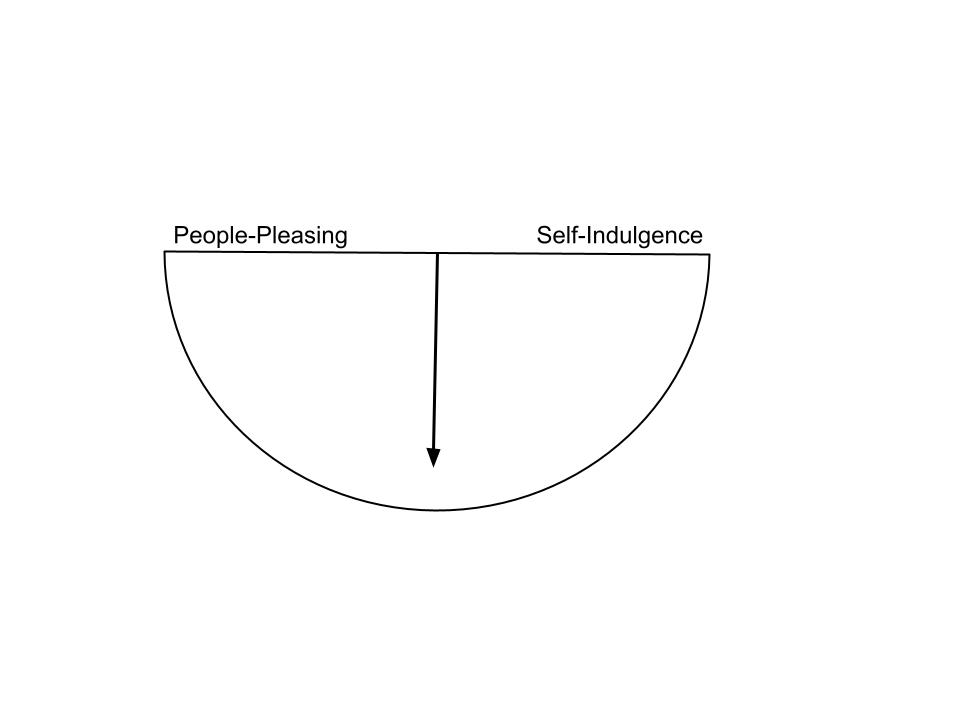
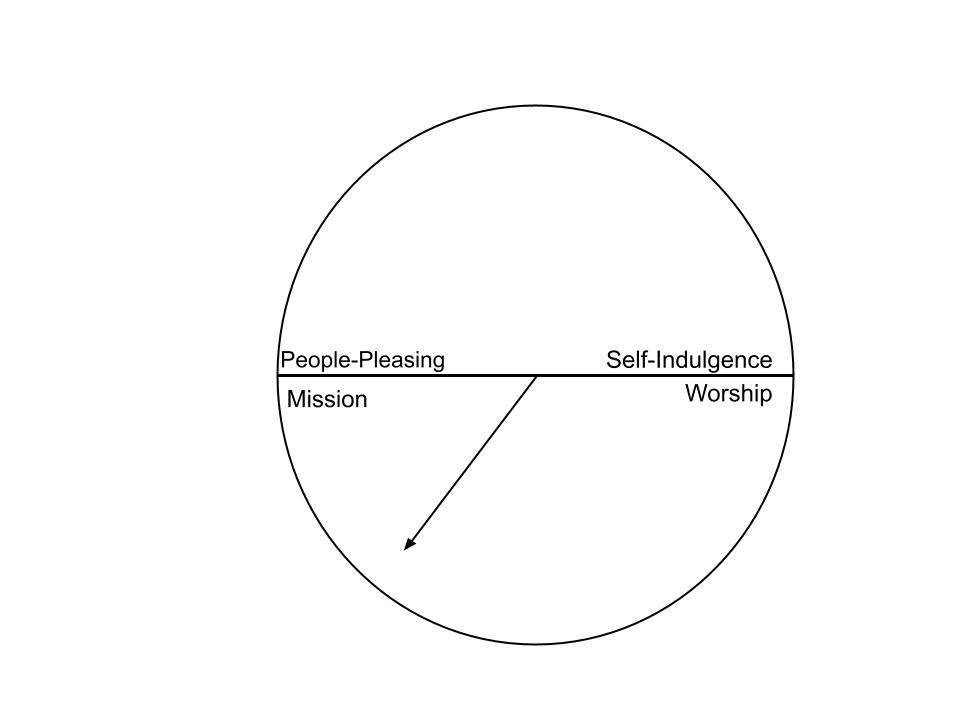
Here is an image adapted from Pastor Mike Breen’s work/rest semi-circle:

I want my life to flow between doing good work (mission) then resting in God (worship). The biblical characters that come to mind are Mary and Martha (Luke 10:38-41). Martha was busy with her many tasks while Mary sat at Jesus’ feet and listened to him. Jesus elevates Mary in this passage, but both are essential. What does my life look like when I get out of rhythm?

The Flesh Semi-Circle

When I get out of rhythm I substitute mission with people pleasing and worship with self-indulgence.

Instead of serving others for their good and God’s glory, I serve to gain approval from people. It might look like flattery, saying yes when I would rather say no, or avoiding confrontation.

Instead of receiving God’s gifts with thanksgiving, I can take them for granted and use them in unhealthy ways. This might look like mindlessly scrolling social media, hitting the snooze button too many times, binging tv shows, over-eating, procrastinating, or lashing out in anger.

The biblical characters that come to mind are the two brothers in Luke 15. The younger brother wanted to live the high life. He demanded his inheritance before his father died (a big no-no), took his wealth and squandered it in wild living. He lived to gratify earthly desires. The older brother, on the other hand, never did anything wrong. He worked hard, did his duty, and obeyed his father. Which isn’t wrong in itself, but at the end of the story we see that he didn’t do his work out of love for his father, but rather so that he could gain status and recognition from his father (Luke 15:29).

Coming Full Circle

Galatians 5:17 tells us that there is a war inside every believer between the flesh and the Spirit. The Spirit is focused on God and others while the flesh is focused on the self. It gets challenging because the line between the flesh and the Spirit can be very thin. How do I know if I am working hard out of love for my neighbor, or if I am finding my worth in being helpful? Where is the line between enjoying the good gifts that God has given and turning a good thing into a god thing?

Am I writing this post to serve others (mission), or so that people will think I’m clever (people-pleasing)? Do I receive my morning coffee as a good gift from God (worship), or am I addicted to caffeine (self-indulgence)? Do I workout acknowledging that God uniquely made my body to move (worship), and he calls me to steward this gift well (mission), or do I do it to feel good about myself (self-indulgence) and to appear more attractive to others (people-pleasing)?

I don’t have an answer. C.S. Lewis was right when he said, “It would seem that Our Lord finds our desires not too strong, but too weak. We are half-hearted creatures, fooling about with drink and sex and ambition when infinite joy is offered us, like an ignorant child who wants to go on making mud pies in a slum because he cannot imagine what is meant by the offer of a holiday at the sea. We are far too easily pleased.” We are indeed half-hearted creatures who are easily distracted by lesser things. Sometimes the Spirit wins that battle and sometimes the flesh.

The good news is that if you are in Christ, the war has already been won. When Jesus died on the cross for your sin and selfishness and rose from the dead in power, he secured your eternity. You don’t have to earn his love or perform your way into his good graces. Rather, you can receive his salvation through faith. You don’t have to live in fear about messing up and not living perfectly because Jesus already paid your debt. We don’t praise God and do good deeds out of fear that he will punish us. We do those things because it is what we were created to do. “For we are God’s handiwork, created in Christ Jesus for good works, which God prepared in advance for us to do” (Ephesians 2:10).

Work hard. Play hard. Praise heartily.

Can You Be Perfect?

With football season starting up, I thought it would be appropriate to examine two of the best football movies: Remember the Titans and Friday Night Lights. In both films the head coach challenged his team with being perfect. I want to take a couple minutes and consider both of these speeches and tease out the good and the bad (not that fictional coaches from 20 years ago need my constructive criticism).

Remember the Titans

Remember the Titans takes place in 1972, when schools in the south were forced to racially integrate. The movie follows the T.C. Williams Titans, coached by Herman Boone. Coach Boone is a no-nonsense, my-way-or-the-highway type of coach. When addressing his team before practices began he said, “We will be perfect in every aspect of the game. You drop a pass, you run a mile. Miss a blocking assignment, you run a mile. You fumble the football, I will break my foot off in your John Brown hind parts! And then you will run a mile. Perfection! Let’s go to work.”

Coach Boone has high standards and he wants his team to keep reaching for that next level of excellence, which is a good thing. However, the way he delivers his message could have the opposite effect. If he demands perfection, players might be hesitant to take risks for fear of failing. Maybe the quarterback doesn’t try to squeeze the ball through a tight window and risk an interception. Maybe a defender doesn’t use a certain move in case the ball-carrier breaks their contain.

Another critique I have is that mistakes will always happen and I can’t think of a worse teaching method than running a mile. Running a mile in no ways helps train for football since it doesn’t prime fast twitch muscles. While running the player loses 6-10 minutes of time that they could have used to learn from their mistakes. What happens when a great offensive player goes against a great defensive player? They will probably both win just as much as they lose. At what point would they have to run? If he is set on demanding perfection, he needs to be specific about what he means by perfection. I would also recommend picking a punishment that actually addresses the mistake. I’m thinking something like ‘paint the fence’ or ‘sand the floor,’ something that is physically exhausting, but teaches muscle memory to perform the task correctly the next time.

In the championship game, Coach Boone seems to change his message. He said, “We’re in a fight. You boys are doing all that you can do. Anybody can see that. Win or lose, we’re gonna walk out of that stadium tonight with our heads held high. Do your best. That’s all anybody can ask for.” Surprisingly, a leader on the team pushed back against this. He acknowledges the he isn’t perfect and will never be perfect, but because the team has won every game, collectively they are perfect and he intends to keep it that way. I wonder what it means to give more than your best? Sometimes you can do everything in your power and at the end of the day the other team is just better. There is no shame in that.

Friday Night Lights

Coach Gary Gaines delivers a similar message about being perfect at the start of the season to his Permian Panthers. He tells his team, “It’s a good day to think about responsibility. It’s a good day to ask yourself if, on a personal level, you’re willing to accept the responsibility that you have to protect this team and this school and this town. And make no mistake about it, gentlemen. We are in the business of protecting this town. We’re in the business of winning. The expectations couldn’t be any higher. We will win state. We will win state. Can you be perfect?

Coach Gaines seems to define perfection as winning state and, in doing so, they will protect the team, school, and town. One wonders why the responsibility to protect the town should fall on the shoulders of 15-17 year-olds? or how winning football games protects the town in any meaningful way?

Similar to Coach Boone, Coach Gaines changes his message about what it means to be perfect during halftime of the championship game. He says, “Now, ya’ll have known me for awhile, and for a long time now you’ve been hearin’ me talk about being perfect. Well I want you to understand somethin’. To me, being perfect is not about that scoreboard out there. It’s not about winning. It’s about you and your relationship to yourself and your family and your friends. Being perfect is about being able to look your friends in the eye and know that you didn’t let them down, because you told them the truth. And that truth is that you did everything that you could. There wasn’t one more thing that you could’ve done. Can you live in that moment, as best you can, with clear eyes and love in your heart? With joy in your heart? If you can do that gentlemen, then you’re perfect.”

I really love this explanation and fully agree with it. Telling the truth, doing your best, and being filled with love and joy is a beautiful way to live life. My main qualm is that he didn’t explain what he meant by perfect from day one (I guess that would take away from the dramatic effect at the end, huh?).

What Does Perfection Mean?

There are a couple different ways to think about perfection. One way is to think about perfection as an absence of errors. A perfect season is a season with no losses. A perfect game is when the pitcher gets out every batter. A perfect fit is when an item of clothing contours to your body just right. This definition of perfect speaks to being all that one can be. This seems to be the perfection that Coach Boone demanded. Living a sinless life or a lamb without spot or blemish would fit this definition of perfection.

We can also think about perfection as living out the fullness of who you are. A synonym for this definition is integrity. “Integrity” is related to “integer” meaning a positive or negative whole number. There are no fractions or decimals with integers. They are all in, whether positive or negative. This is the type of perfection Coach Gaines talks about. Were you honest? Did you do everything you possibly could? If so, you are whole. You are perfect. That doesn’t mean that you played perfectly, but that you honestly gave it your best effort. Being honest when you sin would fit this definition of perfection.

As humans we are constantly divided. We want to be healthy and we also want to eat McDonalds. We want to be productive and we also want to binge Netflix. We want to enjoy rich community and we don’t want to put ourselves in situations where others can hurt us. We want to pursue God and we also want to pursue the things of the world. Given our divided nature, what does Jesus mean when he commands, “Be perfect as your Heavenly Father is perfect” (Matthew 5:48)?

How is God Perfect?

God embodies both definitions of perfection discussed above. He is without sin or blemish, and he is wholly who he says he is. He both speaks the truth and is the truth (John 14:6). You don’t have to look very hard to see that even the best people have sin in their lives and aren’t all that they could be. Even to consider the question of what is the best possible version of yourself gets overwhelming because it seems so unreachable.

Hymn writer John Newton once said, “I am not what I ought to be, I am not what I want to be, I am not what I hope to be in another world; but still I am not what I once used to be, and by the grace of God I am what I am.” I think this is a good way to think about perfection. He is honest about his shortcomings, acknowledges that one day he will experience a radical transformation, yet he also celebrates the good things that God has already done in his life.

It seems to me that the only way to be perfect in this life is to admit where you fall short, learn from it, then aim upward. This is what it means to live a life of repentance. Tell the truth. Do your best. Push yourself to new heights. Trust that one day Jesus will return. On that day you will be everything you ever imagined. You will be perfect as your heavenly Father is perfect.

P.S. A Brief Greek Nerd Sesh

The Greek word for “perfect” as an adjective is τέλειος, and it is used 19 times in the New Testament. It can mean “mature” (1 Cor 2:6, 14:20, Eph 4:13, Phil 3:15, Col 1:28, 4:12, Heb 5:14, Jam 1:4, and 3:2). It describes God’s will (Rom 12:2), God’s tabernacle (Christ in this context) (Heb 9:11), gifts from above (Jam 1:17), law of freedom (Jam 1:25), and love that drives out fear (1 John 4:18).

James 1:4 states, “Let endurance have its full effect, so that you may be mature (τέλειοι) and complete (ὁλόκληροι), lacking nothing.”

First Corinthians 13:10 states, “When the perfect (or completeness) comes, the partial will come to an end.” This seems to describe the time when Jesus comes back and restores everything that is broken. We see him in part now, but one day we will see him face to face.

In Matthew 19:20-21 a wealthy young man asks Jesus, “What do I still lack?” Jesus tells the man, “If you want to be perfect (τέλειος), go, sell your possessions and give to the poor, and you will have treasure in heaven. Then come, follow me.” In this context, being perfect is the opposite of lacking. The rich man had great wealth, but was empty on the inside. He yearned for eternal life (God has put eternity in our hearts, after all), but the cost was too high for him.

“Perfect” can also be a verb (24 times in the New Testament)- τελειόω. It is often used to mean “finished” or “completed.” For example, “After those days were over . . .” (Luke 2:43), and “I have glorified you on earth by completing the work you gave me to do” (John 17:4). There are other examples in Hebrews when it could be translated “completed” or “perfected” (Heb 2:10, 5:9, 7:19, 7:28, 9:9, 10:1, 10:14, 11:40, 12:23). In many of the Hebrews verses, the author seems to have glorification in mind. If Jesus was already perfect, how could it say that he “has been perfected forever” (7:28)?

Both come from the word ‘τέλος’ which means the end, purpose, goal, or consummation. A τέλος is the bullseye of one’s life, the hoop you are shooting at. The more that your τέλος lines up with who God created you to be, the closer you are to perfection.

What is Love?

The Bible offers a different understanding of love than our culture. Jesus said that the greatest form of love is laying your life down for the good of another (John 15:13). God the Father loved the world in this way: sending Jesus to die for our sins (John 3:16). Jesus loved us by giving up his life to die on the cross, even while we were still sinners (Romans 5:8). First Corinthians 13:4-7 lists fifteen characteristics of love:

  1. Love is patient.– Long-suffering, perseverant, and unhurried.
  2. Love is kind.- Compassionate, polite, and servant-hearted.
  3. Love does not envy.– Doesn’t get jealous, compare, or covet.
  4. Love is not boastful. Doesn’t brag or self-promote.
  5. Love is not arrogant. Doesn’t think too highly of self and isn’t self-absorbed.
  6. Love does not dishonor others. Doesn’t mock, humiliate, or treat others as less than they’re worth.
  7. Love is not self-seeking.– Doesn’t look for its own interests/desires, but cares about the good of others.
  8. Love is not easily-angered.– Is hard to offend and doesn’t get irritated.
  9. Love does not keep a record of wrongs.– Is quick to forgive and reconcile, and doesn’t hold a grudge.
  10. Love finds no joy in unrighteousness.– Is grieved by the evil and injustice in the world.
  11. Love rejoices in the truth.– Desires that which is real and true. Speaks the truth in love.
  12. Love bears all things.– Endures without giving up.
  13. Love believes all things.– Keeps the faith in good times and bad.
  14. Love hopes all things. Has a positive vision of the future regardless of current circumstances.
  15. Love endures all things.- Stays and perseveres in the face of hardship.

Twenty percent of the listed characteristics are about enduring hard times (patient, bears, endures). Love endures hard times without becoming bitter or cynical (hopes & believes all things). Love is more focused on others than on self. Love does good to others.

When you look at the list above, how would you grade your love?

Are you patient? Are you kind? Do you get angry easily? Do you tell the truth even when it is hard? Do you get stuck in the comparison game? Is there someone you can’t bring yourself to forgive? How often do you give in to selfish impulses?

These questions aren’t meant to judge or condemn. If you consider love to be the most important thing in life, then wouldn’t you like to know if you were living contrary to love? You have to first recognize that there is a problem before you can grow.

W.W.L.D?

The greatest commandment is to “Love the Lord your God with all of your heart, soul, mind, and strength, and to love your neighbor as yourself.” John tells us that if we don’t love others, we aren’t of God, because God is love (1 John 4:8). However, our love often falls short. We get selfish, irritated, and at times give up when things get hard. But the good news is that God is love.

Jesus perfectly embodied 1 Corinthians 13. He was patient and kind. When he was mocked and ridiculed he didn’t fight back. He told the truth. He valued the outcasts in society and associated with the lowly. He paid for our sins and cast them away from us as far is the east is from the west. When we sin and fall short he pursues us.

Not only did God forgive our sins, he also gave us his Holy Spirit, which is a Spirit of love, joy, peace, patience, kindness, goodness, faithfulness, gentleness, and self-control (Galatians 5:22-23). When our natural instinct is to look out for ourselves, the Holy Spirit gives a supernatural ability to look out for others.

When you are trying to decide what to do or how to respond, ask yourself, “What would love do? What action would most embody love?” If you are reviewing a past action, ask, “Was that loving? Did I live out the standard set in 1 Corinthians?” The answers may not always be clear, but the more we ask and strive to do the loving thing, the more we will embody Jesus to a broken world.

Mortgaged Heart

As my wife and I dabble in house hunting, I have been intrigued by concept of a mortgage. When someone takes a mortgage out on a house, the buyer puts a certain percentage down on the house, say 10%, then the bank offers a loan for the remaining 90%, which is then paid off over the course of 15-30 years. Essentially, you own 10% of the house while the bank owns 90%. There is a sense in which the house is yours at closing, but there is another sense in which the house belongs to the bank. The house is not fully yours until the mortgage is paid off.

I think this is similar to the Christian life. There is a sense in which we belong fully to God upon turning from our sin and trusting in Jesus alone for our salvation. At that point, we received the Holy Spirit, who is “the down payment of our inheritance, until the redemption of [our bodies], to the praise of his glory” (Ephesians 1:14). However, there is still sin in our lives. There are parts of our mind, body, and soul that don’t yet belong to God. This is a great tension of the Christian life. Like the Israelites, we are in the wilderness, caught between slavery and the promised land. We are a purchased people (this is what it means to be redeemed), yet we have not attained a final redemption.

This is why Saint Paul could say that we have been adopted as God’s children (Rom 8:15) and at the same time we “wait eagerly for our adoption to sonship” (Rom 8:23). We are already adopted, yet there is an adoption to come. Let’s compare salvation to buying a house. When you received the Holy Spirit, let’s image 20% of your being was “purchased” and became aligned with God’s will for your life. That means 80% of your life is still “owned” by sin. The remainder of your life is then making “payments” so that God “owns” progressively more of you. The parts of you that were once “owned” by anger are transformed into patience. The parts that were “owned” by worry are transformed into trust. The parts that were “owned” by apathy are transformed into love and compassion.

Continuing with this analogy, what does it mean for Christians to “make payments?” God is the author and perfecter of our faith. I believe that we cannot add to his salvation or take away from it (there is no repo man coming to taking our salvation). Yet, there are things we do to experience more of God, such as bible study, prayer, fellowship, trust, and obedience (all of which is powered by the Holy Spirit). We read the bible to have our minds renewed with the truth and combat false narratives. We pray to ask God to move in this world and to transform us in the process. We connect with other believers to bear each others burdens, confess our sins, and sharpen one another. As we trust and follow God, we become more like Jesus. We become more like who he created us to be.

We will still struggle in this life. Some days sin will get the better of us. But God promises that there will be a day when Jesus will come back to purchase his people for good. “Listen, I tell you a mystery: We will not all [die], but we will all be changed— in a flash, in the twinkling of an eye, at the last trumpet. For the trumpet will sound, the dead will be raised imperishable, and we will be changed. For the perishable must clothe itself with the imperishable, and the mortal with immortality. When the perishable has been clothed with the imperishable, and the mortal with immortality, then the saying that is written will come true: ‘Death has been swallowed up in victory.’ ‘Where, O death, is your victory? Where, O death, is your sting?’” (1 Corinthians 15:51-55). “He will wipe away every tear from their eyes. Death will be no more; grief, crying, and pain will be no more, because the previous things have passed away” (Revelation 21:4)

If you are in Christ, your future is secure and it is glorious. There will be a day when we will be totally free with God forever. May that inspire us to take steps toward freedom in this life.