What is the essence of what work? What are we actually doing when we do stuff? Is it simply the stuff we have to do to keep living or is it something more? Pastor Tim Keller defines work as, “Rearranging the raw materials of a particular domain to draw out its potential for the flourishing of everyone.” God created the world, but he gave humans the responsibility of stewardship. For example, God created the trees out of which humans created tables and chairs. He created iron ore and humans mined and shaped it into tools.
I will argue that all good work consists of confronting chaos to create life-giving order. In doing so we image God in the world. Let’s start with the first page of the bible to see how that works.
God Confronts the Chaos
Before creation, God existed alone with chaos. “The earth was formless and empty, darkness was over the surface of the deep, and the Spirit of God was hovering over the waters” (Genesis 1:2). Out of this chaos God spoke the earth into existence so that it was filled with light and life. God blessed the humans saying, “Be fruitful and multiply; fill the earth and subdue it. Rule over the fish in the sea and the birds in the sky and over every living creature that moves on the ground (Genesis 1:28). God placed the humans in the Garden of Eden so that they could work it and watch over it (Genesis 2:15). Work was always a part of the human condition. We were made to work and represent God with our creativity and effort, cultivating plants and animals so that they flourish.
However, Adam and Eve sinned, and God cursed the ground and frustrated human work. Chaos re-entered the world. “Cursed is the ground because of you; through painful toil you will eat food from it all the days of your life. It will produce thorns and thistles for you, and you will eat the plants of the field. By the sweat of your brow you will eat your food” (Genesis 3:17-19). This is the world we inhabit. Work is often hard and frustrating. Things fall apart. People deceive and disappoint. Deals fall through. Tragedy strikes when we least expect it. Even though work is not what it once was, the charge to work and watch over the earth and to be fruitful and multiply still stand. I turn now to consider what it looks like to confront chaos today.
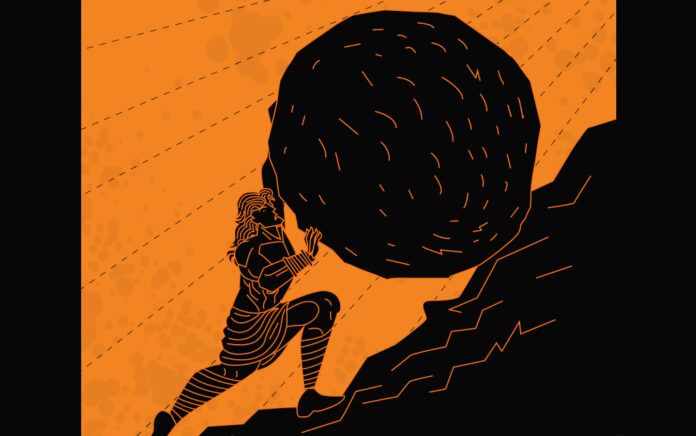
Sisyphus was cursed by the gods to eternally push a boulder up a mountain, only for it to roll down again. This is how many people think of work and the burdens of life.
The Forms of Chaos
Chaos can be negative, positive, or neutral. Below are some forms of chaos:
Chaosto Confront
Work to Do
Life-Giving Order
Dirty
Clean Up
Clean
Out of Place
Organize
Organized
Where you are
Transportation
Where you want to be
Sick/injured
Healing
Well
Potential
Bring Forth
Actual
Wild
Discipline
Tame
Nature
Build
Civilization
Threat
Protective Measures
Security
Evil
Repent
Goodness
Ugly
Renovate
Beautiful
Unknown
Learn/Explore
Known
Negative Emotion
Feel/Process
Positive Emotion
Inefficient
Simplify
Efficient
Confusion
Clear Communication
Clarity
A teacher or coach work to cultivate the potential in children. A detective will gather evidence to solve mysteries and catch bad guys. A landscaper cuts grass and trims trees to make a yard look beautiful. A truck driver takes objects of value from one place to another. Customer service reps walk with their customers through confusion in order to bring clarity and peace of mind. An artist takes ordinary items and transforms them to invoke awe and wonder. Indiana Jones explored many places to recover items of great value.
A useful thought experiment is asking, “What would happen if I didn’t do my work?” Where would the world be if all janitors quit? What would happen if I stopped changing my son’s diapers? What would happen if I stopped making meals or washing clothes? What would happen if farmers stopped planting and harvesting? As Elon Musk once said on the Joe Rogan Podcast, “If you don’t make stuff, there is no stuff.” “The one who is lazy in his work is brother to a vandal” (Proverbs 18:9). “Because of laziness the roof caves in, and because of negligent hands the house leaks (Ecclesiastes 10:18). If we don’t do our work of confronting chaos, people suffer and die.
When Order Isn’t Life-Giving
As mentioned, chaos isn’t always bad and order isn’t always good. For example, nature is both a beautiful sunset overlooking a mountain lake, and it is a lion that wants to eat you. Similarly, order isn’t always life giving. I think of TV detective Adrian Monk who had debilitating OCD and a fear of germs (among other things). His desire for cleanliness and security cut him off from most love and joy in life. Unhealthy chaos is anarchy, but unhealthy order is tyranny.
Consider the chaos of the unknown. If we never explore ideas or places outside of what we already know, we remain stagnant and become ignorant and arrogant. We need to encounter things we don’t know in order to expand our realm of understanding. If not, you will never try new foods, go new places, or meet new people. That is no way to live.
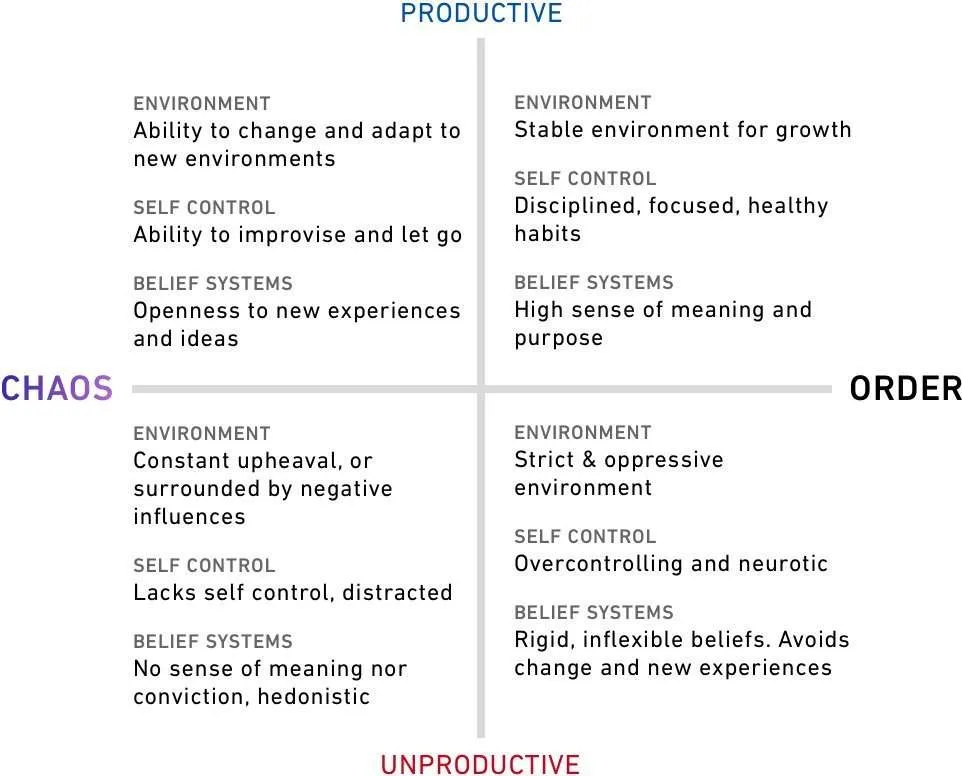
Below is a helpful chart that gives examples of chaos and order in its productive and unproductive forms:
If you find yourself in the lower left quadrant, you should introduce order. If you are in the lower right quadrant, you should introduce some healthy chaos. If you are in the top, you will constantly need wisdom to know whether you need to “stick to your guns” or to be open to other ideas. “There is a time to tear down (chaos) and a time to build (order)” (Ecclesiastes 3:3). We need to wisdom to know which to do at the proper time.
The End of Work
Not all work is good work. Imagine two chemists working in a lab. Both are meticulous in measuring out the proper elements, diligent in timing and temperature, in order to create a high-quality product. However, one of them was making medicine while the other was making meth. They may have been doing the same activity, but the end result was opposite. One chemist made something that heals (life-giving order) while the other made something that destroys (destructive chaos).
When it is all said and done, the end of all work needs to be love. During Minnesota winters, we love our neighbors by shoveling and salting the sidewalks. If we don’t people can get badly hurt. I change diapers so that my son can stay healthy and comfortable. I’m writing this so that you might be informed and encouraged. Work becomes destructive when people are motivated by greed, pride, people-pleasing, or fear.
Jesus’ main commands were to repent and believe in the gospel (Mark 1:15) and to love God and love others (Matthew 22:36-40). A key way we love others is through our work. “For we are God’s handiwork, created in Christ Jesus to do good works, which God prepared in advance for us to do” (Ephesians 2:10). When we do our work well we honor God and bring goodness to the lives of others.
The last couple years I have been getting into the minimalism movement. The Minimalists put out great content, Joshua Becker has many thoughtful insights on his website, and Marie Kondo has a series on Netflix that shows how tidying up can legitimately change lives. All of these people and more have given me practical steps for owning less, organizing, and making space for what matters most in life. However, I only recently saw how minimalism and tidying up connects directly to God. Let’s go back to the first words of the bible.
“In the beginning God created the heavens and the earth. Now the earth was formless and empty and darkness was over the surface of the deep, and the Spirit of God was hovering over the waters” (Genesis 1:1-2).
The Problem of Chaos
In the beginning there was only God and chaos (symbolized by darkness and the waters). Chaos is disorder and the unknown. It contains great potential, but it can also drown you. How does this apply to our homes and possessions? What does it mean for a home to be in chaos? Clutter, mess, and disorder.
William Morris, an English textile designer in the 1880’s said, “Have nothing in your houses that you do not know to be useful or believe to be beautiful.” That is how I would define clutter. Anything in your life that is not useful or beautiful. Similarly, the Minimalists define clutter as anything that doesn’t add value to your life.
According to an ABC News article, cluttered homes lead to increased stress, decreased focus and productivity, and more unhealthy eating. As Tyler Durden said in Fight Club, “The things you own end up owning you.” Just looking at the picture above stresses me out, but often rooms in my house don’t look much better. How can we imitate God in bringing order out of the chaos of our homes?
Separate into Broad Categories
“And God said, ‘Let there be light,’ and there was light. God saw that the light was good, and he separated the light from the darkness” (Genesis 1:3-4). On day one of creation God separated light from darkness. On day two he separated the sky and the sea. On day three he separated the sea from the land.
Step one for dealing with the clutter of your home is to separate your possessions into broad categories. Maybe you separate items by room. For example, if dishes are in your bedroom, that is a good indicator that chaos is winning. Marie Kondo’s method is to go through clothes first, then books, then paper, then miscellaneous household items, and finally sentimental items. You feel the effects of when things are not in their proper place, so putting things into broad categories is a great first step in creating order out of chaos.
Separate According to Their Kinds
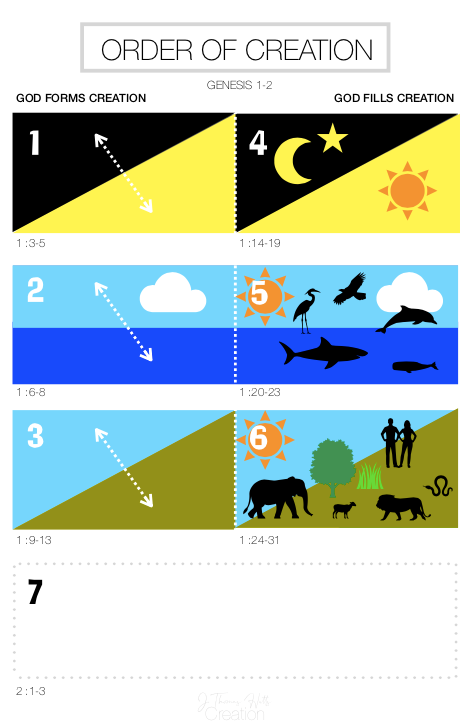
After God separated the land from the sea, he created vegetation: plants bearing seed according to their kinds and trees bearing fruit with seed in it according to their kinds (emphasis added). The phrase “according to their kinds” is used ten times in Genesis 1. God made different birds and fish “according to their kinds,” and all sorts of land animals “according to their kind.” On days 1-3 of creation God created the realm/category and on days 4-6 he filled each realm (see the image below).
In your home, after you broadly separate your possessions, you can then differentiate more specifically. In the bathroom you could put together hair products (brush, hair dryer, hair spray, and hair ties), mouth products (toothbrush, tooth paste, mouth wash, and floss), and healing products (bandages, Ibuprofen, and other OTC medicines). You can separate your shirts from your pants, your pots from your pans, your toys from your blankets, and jewelry from old receipts. I recently did this with my son’s toys as we were unpacking boxes in our new apartment. I put all of the stuffed animals together, all the toy vehicles together, all of his books on the bookshelf, and all of his clothes in a pile separate from the toys. I was able to differentiate his stuff “according to their kinds,” but there is still one more step.
Separate the Sheep from the Goats
Matthew 25:31-33 states, “When the Son of Man comes in his glory . . . all the nations will be gathered before him, and he will separate them one from another, just as a shepherd separates the sheep from the goats. He will put the sheep on his right and the goats on his left.” The sheep are blessed and inherit God’s Kingdom while the goats are cursed and set apart for destruction.
I don’t mean to trivialize God’s judgement. It is something we should all take more seriously. However, for the sake of this post I want to apply the principle of sheep and goats to our possessions. We ought to distinguish between what is useful, valuable, and a blessing from what is just taking up space and keeping us from the most important things. Here are some questions to help you discern what is valuable (Many of these come from the book Love People, Use Things by Joshua Fields Milburn and Ryan Nicodemus):
How much is enough? Be specific. How many shirts? Mugs? Plates? Book?
Pare down to whatever number you decide.
If this object was to spontaneously combust, would you feel relieved?
If yes, you can feel freedom to remove it.
Have you used this in the past 90 days? Will you use it in the next 90 days?
You are already not using it, why not make the break-up official?
What are you afraid of?
Are you afraid of disappointing someone or not having enough? There is power in pressing into your fears.
Is there someone else who can use this more than me?
It is better to give than to receive (Acts 20:35).
Does this item spark joy? (From Marie Kondo)
If it doesn’t give you joy, why hold on to it?
If I were shopping now, would I buy it?
If you wouldn’t buy it again, you probably don’t need it now.
Go through all of your things and discern what is adding value to your life (sheep) and what is not (goats). The goal is to make space in your life for what matters most. The less you own, the less you have to manage, the more time and energy you are able to invest elsewhere. Here is a article of how to start the decluttering process.
We often think of our stuff as an extension of ourselves, which makes it difficult to de-own. One tip is to create a “maybe” box in which you place items you may or may not want to keep. Once you put the items in the box, leave them for for a certain amount of time (anywhere from one to six months). If you don’t miss anything in the box, you can donate it with peace of mind.
Minimalism and tidying up is a process, not a destination. Which brings me to my final point.
Rule with Wisdom, Creativity, and Love
God made males and females in his image so that we would rule over his creation. “God blessed them, and said to them, ‘Be fruitful, multiply, fill the earth, and subdue it. Rule the fish of the sea, the birds of the sky, and every creature that crawls on the earth.'” Psalm 8 goes so far to say that God “put everything under their feet.”
One aspect of imaging God is to “subdue” that which God has put under you. God has given responsibilities to every person. He entrusts his creation to us and expects to have a good return on his investment. He gives money and possessions so that we would put them to good use and be a blessing to others. When we “rule” over our stuff with wisdom we push back against the clutter and chaos of our homes and create a space of warmth, peace, and hospitality. Do you feel like you are ruling over your stuff or is your stuff ruling over you?
God placed Adam in the Garden of Eden to work it and watch over it (Genesis 2:15). If you’ve ever planted a garden, you know that you can’t just plant your seeds and leave it alone. You have to work the soil, water, and pull weeds. If you don’t intentionally maintain your garden, it won’t be fruitful. The weeds and rabbits will stop the growth. Similarly, if we aren’t diligent in taking daily steps to declutter, organize, and maintain our things, the chaos will start to choke out the life we are trying to create in our homes. God has given us all we need to create beauty, life, and peace out of the chaos of our home. What is holding you back?
P.S.
Here is another article by Joshua Becker about daily decluttering routines.
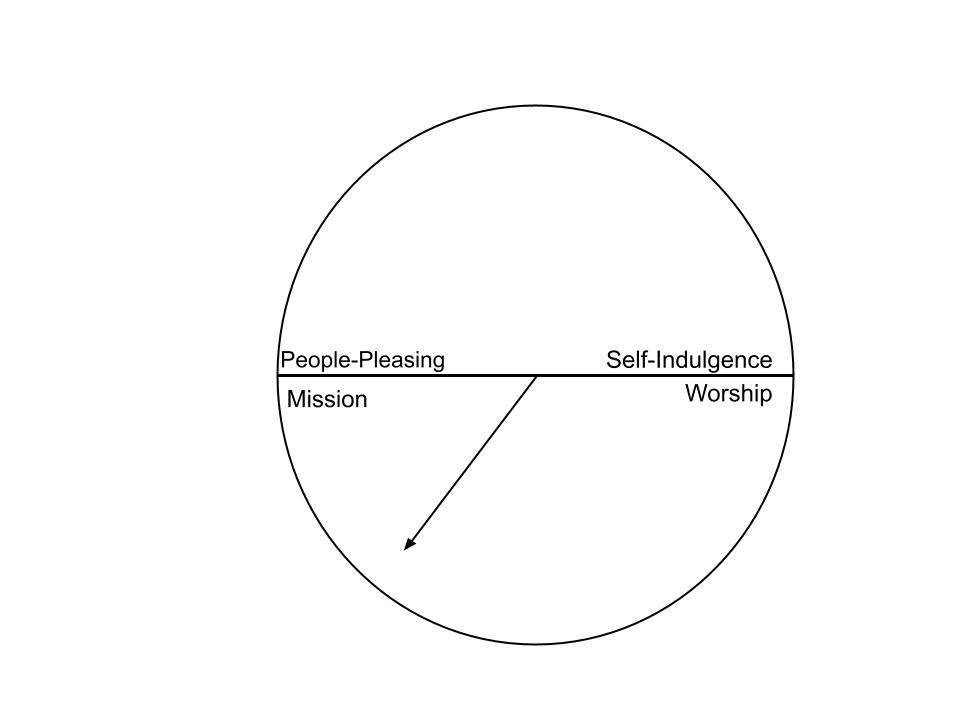
I want everything I do in life to be either worship or mission. Many people have a narrow definition of these words, so let me define my terms.
Worship essentially means treating God like he is a big deal. It consists in both praising God and receiving his gifts with joy and thanksgiving. You can worship through prayer, singing, and reading the bible. You can also worship by taking a walk, laughing with friends, enjoying a good meal (1 Corinthians 10:31), playing a game, or engaging in a hobby you love.
Mission is doing what God created you to do for the betterment of the world. The image of going to a poor foreign country and serving might come to mind when you think of mission. That is mission, but it is a narrow view. Your work in the marketplace, cleaning the house, helping out a loved one who is struggling, telling someone about Jesus, or volunteering in the community can all be mission.
Worship is loving God, mission is loving your neighbor (Matthew 22:36-40). Worship is abiding in Christ, mission is bearing fruit (John 15). Worship is knowing God, mission is making him known. These categories are fluid and can overlap. For example, playing with my son is both worship and mission for me. It gives me great joy, and I am also fulfilling my calling as a father. Exercising and reading are other activities that could fit into either category.
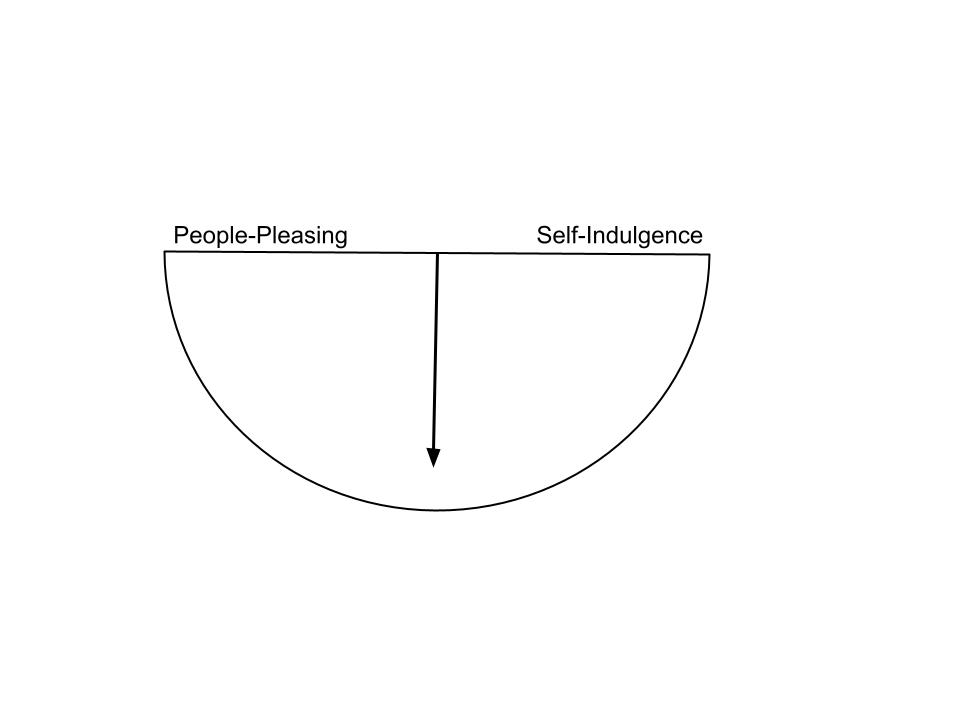
Here is an image adapted from Pastor Mike Breen’s work/rest semi-circle:
I want my life to flow between doing good work (mission) then resting in God (worship). The biblical characters that come to mind are Mary and Martha (Luke 10:38-41). Martha was busy with her many tasks while Mary sat at Jesus’ feet and listened to him. Jesus elevates Mary in this passage, but both are essential. What does my life look like when I get out of rhythm?
The Flesh Semi-Circle
When I get out of rhythm I substitute mission with people pleasing and worship with self-indulgence.
Instead of serving others for their good and God’s glory, I serve to gain approval from people. It might look like flattery, saying yes when I would rather say no, or avoiding confrontation.
Instead of receiving God’s gifts with thanksgiving, I can take them for granted and use them in unhealthy ways. This might look like mindlessly scrolling social media, hitting the snooze button too many times, binging tv shows, over-eating, procrastinating, or lashing out in anger.
The biblical characters that come to mind are the two brothers in Luke 15. The younger brother wanted to live the high life. He demanded his inheritance before his father died (a big no-no), took his wealth and squandered it in wild living. He lived to gratify earthly desires. The older brother, on the other hand, never did anything wrong. He worked hard, did his duty, and obeyed his father. Which isn’t wrong in itself, but at the end of the story we see that he didn’t do his work out of love for his father, but rather so that he could gain status and recognition from his father (Luke 15:29).
Coming Full Circle
Galatians 5:17 tells us that there is a war inside every believer between the flesh and the Spirit. The Spirit is focused on God and others while the flesh is focused on the self. It gets challenging because the line between the flesh and the Spirit can be very thin. How do I know if I am working hard out of love for my neighbor, or if I am finding my worth in being helpful? Where is the line between enjoying the good gifts that God has given and turning a good thing into a god thing?
Am I writing this post to serve others (mission), or so that people will think I’m clever (people-pleasing)? Do I receive my morning coffee as a good gift from God (worship), or am I addicted to caffeine (self-indulgence)? Do I workout acknowledging that God uniquely made my body to move (worship), and he calls me to steward this gift well (mission), or do I do it to feel good about myself (self-indulgence) and to appear more attractive to others (people-pleasing)?
I don’t have an answer. C.S. Lewis was right when he said, “It would seem that Our Lord finds our desires not too strong, but too weak. We are half-hearted creatures, fooling about with drink and sex and ambition when infinite joy is offered us, like an ignorant child who wants to go on making mud pies in a slum because he cannot imagine what is meant by the offer of a holiday at the sea. We are far too easily pleased.” We are indeed half-hearted creatures who are easily distracted by lesser things. Sometimes the Spirit wins that battle and sometimes the flesh.
The good news is that if you are in Christ, the war has already been won. When Jesus died on the cross for your sin and selfishness and rose from the dead in power, he secured your eternity. You don’t have to earn his love or perform your way into his good graces. Rather, you can receive his salvation through faith. You don’t have to live in fear about messing up and not living perfectly because Jesus already paid your debt. We don’t praise God and do good deeds out of fear that he will punish us. We do those things because it is what we were created to do. “For we are God’s handiwork, created in Christ Jesus for good works, which God prepared in advance for us to do” (Ephesians 2:10).
The other day I imagined coaching my son’s youth sports team and I wondered what team rules would resonate with small children. The two rules that came to mind are listen well and do your best. As I pondered these more, I realized that you can get pretty far in life by living by these two rules. Let’s explore what these look like in practice.
Listen Well
A quote from the movie Fight Club sums up a lot of conversations: “Most people don’t listen when you talk, they are just waiting for their turn to speak.” Listening well is a great life skills that will help you in every area of life. Here are some ways in which you can listen well:
Maintain eye contact- In sports this might look like not messing with a ball or your equipment when the coach is talking. In life it might look like putting your phone away during conversations.
Don’t interrupt or talk when the other person is talking– It’s impossible to talk and listen at the same time.
Ask questions until you understand– Curiosity is a much better default than assuming.
Repeat back what the other person said to confirm that you heard correctly– I think this is especially important when conversing with someone who has different beliefs and opinions. Pastor Tim Keller suggests that we represent and engage with our opponents’ position in the strongest form. We should “do all the work necessary until [we] can articulate the views of [our] opponent with such strength that he says, ‘I couldn’t have said it better myself.’”
Assume that they know something that you don’t (Credit to Jordan Peterson)- This requires the humility to admit that you don’t have all the answers and truth can be found in unlikely places.
If possible, take notes– Our minds tend to wander and we are quick to forget. Taking notes helps with both.
Take action– Jesus said that anyone who hears his words yet doesn’t act on them is like a foolish man who builds his house on the sand. When storms come, the house collapsed (Matthew 7:26-27). Imagine a parent who told their kid to clean their room, ony to find the room still a pigsty at the end of the day. The child might’ve heard the parent, but they did not listen.
12 second song that summarizes how to listen well
Do Your Best
There is an amusing story from my childhood when I asked my mom what would happen if I ever got an F in a class.
She said, “I would be disappointed because didn’t do your best.”
I asked, “What if I tried my hardest and the best I could do was an F?”
“That wouldn’t happen.”
“But what if it did?”
“It wouldn’t.”
“But what if it did?”
As you can imagine, this conversation could have gone on forever without getting anywhere. But it brings up a good question to reflect on whenever a task is completed: Did I genuinely give it my best?
A hidden blessing of failures is that it requires us to examine what went wrong. In sports, you can beat a bad team without giving it your best effort. You can also do everything in your power and still lose to a better team. When you win, you tend not to question the results. When you lose, you are forced to ask yourself difficult questions. Here are some questions to ponder whenever it is time to review:
How was my preparation?– Imagine a football team that goes into a game without watching any of their opponent’s film. They might try their hardest during the game, but they didn’t do the necessary preparations. There is truth in the saying, “Failing to prepare is preparing to fail.”
How did I respond to adversity (internal and external)?– Mike Tyson said, “Everyone has a plan until they get punched in the mouth.” How do you respond when things didn’t go according to plan? Did you respond with hope and courage, or did you give up and lose heart?
Did I give in to fear?– Fear can keep us from taking meaningful action. I had teammates in high school who held back in practice and games because they were afraid of giving everything they had and feeling the disappointment of failure. Failure doesn’t hurt as much when you don’t invest your whole heart. The definition of courage isn’t being fearless, rather it is persevering in the face of fear. I think there is value in naming your fears. It’s harder to fight an enemy that you can’t see.
What things were outside of my control?– Sometimes life happens. You get sick. Your car breaks down. There is a family emergency. During high school track I got sick with mono. Giving it my best effort looked a lot different after I was sick. That doesn’t mean we should use these as excuses, but I think it is important to name what is and isn’t in our control in order to assess the situation more fairly.
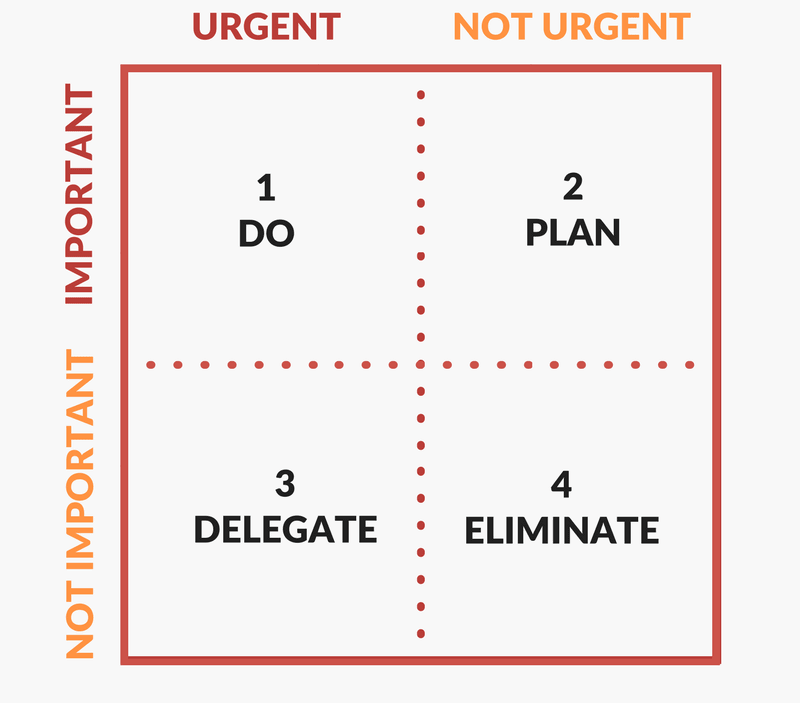
Did I prioritize the most important things?– We can do a lot of things right, but if good things keep us from the best things, we are still falling short of our calling. (See the matrix below.)
What distracted me?– This is related to the previous question. If you didn’t prioritize the most important things, what was it that distracted you? Were they urgent things that weren’t important? Were they time-wasters like TV or social media? Did you spend too much time gossiping with coworkers? What kept you from the most important tasks and how can you avoid them in the future?
Did I ask for help?– I think we often fall short of our goals because we don’t ask for help, either from fear of looking weak, foolish pride that thinks we have all the answers, or maybe you don’t have a network of people you trust. Not asking for help keeps us stagnant. We are created for community and need others. May we have the humility to ask for help when we need it!
Discerning what is Important
One caveat for doing your best is that sometimes we just have to let things be good enough. We can get so fixated on doing things perfectly that we don’t end up getting them done. There are also different responsibilities competing for our time and energy and we have to decide what is most important. A pastor once shared how he preached a sermon without preparing as he normally would because he coached his son’s baseball team the previous day. He didn’t preach his best, but he did the best he could given the circumstances. A way to love his son and the community was to coach the team. To him, the impact he could have coaching outweighed the potential drop in sermon quality.
We must all count the cost. For a college athlete, there might be some weeks that you can’t watch as much film because you have a big paper due. Or maybe you spend less time on a homework assignment because your team was travelling. It would make sense for your quality of work to dip if you are caring for a loved one who is sick. We must constantly be evaluating what are our priorities, and if our actions reflect that they are truly priorities.
Another caveat is that sometimes we don’t have a lot to offer. Every athlete will eventually have a bad game even with great effort and preparation. Sometimes things just go wrong in sports and in life. Everyone will eventually make mistakes and bad decisions. That’s part of being human. I also think of people who suffer with depression or are battling a sickness and have to work extra hard to do seemingly simple tasks. Their best effort looks different depending on how serious their ailment is.
God has given everyone of us great potential and limitations. My potential and limitations will look different than yours or anyone else’s. However, these lines are not set in stone. As we push ourselves to grow, our capacity will increase and our limitations will be pushed further out. May we all have the wisdom and courage to explore those boundaries!
Here is a powerful video about beating perceived limitations and a challenge to give your absolute best.
If you like what you read, subscribe below to stay up to date!
Here are three fill-in-the-blank statements to help you discern your purpose:
“I want to live in a world where . . . so that . . . therefore, I . . .”
“I want to live in a world where . . .“
This statement is about desire: what do I want? It should be future oriented, possible, and within your sphere of influence. You can’t change the past. You can’t stop loved ones from dying. It is one thing for me to say, “I want to live in a world where the Chicago Bears are Super Bowl champs,” and another for the Bears coaches and players to say the same thing. There are tangible things that they can do to realize that desire, while I can do nothing but watch and hope.
The statements can be personal: “I want to live in a world where I am debt free, or own a home, or weigh X amount, or can run a marathon.” They can also be larger in scope: “I want to live in a world where people are judged by the content of their character not the color of their skin, or where children don’t go to bed hungry, or where my political party is in control.” The statements can either be short-term or long-term, character focused or something more tangible. You can also have multiple things for the different areas of life (financial, professional, personal, relational, spiritual, and physical). The main thing is to be honest about what it is you want.
The first step is naming what you want.
“So that . . .”
This statement is about motivation: why do I want what I want? I chose “so that” rather than “because” because “because” addresses the present reality while “so that” addresses future hope. For example, one might say, “I want to live in a world where I am a college graduate because my parents expect me to.” Compare that with the statement, “I want to live in a world where I am a college graduate so that I can make my parents proud.” “Because” is the reason you got started. “So that” is what makes you persevere.
This step is important for understanding your own heart. As you reflect you might realize you want something for selfish reasons, or you might find that it is something that someone else wants for your life and not something you are passionate about. Maybe an athlete doing this exercise will find that they want to win conference so that they feel a greater sense of self-worth. Then you might ask that person, “Why do you think your self-worth is connected with a game?” Perhaps from here you can help them see that their value doesn’t come from their performance.
Lastly, often the first answer that comes to mind isn’t the only or the most important reason. For example, a college student might say, “I want to graduate college so that I can get a good job.” Why do you want a good job? “So that I can make good money.” Why do you want to make good money? “So that I’ll be able to support my loved ones.” Keep asking why until you get to what’s most important.
The second step is understanding why you want what you want.
“Therefore, I . . .”
This is where the rubber meets the road. This is where we take action to get closer to what we want. If you want to get in better shape so that you can pick up your grandkids when you’re older, your action steps might be eating healthier, exercising, and going to the doctor. MLK wanted to see a world where every human being is treated with dignity. Therefore, he prayed, preached, organized, encouraged, marched, and endured beatings and imprisonments. His hope for a better future motivated him to endure. If you really want something, you will take action on it. If you say you want to live in a world where your political party is in power, you should at least vote. If you do nothing, I question how much you actually want what you say you want.
There is freedom in this stage to experiment and make mistakes. You might not have a clear plan, but you can take steps until clarity comes. Maybe you notice that you are doing what you thought were the right things but it hasn’t gotten you to where you wanted. That might mean it’s time to persevere, or it might mean it’s time to try something new. As you take action, you might also discover that your desires have shifted. That is okay! The journey is often more important than the destination.
As you probably already know, life is hard and it is full of disappointment. There is risk in naming your heart’s desires. When you do, you open yourself up to the possibility having your heart broken. You may never attain what you desire. The Bears might never win another Super Bowl. But I am also reminded of what Paul wrote in 1 Corinthians 15:58, “Be steadfast, immovable, always excelling in the Lord’s work, because you know that your labor in the Lord is not in vain.” There is value in the pursuit even if the result isn’t what you want. It is never a mistake to do the right thing for the right reason. May we have the courage to take steps towards what we desire.
The third step is to take action to attain what you desire.
Working Backwards
If you are having trouble naming what you want, I encourage you to work backwards from your current behaviors. Author James Clear wrote, “Your current habits are perfectly designed to deliver your current results.” If you go to the gym a lot, what are you trying to gain? If you watch a lot of TV, what are you looking for? From these examples, maybe working backwards would sounds like, “I go to the gym a lot so that I can be desirable to the opposite sex, because I want to live in a world where I’m not alone.” Or, “I watch a lot of TV so that I can forget about life for a while, because I want to live in a world that doesn’t hurt so much.”
Take a look at your habits and see if they are getting you closer to what you want most. If not, what needs to change?
We live in some crazy times. Through the internet we have access to almost infinite information. We can know what is happening anywhere in the world with just a few clicks. Everyday there are new podcasts, TV series, and MUST READ NEWS. Not to mention the seemingly endless stream of emails, text messages, snapchats, tweets, IG notifications, and Facebook messages. We have access to more information than any other time in human history, but we are also some of the most burnt out, anxious, and depressed people. There has to be a better way of being human.
In The Ruthless Elimination of Hurry John Mark Comer states, “What you give your attention to is the person you become. Put another way: the mind is the portal to the soul, and what you fill your mind with will shape the trajectory of your character. In the end, your life is no more than the sum of what you gave your attention to . . . for better or worse.”
What follows are seven simple habits that have helped me emotionally, mentally, and spiritually the past couple years. Five of the seven take no time to implement. They are small ways to push against the narratives of consumerism, performance based identity, and entertainment addiction that dominate our cultural moment. I’ll list all seven habits here for those who don’t like to read full articles, then explain each in more detail below.
Disclaimer: As a Christian, I believe that nobody is strong enough on their own to live a life pleasing to God, or to live the perfect life that they imagine. Every person is made in the image of God, which gives everyone great worth, value, dignity, and potential. We are also finite, limited, and sinful. We can’t do all the things. We can’t go to all the places. We can’t know all the things. And when we try to do all the things it is often motivated by some kind of self interest. I believe our hope is in Jesus. He died to pay the penalty for our sin, rose from the dead in glory and power, and gave his Holy Spirit to empower those who trust in him. That is the foundation upon which these habits stand for me. They are a means to an end, namely experiencing more of Jesus and letting his story shape my life. However, I hope that you find these habits helpful even if you don’t identify with the Christian faith.
1. Commute in Silence
The car has always been a noisy place for me. I would flip through radio stations, blast music, change the station when commercials came on. When I was younger, my family had a sweet van with a VHS player where we’d watch movies even on 20 minute rides. Now that I can connect a smart phone to my car speakers, I can listen to any music, podcast, sermon, or audiobook through the various apps I’ve downloaded. With the infinite options of good things to listen to, why would I recommend going in silence?
I recommend going in silence because many people constantly have noise on in the background to try to drown out what is happening inside themselves. When was the last time you were alone with your thoughts? How did it feel? Was it uncomfortable? The band 21 Pilots has a song called “Car Radio” that illustrates the existential angst one feels when there is nothing distract from deep thoughts. The context of the song is that their car radio was stolen and they are dealing with driving in silence:
Sometimes quiet is violent I find it hard to hide it My pride is no longer inside It’s on my sleeve My skin will scream reminding me of Who I killed inside my dream I hate this car that I’m driving There’s no hiding for me I’m forced to deal with what I feel There is no distraction to mask what is real I could pull the steering wheel
“Sometimes quiet is violent . . . There’s no hiding . . . Forced to deal with what I feel . . . no distraction . . .” These are all hard things. Silence and meditation aren’t as peaceful as people portray them to be. It is often a mental and spiritual battle. But one that is well worth fighting. So, if I don’t listen to anything, what do I do instead?
Sometimes I pray. I think about the things I have scheduled for the day and ask God to give me what I need to do them for his glory. Sometimes I try to make observations: How many stoplights did I pass on my way to work? What did that graffiti say? Why would someone put that bumper sticker on their car? How many homeless people did I drive by? Other times I just breathe and let my mind wonder. Sometimes it’s on deep things. Sometimes I think about nonsense. Either way, it is a good time for my imagination and creative juices to run wild.
By driving in silence I have found that I am often less distracted and more present when I get to where I’m going. I am learning that I don’t always have to be entertained and my primary identity is not a passive consumer of information. Also, driving in silence literally takes no time to do. All it takes is a little intentionality. Try it for a couple days and examine what happens.
2. Pray at Transition Points
It is so easy to go from one task to another. One meeting to another. One place to another without giving it much thought. And that kinda makes sense. Most people pack their calendars and task managers so full that it feels like there is not enough time to do everything that must get done. However, in all that activity we can forget God– the one who is supposed to be our greatest love. The habit that I’m suggesting is taking a couple seconds in between activities to reorient your heart and mind on God. Here are some ways it can work:
You park your car at the office. You turn off the car, close your eyes, and say “Father, help me work diligently for you and not for man today.” Then you get out of your car and go to work.
You get done with a meeting or phone call and go back to your desk. Maybe you take a deep breath and thank God for what you experienced, then ask for a focused mind as you move to the next agenda item.
After lunch I like to take a walk around the block. Walking slowly and examining the trees, listening to the birds, and reminding myself that God is the creator of all.
When I get home from work, I sit in my car and ask that God help me switch gears to leave work stuff at work and give me the love, grace, and patience to be the husband I need to be.
This habit is easier to implement if you also implement habit one. When there is nothing playing in the car there are no steps to take before praying. From my observations, it seems like most people at transition points check their phone. Who texted me? What did I miss? What did she post? I’m not saying phones are bad, I just think it’s a problem when we go through our day and miss Jesus when we didn’t miss checking social media.
Think about all of the things you do and places you go in a given day and consider how you can intentionally bring Christ into those transitions.
3. Take Cold Showers
On first glance, this habit is probably the one that you think you are least likely to do. You might think, “Yeah right, that sounds like torturing myself, and I’m not one who enjoys torturing myself.” Fair enough. My hope in the next few paragraphs is that you would hold that position less strongly. I’ll start by listing some of the areas that might improve by taking cold showers:
Environmentally– you will use less water and electricity, thus less natural resources are consumed.
Financially– See point above. Because you are using less, you pay for less. One article estimated you can save about $86/yr by switching to cold showers.
Chronically– You will likely spend less time in the shower and more time doing things you are passionate about.
Mentally– Studies have shown that cold showers can decrease the symptoms of anxiety and depression.
Cosmetically– Cold water is good for your hair and skin as hot water strips away natural oils and dries hair and skin out quicker.
Physically– Quickens metabolism, improves circulation, boosts your immune system, improves male fertility, and helps muscle recovery.
The final benefit that I see is more spiritual/emotional in nature. By taking a cold shower I am rewriting the narrative that tells me I should be comfortable at all times. Comfort is not my god. A cold shower is an intentional step out of my comfort zone. I look fear and discomfort in the face and I step into it. The hope is that by intentionally stepping into the discomfort of a cold shower, I will then have more courage to step into other uncomfortable situations in life when they arise.
There are many ways to start your cold shower practice. You can take a normal shower and then finish with cold. You can start cold and then finish warm. You can do a minute of cold in the middle. Or you can jump right in and do the whole thing cold.
4. Track Your Income and Spending
This habit is pretty straightforward, but something I didn’t learn until about three years after I graduated college. I usually had a rough idea of how much was in the bank and was pretty good about not overdrafting myself. But my general thoughts were, “I don’t really know how much money I have, but I know it’s not that much. Therefore, I will spend as little money as I can.” As you can imagine, I didn’t feel much freedom or peace about that. Two things that changed how I manage finances is that I read a book titled How to Manage Your Money When You Don’t Have Any , and started using Mint.
How to Manage Your Money When You Don’t Have Any lists 9 steps of a financial roadmap (these are very similar to Dave Ramsey’s 7 Baby Steps:
Step 0: On a monthly basis, make sure you are not spending more than you earn.
Step 1: Secure your basic needs: food, clothing, and shelter.
Step 2: Create a $1000 emergency fund.
Step 3: Pay off all debts as fast as possible, other than your home.
Step 4: Increase your emergency fund until it reaches 6-10 months of your basic needs.
Step 5: Begin saving 15% of your income for retirement.
Step 6: If you desire, save for your child’s college education.
Step 7: Pay off your mortgage early.
Step 8: Express your values with your money.
From my perspective, I would switch I would put Step 8 at Step 1. Jesus teaches, “Where your treasure is, there your heart will be also” (Matthew 6:21). Where we spend our money shows what is truly most important to us. For example, when I shop at Amazon and go to McDonalds, I might be communicating that I value ease and convenience more than local business and healthy eating, which isn’t inherently wrong, but is useful to know. In order to know where our heart is, we have to have a sense of where our money is spent. Thus, Mint.
Mint.com is a free app/website where you can have all of your financial info in one place (loans, checking accounts, savings accounts, credit cards, etc.). It tracks the purchases you make and categorizes them. You can make your own monthly budget and track how much you have spent on a given category and how much is remaining. You can also make different goals (saving, paying off debts, investing, etc.) and track your progress. I then take the info from Mint and populate a spreadsheet (template here). When I get to the end of the month, whatever money I have leftover I either save, put towards debt, or give to a charity I believe in.
The bible teaches that everything in the world belongs to God and humans are his stewards (see Psalm 8). The money and possessions that we have aren’t really ours, they are God’s. And God created us to “be fruitful and multiply,” to be productive contributors. We were not created to merely consume. By tracking your income and spending you can become a wiser steward and push back against the narrative that says we were born to buy.
5. Quit Social Media/Limit the Time You Spend on it
I first deleted my Facebook account when I was a senior in college. This was before Fake News, misinformation, and privacy breaches caused outrage throughout the world. My reasoning was pretty simple: I wasted too much time on social media and used it to procrastinate doing homework. I would tell myself that I would just look at it for 5 minutes then get back to work then BOOM! 45 minutes went by without me realizing. I probably wouldn’t have had the courage to delete Facebook if my friend Jack hadn’t done it first. He deleted it because he wanted to invest in the people who mattered most in his life and decided that a superficial connection with a thousand people wasn’t as valuable as 100 genuine connections.
Since then, documentaries like the Social Dilemma (available on Netflix) have shown how social media is connected to a rise in anxiety, depression, and partisan echo-chambers. Social media platforms don’t care about what is true because they are designed to keep your attention as long as possible (and that is often done by things that stir strong emotions like anger or fear). Everything you see on social media is curated to look exactly how the poster wants it to look. You might be familiar with the people who spend 20 minutes to get ready for a “woke up like this” post. When we perceive the lives of others to be perfect, it can make us less content with our own lives, and if those feelings aren’t dealt with, it can lead to resentment and envy.
In an article titled “Social Media is a Public Health Crisis” the author noted some troubling stats. “Our research has shown that some 40% of social media users would give up their pet or car before they’d give up their accounts. And shockingly, more than 70% said they would not permanently scrap their social media for anything less than $10,000.” That is not normal. We were created to live in a physical world, with a physical body, and interact with 3-dimensional people. Delete your accounts with the confidence that you will be able to connect with those who matter most and your status doesn’t come from the number of likes you have but in your identity in God.
If you aren’t ready to delete your accounts, here are some steps to limit usage:
Set your phone to Grayscale mode for part of the day.
Decide what is a reasonable amount of time each day to spend on social media (1 hour is about 4% of your day), then tell a close friend.
Set app timers on your phone to coincide with the time you decided above. There is an extension for laptops called “Stayfocused” which blocks websites after you reach your set daily limit.
Delete social media from your phone, and only check it on your laptop at designated times. (I’d also encourage deleting email apps from your phone.)
Lastly, I’d encourage you to ask yourself if you really feel better after spending time on social media. My guess is that scrolling through social media is so ingrained in most of us that we do it without thinking or considering what it is doing to us. Life is short. Let’s invest our time in the best things because, “What you give your attention to is the person you become.”
6. Don’t Sleep with Your Phone in the Bedroom/Have it in Airplane Mode while You Sleep
What is your bedtime routine? For me, it used to take my contacts out, brush my teeth, lay in bed and scroll on my phone until I absolutely needed to go to bed. Sometimes it was Youtube videos. Sometimes it was email. Sometimes it was news articles. Sometimes I would play games on my phone. Eventually I would fall asleep until my phone alarm would go off. Then I’d snooze. Ten minutes later . . . Snooze . . . How long did this go on for? As long as I could. The bed was too cozy and the alarm so easy to snooze for me to get up right away. Here are some interesting stats I found:
If you want to get a good night’s sleep, being on your phone before bed is a terrible idea. Too much screen time reduces melatonin, making it more difficult to fall asleep. Also, phones are designed to stimulate your mind, which is not what you want when trying to fall asleep. What might be an alternative?
Before you go to bed, put your phone to bed. Maybe that is in the living room or kitchen, but make sure it is in an inconvenient place where you won’t be drawn to it. I would then recommend purchasing a physical alarm clock and putting it across the room so you actually have to get out of bed to turn it off. I have started placing my alarm clock on the floor so that I can start my day kneeling in prayer and stretching.
I acknowledge there might be legitimate reasons for having your phone in your bedroom at night. For example, my wife and I usually listen to an audiobook to fall asleep. Sometimes we have the phone in another room and connect to a bluetooth speaker. Other times we have the phone in the room. When the phone is in the room, I like to put it on airplane mode so I don’t have to think about incoming messages or be drawn to look things up. I then keep it on airplane mode until after spending time reading the bible and praying. This allows me to let the truth of Christ influence my thinking before anyone or anything else. Checking our phone right away in the morning makes us reactive to the day rather than proactively pursuing our mission and the things that truly bring us joy.
What comes to mind when you hear “Sabbath?” Maybe a church service? Maybe you have a concept for a day of rest, but what does that mean? Is Sabbath one of those legalistic rules that Jesus freed us from? Remembering/observing the Sabbath is given in the 10 Commandments and interestingly is listed before murder, stealing, and adultery. It is also the commandment with the longest description. Moses declares the 10 commandments on two separate occasions: once after God freed the Israelites from Egypt, then 40 years later before they enter the promised land. Here are the Sabbath commands side by side:
“Remember the Sabbath day by keeping it holy. Six days you shall labor and do all your work, but the seventh day is a sabbath to the Lord your God. On it you shall not do any work, neither you, nor your son or daughter, nor your male or female servant, nor your animals, nor any foreigner residing in your towns. For in six days the Lord made the heavens and the earth, the sea, and all that is in them, but he rested on the seventh day. Therefore the Lord blessed the Sabbath day and made it holy.- Exodus 20:8-11
“Observe the Sabbath day by keeping it holy, as the Lord your God has commanded you. Six days you shall labor and do all your work, but the seventh day is a sabbath to the Lord your God. On it you shall not do any work, neither you, nor your son or daughter, nor your male or female servant, nor your ox, your donkey or any of your animals, nor any foreigner residing in your towns, so that your male and female servants may rest, as you do. Remember that you were slaves in Egypt and that the Lord your God brought you out of there with a mighty hand and an outstretched arm. Therefore the Lord your God has commanded you to observe the Sabbath day.”-Deuteronomy 5:12-15
In the Exodus passage the reason for remembering the Sabbath was that God built the Sabbath into the fabric of the universe. As C.S. Lewis eloquently said, “You can’t go against the grain of the universe and not expect to get splinters.” When we don’t slow down and rest in God we go against how God created us. When we work for six days and rest for one, we enter into the rhythm of God himself.
In Deuteronomy, the reason for observing the Sabbath was that God rescued his people from slavery in Egypt. When the Israelites were in Egypt, they were never allowed a day off. In the eyes of Pharaoh, they were only as valuable as the bricks they produced. Pharaoh saw them as a commodity, not people made in the image of God. The Sabbath was a declaration of independence that they would submit to God’s rule and not Pharaoh’s. I think many of us today have a little Pharaoh inside of us that forbids us to stop working. Maybe you think you’re lazy or weak if you stop. Or maybe you just have too many things to get done. More things to buy. More people to impress Too much debt to pay off. How dare you stop! However, Christ as liberated into freedom (Galatians 5:1). We no longer have to submit to Pharaoh’s yoke. As Christians, we don’t have to keep the Sabbath, just like we don’t have to eat delicious food at Thanksgiving. The Sabbath is God’s gift to us (Mark 2:27), and something our soul desperately needs. So what exactly is Sabbath?
According to Pete Scazzero, the Sabbath is a weekly 24 hour period where you stop, rest, delight, and contemplate. You stop your paid and unpaid work. You stop performing, striving, and producing. You slow down and rest. Take a nap, sleep in, have some time to sit in silence. Do things that let you experience the goodness of God. Maybe it’s a nice meal, a walk in nature, playing games with loved ones, watching a movie that brings out your inner child. And contemplate by making space for prayer, worship, reading, and reflection. Here are some helpful questions that Pete Scazzero gives us to consider as we begin start our Sabbath practice:
What do I need to stop that relates to my work — paid and unpaid?
List the activities that create delight and rest for you?
How can you structure your day to cultivate a greater awareness of God in your life and in the world?
What might help you see God’s goodness and miracles all around you today? “Whatever we choose to do for Sabbath needs to give us rest and life over time. The challenge is discernment, experimenting to find what works for us and the people we love, what helps us catch our breath and remember who we are as God’s beloved.” Lynne Baab.
Here is what Sabbath looks like for my wife and me (this is descriptive not prescriptive. What works for us will be different for others who have different passions and wirings). We begin our Sabbath at 5PM on Saturday and conclude at 5PM on Sunday. This means that Saturday morning and afternoon is our “Preparation Day” in which we do the chores and errands that we need to do in order to make the Sabbath as restful as possible. For example, if the living room isn’t tidy it is harder to feel rest and peace. We often make a meal in the crockpot so that we won’t have to cook dinner in the evening or lunch the next day. On Preparation Day we ask what are the most important things we need to accomplish in order to enter into God’s rest? We won’t be able to do everything, but getting the biggest things done first is a huge benefit.
At 5PM an alarm goes off on my phone that plays our Sabbath song. We then light candles we set aside for the Sabbath and say a prayer together. Then we either read, talk, or go on a slow walk with our dog. We then have dinner and pick out a movie to watch. We try to pick a movie that is high quality, captures our imagination in a positive way, or points us back to the joys of childhood. We then go to sleep, go to church in the morning, maybe pick up a donut after, then we do things that make us feel rest and delight. We do things like reading novels, doing puzzles, playing cribbage, talking and laughing, going to the dog park or walking around a lake, taking naps, shooting hoops, coloring, journaling, etc. We tend to refrain from email, social media, checking our phones, and we try to limit the amount of TV we watch outside the Saturday night movie.
The Sabbath gives rest for our weary souls. It also expresses our dependence on God. We declare that we can stop working for one day knowing that God is still at work. He is in control and we are not. I have also found that setting aside one day a week has actually made me more productive during the other six days of the week. Knowing that a day of rest and delight is coming, I can work more diligently on the things God has entrusted me to do. One thing to keep in mind about the Sabbath, it is “not to recharge our batteries so we can work harder, but to recharge our souls so that we can live better.”
Lastly, your season of life might make keeping a weekly 24 hour Sabbath near impossible. I think of student-athletes, people who have to work some weekend shifts, and people with young children. There are some legitimate barriers to Sabbath keeping, but what might it look like to take a step toward Sabbath? Could you do 6PM Saturday to noon Sunday? Seven PM to 7AM? Sabbath keeping will take some planning and experimenting, and you might not be good at it at the beginning. But anything worth doing is worth doing poorly. Examine where you are in life, and take one step closer to the Sabbath rest our Heavenly Father offers.
Concluding Thoughts
I understand that I may have given more or less information that you might’ve liked, and that thinking of doing all of these things might feel overwhelming. I would suggest picking 1-3 of these habits to focus on for one month. If you try to immediately start all seven habits at once, you will likely end up doing none of them. Start small and let these habits grow. These habits in and of themselves aren’t anything special. They are not a silver bullet that will solve all of the problems in your life. But I hope that they make you feel a little more at peace. A little more well rested. A little more mindful. A little more resilient. A little more free.
“When work is your identity, success goes to your head, and failure goes to your heart.” Pastor Tim Keller.
I think the world tries to define people’s value in one of three ways:
Performance- You are what you do. (Isn’t this what Batman teaches us?)
Possessions- You are what you have.
Reputation- You are what others think of you.
Maybe you think you are somebody because you are successful in work, school or sports. Maybe you find value in having nice clothes, a nice house, and all the coolest toys. Maybe you find identity in being liked by people. Having lots of friends, being desired by the opposite sex, etc. But what happens when you come up short in these areas? What happens when you don’t do well on an assignment, or make a costly mistake at work or in a game? Will you cheat on the next assignment or shift the blame to a coworker/teammate? What do you do when a crappy car is all you can afford? Will you rack up credit card debt to impress people with new stuff? What happens when you ask someone on a date and they turn you down? Will you run to pornography to avoid the possibility of rejection?
These three options I’ve described are false identities. They are identities built on a weak foundation, and can be lost at the drop of a hat. If you put all of your hope in performance, possessions, or reputation you will be disappointed often. Paralyzed by fears of failure, fear of rejection, or constantly questioning if you are actually good enough. Every one of us is either living a false identity, or struggling with a false identity. And it is dangerous and enslaving.
I want to suggest that there is a distinction that must be made between identity and expression, and problems arise when they are confused. Let me illustrate: my dreads do not define me, rather they are an expression of who I am. I have tattoos. They serve as a daily reminder of what God has done in my life and an easy way to share my story with people. But tattoos don’t define me. If people don’t like them (my parents), I am not bothered because I don’t see it as an attack on me, they just prefer different things. I love playing sports, but my worth has nothing to do with my success on the field. I don’t do sports to “find myself”, rather I play because I love it, and on the field I have the freedom to express myself in ways that I can’t in other areas of life.
However, I’m not even close to having things figured out. I really struggle with intellect as my false identity. Sometimes I think I can find worth by wowing people with clever analogies or having a deep understanding of the Bible. Even as a write this I agonize over saying the right thing to impress whoever might read it. And in school with essays and writing a dissertation I’m constantly faced with the reality that there is so much that I don’t know, and there are so many people who are way smarter than me. And sometimes it’s hard for me to deal with because I feel like I pour myself into these blogs and the essays I write, and it hurts when people aren’t feeling it. Sometimes reading a professor’s comments on a paper feels like a personal attack. Rather than receiving criticism and improving, I ignore them. I believe the lie that my value is in how well I can communicate clever ideas.
Don’t get me wrong, God has given me gifts and talents, and I want to pursue excellence and use them to the best of my abilities. But the way in which I use these gifts should be a way to love God and love people. It should be an expression of what God has done in my life, not a way for me to find approval. I already have it. I mean God knows all of my sin, all of my weakness, all of my insecurities, all of my shortcomings, and in spite of all that he gave Jesus to die for my sin. He gave me a new heart and a new identity, one that I don’t deserve, and one that can never be taken away. I want to continue to write and study and grind, but I want it to do it glorify God and build people up. I want to be honest about what I’m going through and share what I think God is teaching me, hoping that people see and believe that there is life and freedom in Jesus. So I end with a challenge. Search your heart. Ask yourself, “Who am I really? Where is my identity really found?”
Although I am no longer in South Africa I’m going to continue to use this blog as a vessel from which I can throw my thoughts into cyberspace. The topic of discussion for today is parents and sports, specifically how parents should approach sports with their kids. I have both seen and experienced for myself loved ones holding unrealistic expectations for their kids. Adults may feel angry when their child messes up on the field or court, scream at the kid, or endlessly critique the player when they get home from the game. Here are a few thoughts in response to these people: 1. the kids probably don’t want to hear from you about how they messed up. 2. You probably aren’t doing anything except looking ridiculous. 3. How well your kid does is not a reflection of your parenting skills. 4. Players are going to mess up. That’s life.
1.Here is the nature of sports: when you mess up you know about it and probably feel worse than anyone. The last thing a player wants to do when they get home is relive again and again how they messed up. They know how they messed up, and you lecturing them is not going to make the problem go away or make them a better player. Really all a player wants from their loved ones is for them to say they are proud of them and that they enjoy watching them play. For example, when I played basketball in high school one game I had 35 points but had a rough time with free throws. There were some people who were like, “Good job, now you just need to learn to shoot free throws.” Why did they need to say that? I didn’t want to hear it and it definitely didn’t help me shoot free throws. It was exhausting trying to live up to all of these expectations people had for me that I couldn’t accomplish. I’ll end this point by saying kids shouldn’t dread talking to loved ones after a game. A home should be a safe haven where kids can get away from all the people talking negatively about them, not a source for more anxiety and questions of self-worth.
2. As I alluded to in the previous point, parental critiques are not helpful. I’m sure the coach has already talked to the player about the mistake, so you’re really just beating a dead horse by saying it again. Also, I’ve heard some very unintelligent advice in my life. For example, “Make your free throws!” “Stop turning it over!” “Tackle better!” “Come on!” These are not constructive. The player will never say, “Oh, I see. Since you told me to make my free throws now I will never miss.” No. That’s not how it works. Screaming at your kid during a game might make you feel better, but trust me it is not making them play better. If anything it is making them more nervous about letting you down. So be careful what you say, you just might be sounding foolish and hurtful.
3. Parents, your child’s performance cannot determine your joy and identity. If your kid plays poorly you are not going to be the laughingstock of the town. Your parenting skills are not the reason why your child had a good or bad game. I see this especially with fathers, where they see their son or daughter as a reflection of themselves. They like puffing out their chest saying, “That’s my boy, or that’s my girl”. Really they are thinking, “My kid is better than yours.” Its kind of like when little kids say, “My dad can beat up your dad.” And there is a great deal of pride in that statement, and boy! do men hate having their pride challenged. But think about how much pressure that puts on the player and the damage that can cause. The player is playing for a lot of people: the coach, the team, the school, etc. They know that if they mess up they could potentially get yelled at by the coach, they might upset their teammates, and kids at school might give them a hard time about it. That’s a lot of stuff! They don’t need to add in the fear of letting their parents down to the mix. I understand that everyone wants their kids to be successful, but there must be some deep insecurities if their worth as a parent is shaken by their child’s performance in a sporting event.
4. This might come as a shock, but players make mistakes. I can’t think of any player in history who did everything exactly perfect in a game. So expecting your kid to do everything correctly is an unrealistic and absurd expectation. The question then is how can parents react when things go poorly? A key thing would be to not bring up the negatives, especially if you don’t also mention the positives. Imagine a parent watching their child in a concert and after the show going up to them and saying, “Man, you really butchered that C note.” You would probably think that that parent is very rude and inconsiderate of the effort they put into the show. So why is it different in sports? After a concert it is expected that you tell them good job, you enjoyed watching them perform, and you can tell that they worked hard. I don’t think it should be any different after a sporting event. Kids should enjoy playing the sport, and parents should enjoy watching them have fun. I’m not saying that we shouldn’t care about winning or performance. Those are important, but they shouldn’t be more important than the relationship that you have with your loved one.
I’ll end with a question. At the end of the day what is more important: that your kid performs well in their sport, or that your kid knows that you love and are proud of them, and that their performance on the field doesn’t determine how much you love them?
Stay tuned for my next post about how Jesus restores these broken relationships.




 Cultural Eulogy