Struggling to Pray? Remember THIS

One thing I love about being a dad is teaching my son about God in a way that he will understand. After following Christ for a while we tend to take things for granted or make things needlessly complicated. But it’s impossible to do this with small children.

Prayer is one area that we make needlessly complicated. You might wonder if you are saying the right thing or praying enough or if your prayers are “working.” The good news is that God already knows what we need (Matthew 6:8), cares deeply for us (1 Peter 5:7), and is never annoyed by our prayers (Luke 18:1).

Here are three types of prayers to get you started:

  • Thank You
  • Help
  • I‘m Sorry

You just have to remember THIS!

Thank You

A frequent dinner question my wife and I ask our son is, “What made you happy today?” We take what he tells us and turn it into a prayer. “God, thank you for friends. Thank you for scooters. Thank you for the park.”

Even when things are bad, there is at least one thing you can thank God for. “Thank you for breath in my lungs. Thank you that you care about me. Thank you that I have a bed, even though I don’t have it in me to get out of it today.”

We can give thanks for who God is and for what he has done.

Help

“Helper” is a frequently used to describe God in the Old Testament. “We wait for the LORD; he is our help and shield” (Psalm 33:20). In John’s Gospel, Jesus uses the word paraclete to describe the Holy Spirit. It is translated “Counselor,” “Comforter,” “Advocate,” and “Helper” (John 14:16, 14:26, 15:26, 16:7). Jesus also tells us that we can do nothing apart from him (John 15:5).

God wants us to acknowledge our need for his help. He is a good Father who knows how to give good gifts to his children. We pray for ourselves and intercede on behalf of others. You can pray things like:

“Help me to be loving and kind today. Give me wisdom and strength to do your will. Please help my friend who has cancer. Help them to know you are near.”
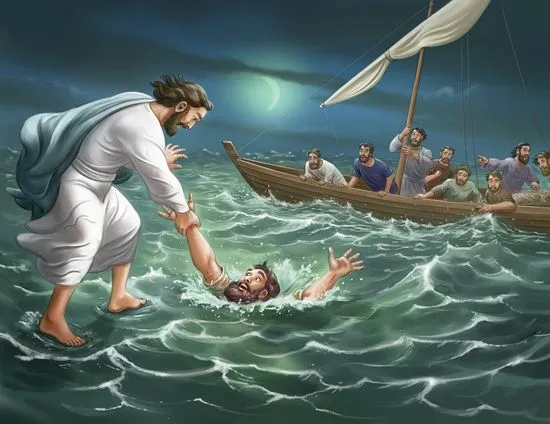
“Lord, help me!” (Matthew 14:30)

I’m Sorry

Confession and repentance is perhaps the most important aspect of the Christian life. Martin Luther penned in his 95 Theses that the entire life of a believer is to be one of repentance. Both Jesus and John the Baptist preached to “Repent and believe the good news!” John (not John the Baptist) tells us “If we confess our sins, he is faithful and just and will forgive us our sins and purify us from all unrighteousness. If we claim we have not sinned, we make him out to be a liar and his word is not in us” (1 John 1:9-10).

Jesus paid the penalty for all of our sins when he died on the cross. That is why John says that God is just, not merciful, to forgive our sins when we confess them. It is just of God to forgive that which has already been paid. We can be honest with God about our sin without fear of rejection. It’s not like he will be surprised by what we say. These prayers can look something like:

“Father, I’m sorry that I lashed out in anger today. I’m sorry for the ways that I live like I don’t need you. I’m sorry that I’m so often inconsiderate of others. I’m sorry for the good things that I didn’t do today. I’m sorry that I so often forget to spend time with you.”

Concluding Thoughts

Theses prayers are not rigid categories. There will often be overlap. For example, “Father, thank you for blessing me with children. Help me to love, protect, and steward them well. I’m sorry for when I forget that they are a gift from you and get frustrated with them. Thank you that you are the true Father that they need. Help them to put their faith in you.”

“Thank you . . .”

“Help . . .”

“I’m Sorry . . .”

Remember THIS. Change your life.

Life Direction Questions: Knowing and Finding What You Seek

What are you looking for? What are you looking at?

These two vision questions can tell you almost everything you need to know about the direction and quality of your life. “What are you looking for?” tells you what you hope for in the future. “What are you looking at?” tells you how you are living in the present. Let’s dive in.

What Are You Looking For?

This is the first question Jesus asked his would-be disciples (John 1:38). Were they looking for a magician? A job? A meal for the night? A teacher? A Messiah? Jesus’ question went straight to their heart.

Psalm 121 declares, “I lift my eyes towards the mountains. Where will my help come from? My help comes from the LORD, the Maker of heaven and earth” (Psalm 121:1-2). Notice how the Psalmist connects vision and hope. He lifts his eyes and waits for a Savior.

Jesus tells us to seek (look for) first the kingdom of God (Matthew 6:33) rather than chasing trivial things like food, clothing, and shelter.

What do you hope for? What is your telos, the thing that pulls you forward in life? What do you think will make everything better? When you picture “the good life,” what do you see? What goals are you pursuing?

If my vision of the good life is that everyone thinks that I am smart, how might that impact my life? I will probably stay up to date on topics of conversation. I might have some quotes in mind from reputable people. Maybe I keep my mouth shut when I don’t know the answer, rather than risk seeming foolish. I’ll probably be hesitant to enter into unknown areas. I hope you can see that this good life vision is seriously lacking. I need to look higher.

Everyone has a greatest good that they are striving for. It is impossible not to. The quality of your life is largely determined by what good you pursue. According to Henry David Thoreau, “In the long run men only hit what they aim at. Therefore, though they should fail immediately, they had better aim at something high.” What should we aim at?

The Westminster Catechism teaches that the chief [purpose] of humanity is to glorify God and to enjoy him forever. People were created to make much of God. To love him, trust him, obey him, and treasure him. We are to find our ultimate identity in God alone.We commit idolatry when we build our lives on anything other than Christ.

I previously wrote that the one either builds their life on God, or they find their worth in their performance, possessions, or reputation. You are what you do, you are what you have, you are what others think of you. If you look for ultimate value in created things you will always be disappointed.

What might our lives look like if we continually ask ourselves, “Will this glorify God?”

What Are You Looking At?

Vision is a big factor in most areas of life. It was crucial in every sport that I played.

In baseball, whether in the field or at bat, you always have to keep your eye on the ball. “See ball, hit ball.”

In basketball, you need to have your eyes up when you’re dribbling to make the correct pass. On defense, you need to see ball and see man.

Defensive backs, get in trouble when their eyes are in the backfield. They get fooled by play-action or don’t see the receivers because they get stuck watching the quarterback. Quarterbacks need a good tackle to protect their blind side. Defensive lineman watch the football and don’t move until it does.

Almost 30% of car crashes are caused by distracted driving. Their eyes were not on the road.

We live in an attention economy where companies profit off of our attention. The more time you spend on a given app or website, the more money the company makes off of you.

What we look at also impacts mental health. Research has shown a correlation between increased screen time and increased levels of depression, anxiety, and other mood disorders. One study found that adolescents who spend more than five hours per day on digital devices are 70% more likely to have suicidal thoughts or actions than those who spend less than an hour a day.

The quality of your life is determined by how you invest your time and attention. The quality of your relationship goes down if you are looking at your phone instead of your loved ones. Am I looking at the bible or social media? Am I looking at good books or the TV? Am I looking at my work or scrolling news sites?

In The Ruthless Elimination of Hurry, John Mark Comer writes, “What you give your attention to is the person you become. Put another way: the mind is the portal to the soul, and what you fill your mind with will shape the trajectory of your character. In the end, your life is no more than the sum of what you gave your attention to.” What we look at is an indication of what we most value. I give my attention to news sites because I want to be knowledgeable (or feel morally superior by seeing what the other side just did). I end up binge-watching TV shows because I desire entertainment and closure. I look up sports scores because I emotionally share in the successes and failures of my favorite teams.

What we look at gives us a clue to what we are looking for. We must be diligent to train our eyes to focus on the right thing at the right time. Our lives depend on it.

“Fixing our eyes on Jesus, the pioneer and perfecter of faith. For the joy set before him he endured the cross, scorning its shame, and sat down at the right hand of the throne of God” (Hebrews 12:2).

Teach Us to Pray

Prayer is often difficult. It is hard to make time for it, hard to stay focused, and hard to know what to say. When Jesus’ disciples asked him to teach them how to pray, he gave them the Lord’s Prayer (Luke 11:1-4).

Another prayer tool I have learned is called the ACTS model. ACTS stands for:

  • Adoration: What is a characteristic of God that you appreciate?
  • Confession: In what ways are you falling short of God’s standard for you?
  • Thanksgiving: What good has God already done for you?
  • Supplication: What do you want/need God to do for you?

In the following, I will show how the Lord’s Prayer and ACTS prayer can be blended. The process involves meditating on each phrase of the Lord’s Prayer and reflecting on what it means for our lives. In each phrase I will state what is true about God, where I fall short, why I am thankful, and what I want God to do.

“Our Father in Heaven”

  • Adoration: “You have given us the Spirit of adoption, by whom we cry ‘Abba! Father!’ You are a great and merciful Father. By your grace you have turned orphans, rebels, and enemies into sons and daughters and co-heirs with Christ.”
  • Confession: “But so often I don’t live like a son. I am the younger son who wants your stuff, but not a relationship with you. I am the older son who believes that I can earn your love if I do enough good things (Luke 15).
  • Thanksgiving: “I thank you for your grace. By your grace I can boldly approach your throne, completely accepted as your child. Thank you that I am yours and you are mine forever.”
  • Supplication: “There are many who do not call on you as Father. They are stuck in their sins and have no concept of your love and compassion. Would you open their eyes to see your goodness and receive you as their true Father?”

“Hallowed Be Your Name”

  • Adoration: “Holy, holy, holy, is the Lord God Almighty. There is no one like you. Let your name be honored as holy.”
  • Confession: “So often I treat you as common. I forget how holy and great you are. I try to make a name for myself rather than glorifying your name.”
  • Thanksgiving: “Thank you that through Jesus you made a way for sinners to be in your presence. You are unapproachable, yet in Christ you made it so we could approach you.”
  • Supplication: “I want to see more people worship you and lifting your name on high. Would you change hearts so they praise your holy name?”

“Your Kingdom Come, Your Will Be Done”

  • Adoration: “Your kingdom is not of this world. It is pure, true, and just. Your kingdom is a priceless pearl. Your will is good, pleasing, and perfect. Your thoughts are not my thoughts and your ways are not my ways. Your plan is so much higher than I could ever comprehend.”
  • Confession: “I often don’t live according to your kingdom. I am selfish. I neglect the needy. I don’t speak the truth in love. I don’t seek your face as I should. I want my own will to be done. I don’t believe that your plans for me are good.”
  • Thanksgiving: “Thank you that you delight to give us the kingdom. Thank you that your will cannot be thwarted.”
  • Supplication: “Would your kingdom of light and love push against the kingdom of sin and darkness both in the world and in my heart? Would you help me to trust that your ways are better than mine? Let your will be done in and through me.”

“Give Us This Day Our Daily Bread”

  • Adoration: “You are a good Father who gives good gifts to your children. The earth is yours and everything in it. All things are dependent on you. You are the Creator of everyone and everything.”
  • Confession: “Forgive me when I live like I don’t need you. When I am ungrateful for the good gifts you provide. When I feel entitled to more than you’ve given. When I envy those with more than me.”
  • Thanksgiving: “Thank you for the good gifts you provide. You have provided jobs. You provided skilled workers to produce and serve food. Every day that I have enough to eat is a miracle, for which I am grateful.”
  • Supplication: “Please provide what I need. I also lift up those who are suffering and don’t know where their next meal is coming from. Give them their daily bread too.”

“Forgive Us, As We Also Have Forgiven Others”

  • Adoration: “You are gracious and compassionate, slow to anger, abounding in love and faithfulness, maintaining love to thousands of generations, and forgiving wickedness, rebellion, and sin. You know all things, yet you cast my sins into the sea of forgetfulness.”
  • Confession: “My sins are many and are ever before me. I haven’t loved you with my whole heart or loved my neighbor as myself. I also hold grudges even though love keeps no record of wrongs.”
  • Thanksgiving: “Thank you that because Jesus died on the cross, there is forgiveness of sins. ‘The wages of sin is death,’ and Jesus paid it all. Thank you for your priceless sacrifice.”
  • Supplication: “Bring to mind my sins and how I am falling short. Forgive me, Father. Give me the love and grace to forgive those who have wronged me. Help those who are far from you find forgiveness.”

Lead Us Not into Temptation, but Deliver Us from the Evil One

  • Adoration: “You are the good shepherd. You lead us beside still waters. You protect us in the valley of the shadow of death. You are stronger than evil. You are our shield, our fortress, and our deliverer. Lord, you are a mighty warrior.”
  • Confession: “I confess how often I lead myself into temptation. I get distracted from the path you called me to walk and befriend evil. I forsake your wisdom and the Spirit within me. I don’t live out the freedom you bought for me with Christ’s blood.”
  • Thanksgiving: “Thank you that you have given your Holy Spirit and your Word to lead us and guide us. Thank you that Jesus defeated sin and death when he rose from the dead. Thank you that by trusting in Jesus we share in your victory.”
  • Supplication: “Lead us, guide us, and protect us. Satan is like a roaring lion, seeking to devour. Help us to stand firm and trust in you. May we not be overcome with evil, but overcome evil with good.”

For Yours Is the Kingdom, and the Power, and the Glory Now & Forever. Amen

The Telos of Fight Club

Today is the movie Fight Club‘s 25th anniversary. Fight Club is a movies that I never get tired of watching. It’s perspective on masculinity, consumerism, and purpose in life challenges me think more deeply. There are many things about this film that I could write about (and probably will in the future), but today I will consider what this movie shows about telos.

Telos is a Greek word meaning “goal, end, or purpose.” According to James K. A. Smith in the book “You are What You Love”, “Our telos is what we want, what we long for, what we crave. It is less an ideal that we have ideas about and more a vision of ‘the good life’ that we desire. It is a picture of flourishing that we imagine in a visceral, often-unarticulated way—a vague yet attractive sense of where we think true happiness is found.”

All of us have a vision of “the good life” that determines what we do and how we do it. We have an idea of what would make life better for us, and we build our lives around that end (consciously or unconsciously). I turn now to consider the telos of the narrator and Tyler Durden. I am not endorsing either of their views, I am simply using them as examples.

The Narrator’s Telos

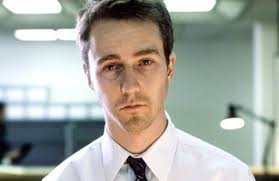
After his condo blew up and all of his possessions were destroyed, the narrator (Ed Norton) and Tyler Durden (Brad Pitt) went to a bar for drinks. He laments to Tyler, “When you buy furniture you tell yourself, ‘That’s it. That’s the last sofa I’m gonna need. Whatever else happens, I have that sofa problem handled.’ I had it all. I had a stereo that was very decent. A wardrobe that was getting very respectable. I was close to being complete.

The narrator felt like something was missing in his life. He had lost faith in God. When his parents divorced he lost faith in family. After the bloodshed of the 20th century he also lost faith in people. He had no meaningful relationships. He suffered from insomnia, likely from the existential angst he felt. He only found relief by attending support groups for people with terminal illnesses. While he was there, he used a fake name. He existence was basically anonymous. The only way to make the feeling of emptiness go away was to buy the right things. How did he pay for those things? He worked many hours at a morally ambiguous company. His life was an endless cycle of working and buying.

His telos was having the right possessions, and that dictated how he spent his time. He thought he could work enough to then buy his way into contentment, but it still left him empty. The things he owned, ended up owning him.

Tyler Durden’s Telos

Tyler Durden’s vision of the good life is quite different. He says, “In the world I see – you are stalking elk through the damp canyon forests around the ruins of Rockefeller Center. You’ll wear leather clothes that will last you the rest of your life. You’ll climb the wrist-thick kudzu vines that wrap the Sears Tower. And when you look down, you’ll see tiny figures pounding corn, laying strips of venison on the empty car pool lane of some abandoned superhighway.”

Tyler was “enlightened.” He sensed the meaninglessness and directionlessness of modern society. He saw that society was smothering people’s’ souls. In hunter/gatherer societies, there was a clear challenge of obtaining enough food to survive. Modern man (generally speaking) doesn’t have that problem. Affluence left people feeling empty. What was his solution? Tear it all down.

He began by starting fight club, a place where men can unleash their suppressed aggression. From there he recruited members to join project mayhem. Project mayhem was a terrorist organization that committed many acts of violence and vandalism. All of this culminated in a plan to blow up credit card buildings to erase the debt record so everything would reset to zero.

Tyler wanted chaos. He thought that by tearing down society, individuals would be free. “It is only after we’ve lost everything that we are free to do anything.” For Tyler, society was so bad that going back to a time before modern technology was the only answer. He worked tirelessly to bring about the world’s destruction.

What is Your Telos?

What about you? What is your vision of the good life? What do you believe will make everything better? For some it is being respected, for others it is being loved. Maybe yours is having a great career and status, or looking a certain way, or being at ease. If you are struggling to discern you telos, start by examine your emotions, how you spend your time, and how you spend your money.

According to the Westminster Shorter catechism, “The chief end of man is to glorify God, and to enjoy him forever.” The telos for which God created us was to be in union with him. We were made to know, love, trust, and obey God. Jesus said that the greatest command is to love God and to love your neighbor. Jesus made a way for us to be in union with God by dying on the cross for our sins. Because of the sin that lives in us and the complexity of our world, we will always have mixed desires. A good first step is to name what you want and why. To do so, finish these three sentences: “I want to live in a world where . . .” “so that . . .” “Therefore, I will . . .” This article goes into more depth.

Rethinking Your Narrative: Unlocking Potential

In his book Mind Your Mindset, Michael Hyatt’s main idea is that “[Many] challenges people face— in fact, nearly all of them— are essentially (1) based in the brain and (2) evident in the stories we tell ourselves about reality.”

The stories we tell ourselves inform how we see the world and act within it, including how we pursue our goals. Our narratives determine what goals we set and how successful we are in achieving them. Storytelling is a function of how our brains conceive and represent reality, and our results depend to a large degree on how good our storytelling is.

Hyatt argues that when our stories leave us in a rut, we need to rethink our thinking by adopting a different vantage point. We must examine the stories our brain is telling, and imagine better, more empowering narratives. To do this we must:

First, identify your problem and your story about it. Improvement begins with awareness. Many of the invisible scripts we live are holding us back, and we might not even know it. You might have unexamined stories about money, people of different backgrounds, or what your are capable of achieving. For example, a story someone might tell themselves is, “I can’t get out of debt because I am not good with money.” This will likely turn into a self-fulfilling prophecy.

Second, interrogate the story. Many of the stories we tell ourselves are flawed. We need to separate what’s factual from what’s merely opinion, inference, conjecture, and the like. Take the phrase “I’m not good with money.” You can interrogate that by asking, “Why do you say that? Have you done any research? Read any books or articles? Asked any friends or mentors? Tried anything to improve? If you haven’t taken any steps, how can you say you are bad at money?” In this stage you have to challenge your assumptions to separate what is helpful and what is holding you back.

Third, imagine a more empowering story. Once we’ve exposed our faulty stories, we can use our brain’s natural ability to rewire itself to find new paths and solutions. Continuing with the money example, what if instead of “I’m not good with money” you said, “I have struggled with money in the past, but money is a skill I am committed to master.”

I think Henry Ford’s quote rings true, “Whether you think you can or think you can’t, you’re right.” Obviously, this isn’t absolutely true. There are plenty of sports teams and businesses who believed that they would succeed but didn’t. However, the belief that they would succeed gave them a fighting chance.

Kairos Circle

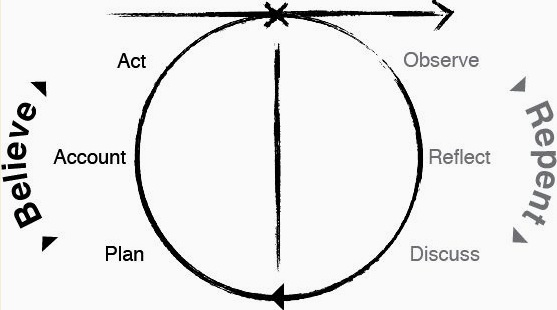
Hyatt’s framework of Identify, Interrogate, and Imagine pairs nicely with Mike Breen’s Kairos Circle.

In the image above, the arrow represents time. You are going about your life when a significant moment occurs (the X). The moment could be an emotional response, a tragic event, a meaningful conversation, or reading something profound. When the significant moment arrives, we have a choice. We can ignore it and keep doing what we are doing, or we can enter the learning circle.

The first step is to observe. Gather the facts. What happened? What did you feel? This fits with identifying your current narrative.

The next step is to reflect. This is where you ask “why?” and “how” questions. When you reflect you go under the surface. The purpose is to move from a false narrative to one that is truer. However, we can’t do this alone, we must discuss. We need other people to speak truth, love, and wisdom. Everybody has blind spots, so having a trustworthy person to speak with is crucial. The purpose of observing, reflecting, and discussing is to ultimately move you from a false belief to a true one. The Greek word “repent” means to change one’s mind. We must turn from false mindset about God or the world and turn to what is true.

I will use a scene from the Kung-Fu Panda to illustrate.

Master Shifu tells Master Oogway that notorious kung-fu villian, Tai Lung, escaped from prison (kairos moment). Although it is the Dragon Warrior’s destiny to defeat him, Shifu doesn’t believe that Po the panda is really the Dragon Warrior because he was unlike anyone he ever trained. Po must have been chosen by accident. He tried to control the situation by forcing Po to quit. Oogway tells Shifu that there are no accidents, and that Shifu must give up the illusion of control in order to fulfill his destiny. This is the moment when Oogway gets Shifu to imagine a better story:

Shifu: A peach cannot defeat Tai Lung!

Oogway: Maybe it can. If you are willing to guide it. Nurture it. Believe in it.

Shifu moved from a false narrative to a better narrative and that changed everything. He realized that Po had potential, but he would need to train him differently in order to unlock it. Oogway helped Shifu identify his limiting belief, interrogate its validity, and imagine a better way.

What about you? What stories are you currently living? How are they holding you back from the life God has for you?

The Case Against “Should”

“Should” is a weird word. We all use it multiple times a day, yet I struggle to define it. According to dictionary.com, “should” is an auxiliary verb meaning “must; ought (used to indicate duty, propriety, or expediency).” It can also be used to express an expectation: “They should be here soon,” or express a correction: “That semicolon should be a comma.”

Outside of giving or asking for advice, I think “should” should be avoided. The way we use that word today is often not helpful, and different vocabulary would serve us better. Here are some problems with “should.” It is non-commital, not actionable, isn’t honest, and it produces a vague feeling of guilt. Let’s explore these more deeply.

It is Non-Commital

How often have acquaintances said, “We should hang out sometime,” and then never hang out? By saying “we should hang out” you get the feeling that you are a caring and friendly person without having to put in any effort to follow through. Imagine a man says to his date, “We should get married.” Ladies, would you consider that a satisfying proposal? I think not.

Instead of saying “should” you could say, “I want to hang out with you, is there a good time when we could get together?” This phrasing takes for granted that the other person would want to get together with you. If you are less sure of the relationship you could ask, “Do you want to hang out?” This is more vulnerable and allows for the possibility of being rejected, but it is more likely to result in hanging out with a friend.

It is not an Action Verb

I often hear people say, “I should do X more.” It could be praying, calling loved ones, going to the gym, etc. However, just because you know that something would be good for you doesn’t mean that you will do it.

What would happen if you substituted “should” with “I need to . . .” “I want to . . .” “I will . . .” or “I get to . . .”?

“Need” indicates necessity. If you aren’t doing what you say you need, is it really necessary to you? “Want” indicates desire. Why wouldn’t you do what you want? “Will” indicates a commitment to action. It is still possible for people to break their commitments, but making a verbal commitment makes it more likely that you will follow through. “Get to” reframes your thinking from an obligation to an opportunity. “I get to pray,” sounds more positive than “I should pray.”

It is not Honest

Often when people say things like, “I should go to the gym,” what they are really saying is, “I know going to the gym would be good for me, but I really don’t want to go.” There is an internal conflict between wanting to be more fit and staying cozy. We all have conflicting desires. There is a battle between the flesh and the Spirit, and between what I want now and what will be better for me in the future. By naming the lesser desire its power over you weakens.

Consider the phrase, “I should pray more.” What is the unspoken “but” at the end of the sentence? “I should pray more, but I don’t know how, I don’t have time, I don’t believe it will do anything for me, etc.” By naming the hesitation you can then make a plan to move forward.

It Produces a Vague Feeling of Guilt or Regret

One of the ways “should” is helpful is in learning from mistakes. For example, “I should have made a reservation instead of just showing up at the restaurant.” It can express regret in such a way that you can make a better decision in the future.

However, it is unhelpful when disconnected from a specific action. Phrases like, “I should be doing more,” “I should be farther along than I am,” or “I should be more like that person,” make us feel a vague sense of guilt and shame. I believe it is better to feel a specific feeling of guilt. For example, if you said, “I need to complete these three tasks this week,” and you didn’t do them, you can feel guilty specifically about not doing what you needed. This is more productive than a vague feeling of not doing enough.

A counselor named Chip Dodd calls “should” the language of toxic shame. He says S.H.A.M.E. stands for “Should Have Already Mastered Everything.” We become contemptuous of our shortcomings and our neediness. We can’t accept ourselves for who we are, so we declare what we should be instead.

Whenever you catch yourself saying, “I should . . .” ask yourself “Why?”. Why should you be stronger? Why should you look for a new job? Why should you be farther along? When we ask these questions we get to the heart of our desire. We see what is, what can be, and then decide a next step to get to where you want to go.

Remove “should” from your vocabulary and change your life.

Chariots of Fire: Why Do You Run?

Last week I discussed how people are either driven by love or fear. According to John Lennon, “There are two basic motivating forces: fear and love.” Today, I wanted to show how these motives are lived out. I will examine Harold Abrahams and Eric Liddell from the movie Chariots of Fire.

Harold Abrahams

There are three conversations that shows the heart and mindset of Harold Abrahams. The first comes while he is at dinner with Sybil Gordon:

Sybil Gordon: Do you love running?

Harold M. Abrahams: I’m more of an addict. It’s a compulsion, a weapon.

Sybil Gordon: Against what?

Harold M. Abrahams: Being Jewish, I suppose.

Sybil Gordon: [laughs incredulously]  You’re not serious!

Harold M. Abrahams: You’re not Jewish, or you wouldn’t have had to ask.

Harold was always an outsider because he was a Jew in a Protestant world. No matter what he did he never quite fit in and was never fully accepted. If he couldn’t be accepted just for being himself, he had to earn his place in society by being the best runner.

The next scene shows Harold after he lost a race to Eric Liddell. A distraught Abrahams was lamenting to Sybil, to which she said:

Sybil Gordon: If you can’t take a beating, perhaps it’s for the best.

Harold M. Abrahams: I don’t run to take beatings. I run to win. If I can’t win, I won’t run!

Sybil Gordon: If you don’t run, you can’t win.

Being the best was his sole motivation. He had no joy in competing, only in winning. Coming in second was almost enough for him to give up running altogether.

In the final scene, Abrahams is getting ready to run in the 100 meter dash final at the Olympics. He is speaking to his best friend (Aubrey), sharing his fears and doubts about the race.

Harold M. Abrahams: You, Aubrey, are my most complete man. You’re brave, compassionate, kind: a content man. That is your secret – contentment; I am 24 and I’ve never known it. I’m forever in pursuit, and I don’t even know what I am chasing . . . And now, in one hour’s time, I will be out there again. I will raise my eyes and look down that corridor – 4 feet wide, with 10 lonely seconds to justify my whole existence. But will I? Aubrey, I’ve known the fear of losing – but now I am almost too frightened to win.

Never feeling contentment, constantly striving, feeling that his entire worth depends on winning this race. It is heartbreaking to hear Harold share the burden he feels. If you are reading this, you likely aren’t preparing to win an Olympic gold medal. But are there other ways that you are trying to justify your existence? Is it through a relationship? a job? an accomplishment?

Eric Liddell

Eric Liddell also represented Britain in the Olympic Games. The challenges that he faced seem to be more external than internal. The first opposition to his running came from his sister. She believed that running track was a waste of time and that Eric should go back to China to serve as a missionary. He tells his sister:

Eric Liddell: I believe that God made me for a purpose, for China. But he also made me fast. And when I run I feel his pleasure. To give it up would be to hold him in contempt.

Eric was secure in who God made him to be. For Harold Abrahams, running was a weapon, a means of earning acceptance from a society who saw him as an outsider. For Eric Liddell, running was a form of worship. He knew that he was loved and accepted by God, so he didn’t have to run to justify his existence. “When I run I feel his pleasure.” He felt freedom to use the gifts that God gave him to the best of his abilities.

Eric was so secure in his identity in Christ that he refused to run a race on the Sabbath. He had a strong conviction to keep the Lord’s day holy, and for him that meant that he would give up a chance at winning an Olympic gold medal in order to follow God. In doing so, he upset a lot of people and was accused of not loving his country. Because he knew that he was loved and accepted by God, he didn’t need the approval of people.

Love or Fear?

When you consider your life, do you feel more like Harold Abrahams or Eric Liddell? Do you work hard in order to earn love or do you work hard because you are loved?

“It is for freedom that Christ has set us free” (Galatians 5:1). When I see Harold Abrahams I don’t see a man who is free. I see a man who is scared, burdened, and angry. When I see Eric Liddell, I see passion, courage, peace, and joy. He knows who he is and what his purpose is.

God offers you this same freedom. Jesus died on the cross for all the wrong things you have done, thought, or said. If you have faith in Jesus you can be accepted into God’s family forever. You can’t earn this love and acceptance, rather Jesus earned it on your behalf. In Christ, we can live, work, and love freely and lightly.

Pastor Tim Keller wrote, “If our identity is in our work, rather than in Christ, success will go to our heads, and failure will go to our hearts.” If we are defined by what we do, we will boast when things go well and wallow in self-hatred or live in denial when things go poorly. We were made for more.

Love or Fear

I came across a quote by John Lennon that said, “There are two basic motivating forces: fear and love.” I don’t fully agree with his conclusion, but I still think that this observation is profound. Consider, why do people work hard at their job? Some work hard because they love what they do and are loving others by what they create. Others work hard out of fear of failure, fear of disappointing their boss, or out of fear of not having enough.

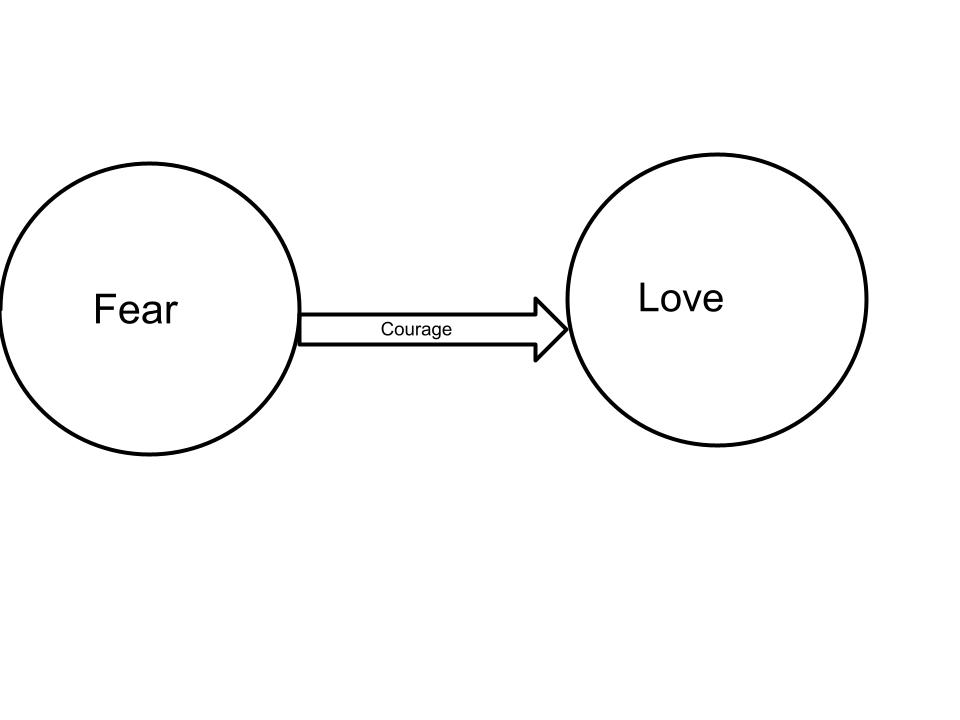
I think it is useful to simplify what we do in life into two motivations. A reflection question I’ve been asking myself is, “Is love driving me right now or is fear?” If I can’t honestly say “love,” then I know I need to adjust my course. To move from fear to love takes courage. Courage is not fearlessness, rather it is taking loving action even when you feel afraid.

Lennon’s quote seems in line with the bible. First John 4:18 says, “There is no fear in love. But perfect love drives out fear because fear has to do with punishment. The one who fears is not made perfect in love.” This verse suggests that love and fear are incompatible, but what does John mean what he says fear? “Fear has to do with punishment . . .” The fear that John is talking about is fear of standing before God’s judgement. He says in v. 17 that if we live in love as Jesus did, we will have confidence in the day of judgement. When we do good for others out of fear that God will punish us, we make our good deeds about ourselves and not the other person.

My critique of Lennon’s quote is that there are things in life such as hunger, thirst, or sexual lust don’t fit into the love/fear binary. I don’t think the root of hunger has to be a love for living or a fear of starving. Hunger can just be hunger. Also, I don’t think fear and love are always mutually exclusive, but first let me define my terms.

Love, Fear, Desire

Fear is an emotional and physical response to perceived danger or threat (real or imagined). Everybody feels fear, the question is, will fear keep you from living the life God has for you?

I define love as desiring the good of another. Love is often accompanied by feelings of joy and delight, but also opens the door to heartbreak. We can choose love even when we don’t feel like it.

We feel desire whenever we want or feel like we are lacking. It is the force that drives us to act. We can think of desire as the drive to meet your internal wants and needs. Desire is neither inherently good nor bad. Factors such as the magnitude of the desire, the object of the desire, and the means by which you fulfill the desire will determine whether it is right or wrong. We also have competing desires within us. For example, the desire to get fit and the desire to stay on the couch.

In his book You Are What You Love, James Smith explains how desire (eros) with love (agape) are connected yet distinct. “In its truest sense, eros signals a desire and attraction that is a good feature of our creaturehood. Instead of setting up a false dichotomy between agape and eros, we could think of agape as rightly ordered eros: the love of Christ this is shed abroad in our hearts by the Holy Spirit is a redeemed, rightly ordered desire for God. You are what you desire.” Aligning our desires to God’s will is the lifelong work of following Jesus.

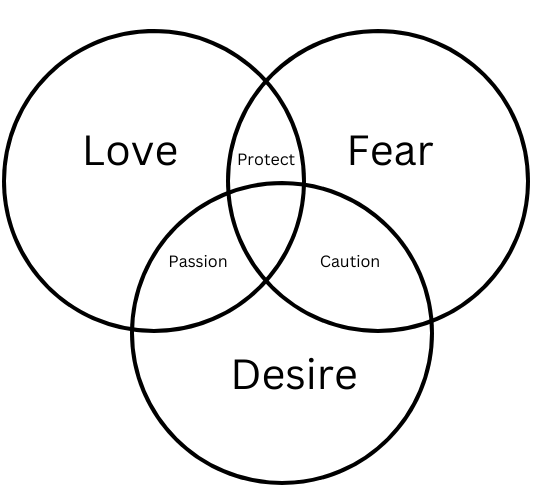
There may be some situations in which love, fear, and desire are all present. A man might be attracted to a woman (desire). Maybe he also realizes that being with him will help her to flourish and become more who God created her to be (love). But, at the same time, he his terrified that she will reject him (fear). Below is a graphic that shows how love, fear, and desire can overlap.

Imagine a hungry hunter who is stalking a bear. He is motived by his desire to kill the bear and harvest it’s meat for food, but he should also be keenly aware that the bear could easily maul him to death (fear). His best course of action will be to proceed with caution. Now imagine that the same hunter has his ten year old son with him. When they come across the bear the father will put himself between his son and the bear to protect him. After he kills the bear, they have a feast and rejoice together in the spoils of their labor. Out of love for his family and his desire to eat, the hunter faced his fear.

I think everyone should work to answer: “What do I want? Who do I love? and What am I afraid of?” We so often go through life without seriously considering why we do what we do. Examining which motivations drive us is a great starting place to living a meaningful and intentional life.

“There are two basic motivating forces: fear and love. When we are afraid, we pull back from life. When we are in love, we open to all that life has to offer with passion, excitement, and acceptance. We need to learn to love ourselves first, in all our glory and our imperfections. If we cannot love ourselves, we cannot fully open to our ability to love others or our potential to create. Evolution and all hopes for a better world rest in the fearlessness and open-hearted vision of people who embrace life.”

John Lennon

How to Change the World

My theory is that the best way to change the world is to live your life as if your own sin is the biggest problem in the world. I want to examine wisdom from different times, cultures, and faith traditions that are all getting at this same point.

One caveat before we dive in: I wouldn’t apply this teaching to someone who has just experienced trauma. There are times when the sin and brokenness of the world comes knocking at your door, and you first need time to grieve and find healing. Jesus said he wouldn’t break a bruised reed (Isaiah 42:3). Please receive this as a general principle that will be applicable to most but not every situation.

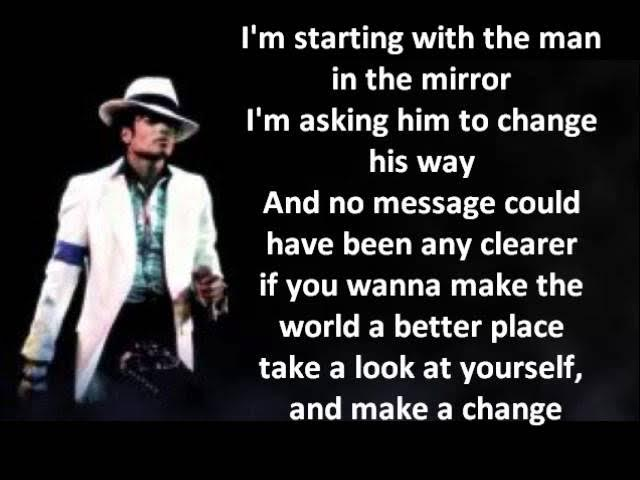
“Man in the Mirror”- Michael Jackson, 1988

In his 1988 hit song, Michael Jackson sings, “If you wanna make the world a better place, take a look at yourself and then make a change.” There are so many needs and so much brokenness in the world. It can be discouraging to feel like the world is run by corrupt governments and greedy corporations. What can one person do in the face of that much opposition?

Start with yourself, the man in the mirror. Start with what you can control. Maybe you can’t solve your cities homelessness crisis. But maybe you can show kindness and dignity to one homeless person on your way home from work.

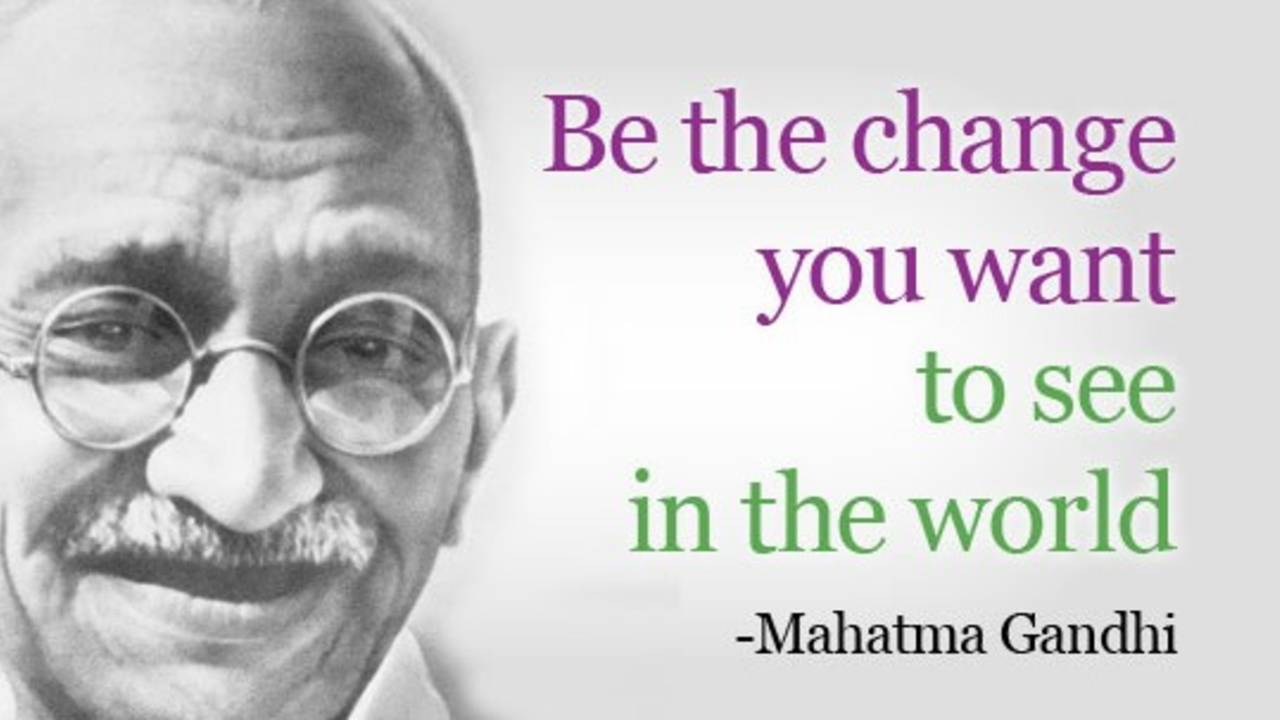
“Be the Change”

Mahatma Gandhi (1869-1948) is one of the most influential voices on non-violent resistance in history. He was influential both in fighting for civil rights in South Africa and in gaining Indian independence. He famously said, “Be the change you want to see in the world.”

Do you want to see less poverty in the world? Give to the poor.

Do you want to see less racism in the world? Befriend people who don’t look like you.

Are you tired of corrupt politicians? Run for office.

We all have to ask ourselves, “What do I want? and What am I willing to sacrifice to get it?”

“I am.”

There is a popular story where a newspaper sent out an inquiry to famous authors, asking the question, “What’s wrong with the world today?” To which G.K. Chesterton responded,

“Dear Sir,

I am.

Yours, G.K. Chesterton.”

Living in the early 20th century you might expect him to say something along the lines of war, poverty, drunkenness, factory conditions, or the poor education of the masses. But I think Chesterton is both humble enough and wise enough to first look at his internal problems rather than the external problems. I think this is where activists can go wrong. They perhaps rightly point out the wrongs and injustices that exist in the world, but can turn prideful and self-righteous if they don’t also take serious where they fall short.

In the book How People Change, Paul Tripp says, “Whenever you believe that the evil outside you is greater than the evil inside you, a heartfelt pursuit of Christ will be replaced by a zealous fighting of the ‘evil’ around you. A celebration of the grace that rescues you from your own sin will be replaced by a crusade to rescue the church from the ills of the surrounding culture.” We can end being overly critical of others when we forget that we are sinners saved by grace alone.

The Plank and the Speck

Lastly, we’ll consider Jesus’ words from the sermon on the mount:

“Do not judge, or you too will be judged. For in the same way you judge others, you will be judged, and with the measure you use it will be measured to you.

“Why do you look at the speck of sawdust in your brother’s eye and pay no attention to the plank in your own eye? How can you say to your brother, ‘Let me take the speck out of your eye,’ when all the time there is a plank in your own eye? You hypocrite, first take the plank out of your own eye, and then you will see clearly to remove the speck from your brothers eye” (Matthew 7:1-5).

A few things stand out: First, God will judge us by the same standards we judge others. This should cause all of us to pause and consider how we think about others.

Second, we are to take the plank out of our own eye first. Jesus doesn’t say that is all that we do. He still calls us to remove the speck from our brother’s eye, but only after we have removed the plank from our own eye. But what does that mean?

I think the plank is our own sin and the speck is the sins of others. Our sin should be so in our face (no pun intended) that we can’t avoid it. So often we get this illustration backwards. We think we are the ones with the speck in our eye while everyone else has the big plank. We say things like, “I would never do that . . .” “Can you believe what she said?” “At least I’m not as bad as . . .”

Deal with your own stuff first, then you can clearly see what others are going through with a sense of love and compassion. Nobody likes having sawdust in their eye. It is unloving to let someone continue in a destructive behavior, but when we fail to approach them with humility and gentleness we often do more harm than good. How might this play out in the real world?

A Hypothetical Example

Let’s say you are in a meeting and a coworker blatantly disrespects you. What do you do? Do you lash out in the moment? Gossip about what happened? Bury your anger and pretend it wasn’t a big deal? Passive-aggressively hint that something is bothering you for the next year or so? Get the incident on film and post it to social media so that he might be shamed or even cancelled? Or do you take the plank out of your eye by self-reflecting?

Maybe you start with noticing your anger. Anger itself isn’t sinful, but it points to what is important to us. Then you might consider what exactly triggered that response. Did you feel threatened or embarrassed? Did it remind you of an incident or relationship from your past?

As you go down this path you might discover that you actually have an anger problem and are hyper-critical of those around you. Or maybe you take yourself too seriously because deep down you believe that your worth as a person comes from what you do and how others think about you.

After doing this work, you can look at the situation clearly to address your coworker. You could say something like, “When you said what you said in the meeting it made me feel ________. I’m sure that wasn’t what you intended, but I would appreciate if you would be more considerate in the future. I want our team to stay unified, and your comments created unhealthy friction.”

Doesn’t that seem more productive than anything listed in the first paragraph? Maybe the coworker realizes that he resorts to sarcasm when he is under stress as a self-protection mechanism. After noticing the problem he can take steps to fixing it.

Final Thoughts

From the King of Pop to the King of Kings, the message is consistent: start with yourself. Live as if your own sin is the greatest problem in the world. Only then will you be able to make a difference in the world. Imagine how marriages, friendships, families, and organizations might look different when individuals stop blaming others and circumstances and take ownership for the wrongs they do and the good that they leave undone.

What Drives an Adventure Stories?

What compels a hero to act? As far as I can tell, the hero in an adventure story tends to be motivated by one or a combination of these three objectives:

  1. Seek Treasure
  2. Defeat Evil
  3. Survive Danger

This came to mind when thinking about the motivations of the characters in The Hobbit and the characters from Lord of the Rings. Bilbo and the dwarves set out from the Shire to reclaim their gold and home (seek treasure). Frodo and Sam left the Shire in order to destroy the ring of power, and thus destroy Sauron (defeat evil). At first I thought these might be the only two motives, but then I thought about movies like Cast Away or The Day After Tomorrow or the book Robinson Crusoe in which the main characters are trying to survive the horrible predicament they find themselves in (I guess one could argue that they are seeking life and trying to prevent death, but I think having survival as its own category makes more sense). Here is how it plays out in some other movies:

Some Examples

In Pirates of the Caribbean: Curse of the Black Pearl Jack Sparrow told William Turner, “Not all treasure is silver and gold.” Will’s treasure was Elizabeth Swan. He would do anything to rescue her, even give his own life. Jack’s treasure was a ship, which symbolized freedom. Captain Barbosa and his crew, on the other hand, sought to break the curse that they had endured for many years.

In Gladiator Maximus has all three motives. By surviving gladiatorial combat, he seeks his freedom and plots to defeat the wicked Emperor Commodus.

Similarly, Harry Potter seeks various things in the novels: the sorcerer’s stone, Ginny from the Chamber of Secrets, all of the tasks in the Triwizard Tournament, a prophecy, and horcruxes. In the process he faces plenty of danger as he pursues his ultimate goal of defeating Voldemort.

The treasure in whodunits is the truth. Hopefully by finding out “whodunit” the detective also defeats the killer.

In the Iliad the Greeks seek to recover Helen and defeat the Trojans. In the Odyssey, Odysseus and his crew try to get home.

The rebels in Star Wars set out to defeat the evil Empire.

In Die Hard John McClane tries really hard not to die (hence the name), but he also attempts to stop the terrorists.

The kids in The Sandlot recover a baseball signed by Babe Ruth.

In the world of sports the offense seeks points while the defense attempts to stop their opponents.

Why Should You Care?

I think there are at least two reasons why you should care. First, it allows you to get a sense of the overall story arc. You can then judge for yourself whether or not the motives that drive the main characters are compelling. It also helps you keep the big picture in mind when you a plot becomes convoluted. Sometimes characters go on so many side quests that the audience can lose sight of what they are really trying to accomplish.

Second, these categories can help us live out our own stories. If you wake up and imagine that you are the hero of a story, what would you do? What good are you seeking? Money? Love? Friendship? Approval? Comfort? Success? I have used this mindset when on the treadmill. Whatever goal distance I have for the day, I imagine that there is treasure on the other side. This mindset can also help you discern whether or not the things you are doing are getting the results you want.

On the other hand, what evil are you trying to defeat? Maybe it is conquering a sink full of dishes or overcoming an illness. Maybe you are working to overcome an internal struggle or addiction. Mastering the dragon within is often our biggest obstacle.

As we get older we tend to lose our childlike wonder. Days start to feel monotonous and the grind of life with our never-ending to-do lists can wear us down. Understanding the hero’s motivations can help you reframe your tasks as steps on a quest and can add a sense of grandeur to the day.

It is also useful to know that there are seasons when you will be in survival mode. If you find yourself facing a tragedy, it is okay for your goals to take a backseat for a time while you process and heal. Just as Frodo took time to recover in Rivendell, so do we need room to heal when tragedy strikes. If not, we won’t have the strength to pursue the quests we set out to accomplish.

Remember, if you want to get the gold, you have to face the dragon. We live in a world of both abundant treasure and abundant evil. May we have the courage to get out of the Shire.