Life Direction Questions: Knowing and Finding What You Seek

What are you looking for? What are you looking at?

These two vision questions can tell you almost everything you need to know about the direction and quality of your life. “What are you looking for?” tells you what you hope for in the future. “What are you looking at?” tells you how you are living in the present. Let’s dive in.

What Are You Looking For?

This is the first question Jesus asked his would-be disciples (John 1:38). Were they looking for a magician? A job? A meal for the night? A teacher? A Messiah? Jesus’ question went straight to their heart.

Psalm 121 declares, “I lift my eyes towards the mountains. Where will my help come from? My help comes from the LORD, the Maker of heaven and earth” (Psalm 121:1-2). Notice how the Psalmist connects vision and hope. He lifts his eyes and waits for a Savior.

Jesus tells us to seek (look for) first the kingdom of God (Matthew 6:33) rather than chasing trivial things like food, clothing, and shelter.

What do you hope for? What is your telos, the thing that pulls you forward in life? What do you think will make everything better? When you picture “the good life,” what do you see? What goals are you pursuing?

If my vision of the good life is that everyone thinks that I am smart, how might that impact my life? I will probably stay up to date on topics of conversation. I might have some quotes in mind from reputable people. Maybe I keep my mouth shut when I don’t know the answer, rather than risk seeming foolish. I’ll probably be hesitant to enter into unknown areas. I hope you can see that this good life vision is seriously lacking. I need to look higher.

Everyone has a greatest good that they are striving for. It is impossible not to. The quality of your life is largely determined by what good you pursue. According to Henry David Thoreau, “In the long run men only hit what they aim at. Therefore, though they should fail immediately, they had better aim at something high.” What should we aim at?

The Westminster Catechism teaches that the chief [purpose] of humanity is to glorify God and to enjoy him forever. People were created to make much of God. To love him, trust him, obey him, and treasure him. We are to find our ultimate identity in God alone.We commit idolatry when we build our lives on anything other than Christ.

I previously wrote that the one either builds their life on God, or they find their worth in their performance, possessions, or reputation. You are what you do, you are what you have, you are what others think of you. If you look for ultimate value in created things you will always be disappointed.

What might our lives look like if we continually ask ourselves, “Will this glorify God?”

What Are You Looking At?

Vision is a big factor in most areas of life. It was crucial in every sport that I played.

In baseball, whether in the field or at bat, you always have to keep your eye on the ball. “See ball, hit ball.”

In basketball, you need to have your eyes up when you’re dribbling to make the correct pass. On defense, you need to see ball and see man.

Defensive backs, get in trouble when their eyes are in the backfield. They get fooled by play-action or don’t see the receivers because they get stuck watching the quarterback. Quarterbacks need a good tackle to protect their blind side. Defensive lineman watch the football and don’t move until it does.

Almost 30% of car crashes are caused by distracted driving. Their eyes were not on the road.

We live in an attention economy where companies profit off of our attention. The more time you spend on a given app or website, the more money the company makes off of you.

What we look at also impacts mental health. Research has shown a correlation between increased screen time and increased levels of depression, anxiety, and other mood disorders. One study found that adolescents who spend more than five hours per day on digital devices are 70% more likely to have suicidal thoughts or actions than those who spend less than an hour a day.

The quality of your life is determined by how you invest your time and attention. The quality of your relationship goes down if you are looking at your phone instead of your loved ones. Am I looking at the bible or social media? Am I looking at good books or the TV? Am I looking at my work or scrolling news sites?

In The Ruthless Elimination of Hurry, John Mark Comer writes, “What you give your attention to is the person you become. Put another way: the mind is the portal to the soul, and what you fill your mind with will shape the trajectory of your character. In the end, your life is no more than the sum of what you gave your attention to.” What we look at is an indication of what we most value. I give my attention to news sites because I want to be knowledgeable (or feel morally superior by seeing what the other side just did). I end up binge-watching TV shows because I desire entertainment and closure. I look up sports scores because I emotionally share in the successes and failures of my favorite teams.

What we look at gives us a clue to what we are looking for. We must be diligent to train our eyes to focus on the right thing at the right time. Our lives depend on it.

“Fixing our eyes on Jesus, the pioneer and perfecter of faith. For the joy set before him he endured the cross, scorning its shame, and sat down at the right hand of the throne of God” (Hebrews 12:2).

Lessons on Repentance from The Greatest Showman

The Greatest Showman is a classic “rags to riches” story in which a poor boy named P.T Barnum falls in love with a rich girl. Her father does not approve of the relationship because he doesn’t believe P.T. will be able to give her the life she deserves.

Against her father’s wishes, they get married and have two daughters. Despite Barnum’s dreams for a better life, he and his family struggle financially.

After a lot of luck and a little fraud, Barnum was able to secure a loan from the bank to open the circus.

The circus became a massive success, enabling Barnum to afford the mansion of his dreams. Barnum was wealthy, but he wasn’t respected by high society. The circus was too low-brow and blue-collar for the “swells.”

As he chased the acceptance of the elite, he lost everything: his family when he was caught in a romantic scandal, his friends when he was ashamed to invite them to a party, and his business when rioters burned it down. Barnum hit rock bottom. He gained the whole world and lost his soul. Then he lost the world too.

We find P.T. where many who hit rock bottom find themselves: drinking in a bar alone. When his circus friends show up, he has an epiphany.

A Picture of Repentance

The following song is one of the best depictions of what the bible calls repentance:

“I saw the sun begin to dim
And felt that winter wind
Blow cold
A man learns who is there for him
When the glitter fades and the walls won’t hold
‘Cause from then, rubble
What remains
Can only be what’s true
If all was lost
Is more I gain
‘Cause it led me back
To you”

Barnum describes what it was like to lose everything. He went from a place that was warm and full of glitter and lights to a dim and cold place. He thought his dwelling was secure, but it became rubble.

By losing everything he realized that his family was more important than any fame or fortune he acquired.

“From now on
These eyes will not be blinded by the lights
From now on
What’s waited ’til tomorrow starts tonight, tonight
Let this promise in me start
Like an anthem in my heart
From now on
From now on”

“From now on” implies an immediate change. The things that once “blinded” him will do so no longer. He will no longer procrastinate the things he put off (like spending time with his kids). He resolved in his heart to change his priorities.

“I drank champagne with kings and queens
The politicians praised my name
But those were someone else’s dreams
The pitfalls of the man I became
For years and years, I chased their cheers
A crazy speed of always needin’ more
But when I stop and see you here
I remember who all this was for”

He spent so much time clamoring for the approval of the elite that he became addicted to their praise. He wore himself out chasing their cheers, never pausing to consider his ways. He sacrificed the greater (family) for the lesser (approval). When life circumstances forced him to slow down, he remembered that he started the circus to provide a good life for his family. He saw that the things he chased were not his true desires. It was like he was living someone else’s life and pursuing their dreams.

“And we will come back home
And we will come back home
Home again”

We were created for God. He is meant to be our home. But we all go astray and look to make our home in the world. To repent is to come back home again. It is like the Prodigal Son who rejected his father, ran away from home, and lost everything. When he was at his lowest, he realized it was better to be back with his father. And his father accepted him with open arms and a place of honor.

We sin by sacrificing the greater to the lesser. We choose created things instead of the Creator and prioritize things that are less important. My sin is on display when I scroll on my phone instead of paying attention to my son. Lying prioritizes convenience over the truth. Sloth prioritizes comfort over good deeds done in love. Those who are workaholics prioritize money and success over family, health, and worshiping God. Giving into fear prioritizes emotional and physical safety over courageous acts of love.

To repent is to see our sin, own it, ask for forgiveness, and return to God and his ways, trusting that Jesus’ death covers all of our sin. Repentance is to change your mind. P.T. Barnum thought that he would feel satisfied when people like his father-in-law accepted him. His repentance was realizing that the love of his wife and daughters was what he really wanted, and he didn’t need to earn that.

Martin Luther declared in his 95 Theses that Jesus wills for the entire life of believers is to be one of repentance. God desires for us to move from sin to freedom, not just with our actions, but also in our thoughts and hearts.

Where are you making your home apart from God? Where are you sacrificing the greater for the lesser? May God give us eyes to see where we go astray and courage to come back home again.

How Sam-I-Am Can Transform Your Selling Skills

Within Green Eggs and Ham are lessons that any entrepreneur, salesman, or recruiter should take to heart. If you sell or promote a product, service, or opportunity, you would be wise to pay attention to Sam-I-Am.

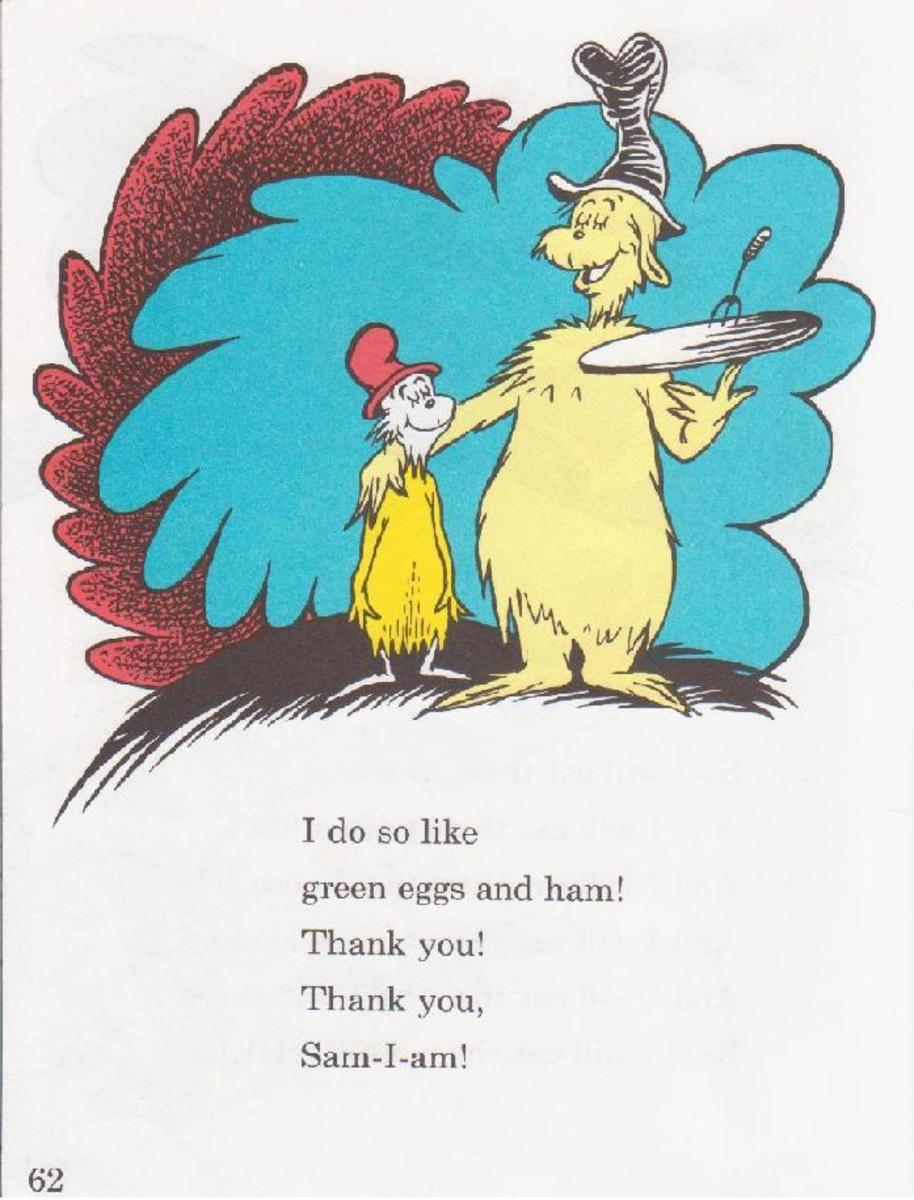
Sam-I-Am created a product that was unlike anything the world had ever seen. He knew it had the potential to transform the breakfast game. He identified one man to be an early adopter, and hopefully a life-long customer. But the man was not interested and even hostile towards Sam-I-Am. Sam-I-Am then showed great perseverance and creativity to get the man to try his green eggs and ham.

What follows are four interrelated principles we learn from Sam-I-Am:

  1. Believe in Your Product
  2. Don’t Fear Rejection
  3. Be Willing to Innovate
  4. Love Your Customers

1. Believe in Your Product

I heard someone break “enthusiasm” into two parts; Enthus and IASM. Enthus comes from the Greek “to be inspired by God/possessed by a god.” Enthus is to be captivated by an idea, and IASM is an acronym for “I am sold myself.

Do you believe in what you are selling? Are you sold yourself?

When I was a barista there were seasons when we tried to sell different promotional bags of coffee. We were supposed to tell every customer about the coffee we were selling. I struggled with this because I didn’t really believe in the product. I didn’t care whether they made our coffee at home or came to the coffee shop. It felt like an obligation when I asked people if they wanted to buy beans. I didn’t have much excitement or a sense of curiosity about what they were looking for in a product. I did the bear minimum to keep my manager happy. As a result, I didn’t sell much coffee.

“Out of the overflow of the heart the mouth speaks.” We can’t help but talk about things that are important to us and that we really believe in.

Sam-I-Am is sold on green eggs and ham. He was confident that it would make people’s lives better. (I’m going to assume that this is all organic, free-range, with no added hormones or preservatives). We can tell he believes in his product by how he perseveres and remains optimistic in the face of rejection. Which brings us to the second point.

2. Don’t Fear Rejection

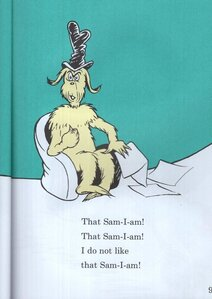
Green Eggs and Ham begins with a man asserting that he does not like Sam-I-Am. It is unclear why he has this negative bias. When Sam-I-Am offered green eggs and ham, the man refused. It is unclear if he refused because he disliked Sam-I-Am or because the product was so different.

He said “no” to green eggs and ham more than 70 times before agreeing to take a bite. Sam-I-Am was willing to face rejection because he believed in his product. He wasn’t afraid of being annoying (even though the man found him to be quite annoying).

How often do you get a “no” and never try again? Maybe someone didn’t respond to a text or answer a phone call and we assume that they don’t want anything to do with us or are annoyed by us. What if there is nothing wrong with us or the product? What if we just need to try a different way?

3. Be Willing to Innovate

When the man said he didn’t like green eggs and ham, Sam-I-Am didn’t take no for an answer. He was persistent and offered different situations in which the man could eat green eggs and ham:

  1. Here
  2. There
  3. In a house
  4. With a mouse
  5. In a box
  6. With a fox
  7. In a car
  8. In a tree
  9. On a train
  10. In the dark
  11. In the rain
  12. With a goat
  13. On a boat

Sam-I-Am was willing to change things up and find new ways to make his product appealing. He didn’t “shake the dust off his feet” and move on until he exhausted every reasonable option. He did the hard work of getting to know his customer and adapting to fit the individual.

How about you? What innovations do you need to make to communicate more effectively with your constituents?

4. Love Your Customers

Sam-I-Am loved the man enough to persevere. He believed that green eggs and ham would improve the man’s quality of life, so he creatively attempted to get the man to try them. Jesus said that there is no greater love than laying one’s life down for a friend (John 15:13). Sam-I-Am laid down his comfort, his time, and his respectability. He endured rejection and anger so that the man would have a great meal. (I am assuming that Sam-I-Am has good intentions with the man and isn’t trying to get him addicted to a product that will end killing him. I am also assuming that his primary concern is for the man, and not for the money the man may or may not give him).

If you have something that can improve people’s lives, it is loving to do whatever it takes to encourage them to try it. Whether you are a personal trainer, financial advisor, evangelist, or coach, if you believe in what you are offering and care about the quality of their lives, you will do what it takes to get a ‘yes’.

Do you love them enough to try a new approach?

Do you love them enough to hear “no” multiple times?

Are you sold yourself?

Wicked Theology

I recently saw Wicked in theaters and was impressed. The songs were great, the world was bright and colorful, and the cast had great chemistry. However, I struggle with movies that reimagine a classic villain as misunderstood rather than genuinely evil (Cruella and Maleficent gave me a similar feeling). I will not give a full movie review here. My focus will be on what this film says about the nature of God and morality.

Disclaimer: There are some spoilers in this review. I’d also encourage you to read Brett McCracken’s fuller review here. Brett is who I wish I could be as a writer 🙂

How Wicked Views God

In Wicked the Wizard of Oz is essentially their God. We hear phrases like “Oz bless you,” “Thank Oz!” or “What in the name of Oz!” Everyone puts their hope in the Wizard. They believe that he will deliver them from all their problems. However, Elphaba learns that the Wizard is a fraud. He has no power of his own, but uses smoke and mirrors to deceive the masses.

In the 1939 Wizard of Oz, the Wizard was portrayed as a snake-oil salesman type. He had no power but was generally well-intentioned. In Wicked, the Wizard is analogous to Hitler. He believed that people would only unite around a common enemy, so he used propaganda to turn humans against innocent talking animals.

The theology of Wicked is that God is a fraud. He has no power to save anyone, but uses rituals and deception to prop up the privileged class. He is only concerned with staying in power and maintaining order, even if it means hurting the innocent. A common critique against Christianity is that the Church is a man-made institution that only exists to prop up current power structures. Karl Marx called religion the “opiate of the masses.” Those skeptical of religion don’t see love, joy, peace, and beauty. They see shame, division, and various forms of exploitation.

The audience is left wondering, if the Wizard can’t save us, who can? The answer seems to be Elphaba.

What Makes the Witch Wicked?

Elphaba was dealt a bad hand in life. Her birth was the result of her mother’s adultery, giving her green skin. Her father hated her and children bullied her for how she looked. Despite this, she shows no moral flaws. She carries much guilt for her paraplegic sister and constantly advocates on her behalf. Her two flaws are that she struggles to control her powers and is socially awkward (which is explained by being an outcast all her life). At this end of the movie, Elphaba is clearly the hero. The Wizard is the real villain, along with the ambivalent majority who refuse to care about the oppression of animals.

At the end of Part 1 my main questions are, how/will Elphaba go bad? Will her compassion for the downtrodden slowly turn her bitter and resentful to the rest of the world? Or will she stay the same, showing everyone else to be the real villians? Also, how does her sister become the Wicked Witch of the East? In Wicked she is wheelchair-bound, shows no magical abilities, and has a crush on a boy from Munchkin Land. What will happen to make the munchkins throw a parade when a house falls on her? I’m eager to see how Part 2 will answer these questions!

What Happens when God is Dead?

Elphaba rightly advocates for the dignity of all people (including animals in that world). It is wrong to treat somebody as less than because of their skin color or physical abilities. Most people in the West would agree. One might call these truths self-evident. But why is it true?

The bible says it is because there is a God who made us in his own image. Genesis 1:27 is the basis for all human rights. “So God created man in his own image, in the image of God he created him; male and female he created them.” This is why oppression, racism, and sexism is wrong. Without God, these things are relatively immoral, not absolutely immoral (meaning in a different time and place, what we think of as bad might actually be good). If there is no God, all morality ultimately comes down to the preferences of the times. So, if the Axis had won WWII we could be celebrating Hitler as a revolutionary hero, rather than the personification of evil. Wicked shows that God is a fraud, while simultaneously calling people to high moral standards. But these standards are not rooted in anything but intuition.

In the song “Defying Gravity” Elphaba sings, “I’m through with playing by the rules of someone else’s game . . . I’m through accepting limits ’cause someone says they’re so. Some things I cannot change, but ’til I try, I’ll never know . . . And nobody in all of Oz, no wizard that there is or was is ever gonna bring me down.”

This song is a call to push past limits and to self-actualization. The message is essentially, “You are your own authority. You are free to be anything you want to be. Even the law of gravity can’t hold you back.” But everyone has limitations. We are limited by our knowledge, time, and strength. We all need to eat and sleep. It is wise to distinguish between limitations we need to accept for our own good, and arbitrary limitations we need to push beyond. G.K. Chesterton once said, “The more I considered Christianity, the more I found that while it had established a rule and order, the chief aim of of that order was to give room for good things to run wild.” God gives rules and limits no to kill our joy, but to maximize it.

If God is a fraud, like Wicked suggests, then it would make sense to play by our own rules and follow our own moral intuition. But if God is real and he is good, wise, and powerful, if he loved the world so much that he gave his own and only son to die on the cross for our sins, then we are obligated to live our lives according to that reality. Is it possible the the God who created the universe can run it better than us?

The Telos of Fight Club

Today is the movie Fight Club‘s 25th anniversary. Fight Club is a movies that I never get tired of watching. It’s perspective on masculinity, consumerism, and purpose in life challenges me think more deeply. There are many things about this film that I could write about (and probably will in the future), but today I will consider what this movie shows about telos.

Telos is a Greek word meaning “goal, end, or purpose.” According to James K. A. Smith in the book “You are What You Love”, “Our telos is what we want, what we long for, what we crave. It is less an ideal that we have ideas about and more a vision of ‘the good life’ that we desire. It is a picture of flourishing that we imagine in a visceral, often-unarticulated way—a vague yet attractive sense of where we think true happiness is found.”

All of us have a vision of “the good life” that determines what we do and how we do it. We have an idea of what would make life better for us, and we build our lives around that end (consciously or unconsciously). I turn now to consider the telos of the narrator and Tyler Durden. I am not endorsing either of their views, I am simply using them as examples.

The Narrator’s Telos

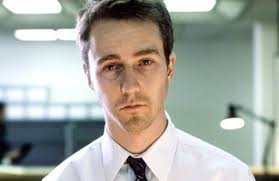
After his condo blew up and all of his possessions were destroyed, the narrator (Ed Norton) and Tyler Durden (Brad Pitt) went to a bar for drinks. He laments to Tyler, “When you buy furniture you tell yourself, ‘That’s it. That’s the last sofa I’m gonna need. Whatever else happens, I have that sofa problem handled.’ I had it all. I had a stereo that was very decent. A wardrobe that was getting very respectable. I was close to being complete.

The narrator felt like something was missing in his life. He had lost faith in God. When his parents divorced he lost faith in family. After the bloodshed of the 20th century he also lost faith in people. He had no meaningful relationships. He suffered from insomnia, likely from the existential angst he felt. He only found relief by attending support groups for people with terminal illnesses. While he was there, he used a fake name. He existence was basically anonymous. The only way to make the feeling of emptiness go away was to buy the right things. How did he pay for those things? He worked many hours at a morally ambiguous company. His life was an endless cycle of working and buying.

His telos was having the right possessions, and that dictated how he spent his time. He thought he could work enough to then buy his way into contentment, but it still left him empty. The things he owned, ended up owning him.

Tyler Durden’s Telos

Tyler Durden’s vision of the good life is quite different. He says, “In the world I see – you are stalking elk through the damp canyon forests around the ruins of Rockefeller Center. You’ll wear leather clothes that will last you the rest of your life. You’ll climb the wrist-thick kudzu vines that wrap the Sears Tower. And when you look down, you’ll see tiny figures pounding corn, laying strips of venison on the empty car pool lane of some abandoned superhighway.”

Tyler was “enlightened.” He sensed the meaninglessness and directionlessness of modern society. He saw that society was smothering people’s’ souls. In hunter/gatherer societies, there was a clear challenge of obtaining enough food to survive. Modern man (generally speaking) doesn’t have that problem. Affluence left people feeling empty. What was his solution? Tear it all down.

He began by starting fight club, a place where men can unleash their suppressed aggression. From there he recruited members to join project mayhem. Project mayhem was a terrorist organization that committed many acts of violence and vandalism. All of this culminated in a plan to blow up credit card buildings to erase the debt record so everything would reset to zero.

Tyler wanted chaos. He thought that by tearing down society, individuals would be free. “It is only after we’ve lost everything that we are free to do anything.” For Tyler, society was so bad that going back to a time before modern technology was the only answer. He worked tirelessly to bring about the world’s destruction.

What is Your Telos?

What about you? What is your vision of the good life? What do you believe will make everything better? For some it is being respected, for others it is being loved. Maybe yours is having a great career and status, or looking a certain way, or being at ease. If you are struggling to discern you telos, start by examine your emotions, how you spend your time, and how you spend your money.

According to the Westminster Shorter catechism, “The chief end of man is to glorify God, and to enjoy him forever.” The telos for which God created us was to be in union with him. We were made to know, love, trust, and obey God. Jesus said that the greatest command is to love God and to love your neighbor. Jesus made a way for us to be in union with God by dying on the cross for our sins. Because of the sin that lives in us and the complexity of our world, we will always have mixed desires. A good first step is to name what you want and why. To do so, finish these three sentences: “I want to live in a world where . . .” “so that . . .” “Therefore, I will . . .” This article goes into more depth.

Rethinking Your Narrative: Unlocking Potential

In his book Mind Your Mindset, Michael Hyatt’s main idea is that “[Many] challenges people face— in fact, nearly all of them— are essentially (1) based in the brain and (2) evident in the stories we tell ourselves about reality.”

The stories we tell ourselves inform how we see the world and act within it, including how we pursue our goals. Our narratives determine what goals we set and how successful we are in achieving them. Storytelling is a function of how our brains conceive and represent reality, and our results depend to a large degree on how good our storytelling is.

Hyatt argues that when our stories leave us in a rut, we need to rethink our thinking by adopting a different vantage point. We must examine the stories our brain is telling, and imagine better, more empowering narratives. To do this we must:

First, identify your problem and your story about it. Improvement begins with awareness. Many of the invisible scripts we live are holding us back, and we might not even know it. You might have unexamined stories about money, people of different backgrounds, or what your are capable of achieving. For example, a story someone might tell themselves is, “I can’t get out of debt because I am not good with money.” This will likely turn into a self-fulfilling prophecy.

Second, interrogate the story. Many of the stories we tell ourselves are flawed. We need to separate what’s factual from what’s merely opinion, inference, conjecture, and the like. Take the phrase “I’m not good with money.” You can interrogate that by asking, “Why do you say that? Have you done any research? Read any books or articles? Asked any friends or mentors? Tried anything to improve? If you haven’t taken any steps, how can you say you are bad at money?” In this stage you have to challenge your assumptions to separate what is helpful and what is holding you back.

Third, imagine a more empowering story. Once we’ve exposed our faulty stories, we can use our brain’s natural ability to rewire itself to find new paths and solutions. Continuing with the money example, what if instead of “I’m not good with money” you said, “I have struggled with money in the past, but money is a skill I am committed to master.”

I think Henry Ford’s quote rings true, “Whether you think you can or think you can’t, you’re right.” Obviously, this isn’t absolutely true. There are plenty of sports teams and businesses who believed that they would succeed but didn’t. However, the belief that they would succeed gave them a fighting chance.

Kairos Circle

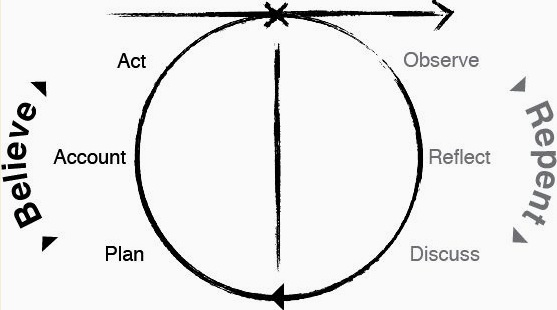
Hyatt’s framework of Identify, Interrogate, and Imagine pairs nicely with Mike Breen’s Kairos Circle.

In the image above, the arrow represents time. You are going about your life when a significant moment occurs (the X). The moment could be an emotional response, a tragic event, a meaningful conversation, or reading something profound. When the significant moment arrives, we have a choice. We can ignore it and keep doing what we are doing, or we can enter the learning circle.

The first step is to observe. Gather the facts. What happened? What did you feel? This fits with identifying your current narrative.

The next step is to reflect. This is where you ask “why?” and “how” questions. When you reflect you go under the surface. The purpose is to move from a false narrative to one that is truer. However, we can’t do this alone, we must discuss. We need other people to speak truth, love, and wisdom. Everybody has blind spots, so having a trustworthy person to speak with is crucial. The purpose of observing, reflecting, and discussing is to ultimately move you from a false belief to a true one. The Greek word “repent” means to change one’s mind. We must turn from false mindset about God or the world and turn to what is true.

I will use a scene from the Kung-Fu Panda to illustrate.

Master Shifu tells Master Oogway that notorious kung-fu villian, Tai Lung, escaped from prison (kairos moment). Although it is the Dragon Warrior’s destiny to defeat him, Shifu doesn’t believe that Po the panda is really the Dragon Warrior because he was unlike anyone he ever trained. Po must have been chosen by accident. He tried to control the situation by forcing Po to quit. Oogway tells Shifu that there are no accidents, and that Shifu must give up the illusion of control in order to fulfill his destiny. This is the moment when Oogway gets Shifu to imagine a better story:

Shifu: A peach cannot defeat Tai Lung!

Oogway: Maybe it can. If you are willing to guide it. Nurture it. Believe in it.

Shifu moved from a false narrative to a better narrative and that changed everything. He realized that Po had potential, but he would need to train him differently in order to unlock it. Oogway helped Shifu identify his limiting belief, interrogate its validity, and imagine a better way.

What about you? What stories are you currently living? How are they holding you back from the life God has for you?

Why The Good Place’s Good Place Isn’t That Good

I really like The Good Place. It is smart, funny, and poses interesting questions about morality and the human condition. The premise of the show is that Eleanor Shellstrop (Kristen Bell) dies and goes to “the Good Place.” However, she soon finds out that someone made a mistake and she doesn’t belong. She then tries to learn how to be a good person by learning moral philosophy from her soulmate, Chidi (William Jackson Harper). Will she ever be good enough to earn her place in the good place? Are things really what they appear to be? I will skip most of the plot points and focus on the final two episodes. There will be spoilers ahead if you have yet to see this series.

The Problem with the Good Place

When our heroes finally get to the real good place, we see that things aren’t quite what they expected. They quickly learn that because any desire can be met at any moment, they turn into “happiness zombies” who are numb to everything. For example, one man said, “Can I get coke?” (receives it instantly). “No, a water. No, a lamp. No, a cat. No, a spaceship. No, one huge Junior Mint. No, a coke.” Being able to get anything you want whenever you want doesn’t lead to satisfaction. Hypatia of Alexandria (Lisa Kudrow) added, “On paper, this is paradise. All your desires and needs are met. But it is infinite. And when perfection goes on forever, you become this glassy-eyed mush person.”

Another example is from Jason (Manny Jacinto). His ultimate dream was to race monkeys in go-karts, but that got boring quickly. Jason reported, “I mean, monkeys and go-karts was fun for a while. Then I was like, ‘Oh, you know what’d be cool? Hippos and go-karts.’ And I was like, ‘Yo, what about Draculas with jet packs?’ I did, like, fifty combos, and then I just kinda wanted to hang out with you guys again.”

Hypatia responded, “That’s it in a nutshell. ‘Cause you get here and you realize that anything’s possible, so you do everything, and then you’re done. But you still have infinity left. This place kills fun and passion and excitement and love, ’till all you have left are milkshakes.”

The Solution

The apparent problem of the good place is that it goes on for eternity. ” They argue that what makes a vacation special is that it eventually ends. Similarly, they “fix” the afterlife by giving everyone the opportunity to end their existence. They can walk through a magical door and their soul will no longer exist as a single entity, but will be scattered throughout the universe (similar to the Buddhist idea of Nirvana). The only way to make the good place tolerable is to have the option to commit soul suicide.

My Thoughts

The problem with the good place is not that it goes on for eternity, but that there is no God. This show correctly demonstrates that any eternity without a God who can completely satisfy our souls is hell. Ecclesiastes 3:11 tells us that God placed eternity in our hearts. We were created for God. Even if you removed all of the bad things from your life (or afterlife) and had access to any pleasure at any time, you still wouldn’t be satisfied.

But the bible describes a God who is all-satisfying. Jesus said, “Whoever drinks from the water that I will give him will never get thirsty again. In fact, the water I will give him will become a well of water springing up in him for eternal life” (John 4:14). Christians get a taste of this on earth, but it will be fully realized in the new heavens and new earth. “Look, God’s dwelling is with humanity, and he will live with them. They will be his peoples, and God himself will be with them and will be their God. He will wipe away every tear from their eyes. Death will be no more; grief, crying, and pain will be no more, because the former things have passed away” (Revelation 21:3-4).

Jesus offers the life that will never die. Because God is unimaginably great and beautiful, we never have to fear being bored in heaven. There will be a sense of peace, joy, and contentment that we always longed for but could never quite grasp on earth. Our souls will finally be home.

Chariots of Fire: Why Do You Run?

Last week I discussed how people are either driven by love or fear. According to John Lennon, “There are two basic motivating forces: fear and love.” Today, I wanted to show how these motives are lived out. I will examine Harold Abrahams and Eric Liddell from the movie Chariots of Fire.

Harold Abrahams

There are three conversations that shows the heart and mindset of Harold Abrahams. The first comes while he is at dinner with Sybil Gordon:

Sybil Gordon: Do you love running?

Harold M. Abrahams: I’m more of an addict. It’s a compulsion, a weapon.

Sybil Gordon: Against what?

Harold M. Abrahams: Being Jewish, I suppose.

Sybil Gordon: [laughs incredulously]  You’re not serious!

Harold M. Abrahams: You’re not Jewish, or you wouldn’t have had to ask.

Harold was always an outsider because he was a Jew in a Protestant world. No matter what he did he never quite fit in and was never fully accepted. If he couldn’t be accepted just for being himself, he had to earn his place in society by being the best runner.

The next scene shows Harold after he lost a race to Eric Liddell. A distraught Abrahams was lamenting to Sybil, to which she said:

Sybil Gordon: If you can’t take a beating, perhaps it’s for the best.

Harold M. Abrahams: I don’t run to take beatings. I run to win. If I can’t win, I won’t run!

Sybil Gordon: If you don’t run, you can’t win.

Being the best was his sole motivation. He had no joy in competing, only in winning. Coming in second was almost enough for him to give up running altogether.

In the final scene, Abrahams is getting ready to run in the 100 meter dash final at the Olympics. He is speaking to his best friend (Aubrey), sharing his fears and doubts about the race.

Harold M. Abrahams: You, Aubrey, are my most complete man. You’re brave, compassionate, kind: a content man. That is your secret – contentment; I am 24 and I’ve never known it. I’m forever in pursuit, and I don’t even know what I am chasing . . . And now, in one hour’s time, I will be out there again. I will raise my eyes and look down that corridor – 4 feet wide, with 10 lonely seconds to justify my whole existence. But will I? Aubrey, I’ve known the fear of losing – but now I am almost too frightened to win.

Never feeling contentment, constantly striving, feeling that his entire worth depends on winning this race. It is heartbreaking to hear Harold share the burden he feels. If you are reading this, you likely aren’t preparing to win an Olympic gold medal. But are there other ways that you are trying to justify your existence? Is it through a relationship? a job? an accomplishment?

Eric Liddell

Eric Liddell also represented Britain in the Olympic Games. The challenges that he faced seem to be more external than internal. The first opposition to his running came from his sister. She believed that running track was a waste of time and that Eric should go back to China to serve as a missionary. He tells his sister:

Eric Liddell: I believe that God made me for a purpose, for China. But he also made me fast. And when I run I feel his pleasure. To give it up would be to hold him in contempt.

Eric was secure in who God made him to be. For Harold Abrahams, running was a weapon, a means of earning acceptance from a society who saw him as an outsider. For Eric Liddell, running was a form of worship. He knew that he was loved and accepted by God, so he didn’t have to run to justify his existence. “When I run I feel his pleasure.” He felt freedom to use the gifts that God gave him to the best of his abilities.

Eric was so secure in his identity in Christ that he refused to run a race on the Sabbath. He had a strong conviction to keep the Lord’s day holy, and for him that meant that he would give up a chance at winning an Olympic gold medal in order to follow God. In doing so, he upset a lot of people and was accused of not loving his country. Because he knew that he was loved and accepted by God, he didn’t need the approval of people.

Love or Fear?

When you consider your life, do you feel more like Harold Abrahams or Eric Liddell? Do you work hard in order to earn love or do you work hard because you are loved?

“It is for freedom that Christ has set us free” (Galatians 5:1). When I see Harold Abrahams I don’t see a man who is free. I see a man who is scared, burdened, and angry. When I see Eric Liddell, I see passion, courage, peace, and joy. He knows who he is and what his purpose is.

God offers you this same freedom. Jesus died on the cross for all the wrong things you have done, thought, or said. If you have faith in Jesus you can be accepted into God’s family forever. You can’t earn this love and acceptance, rather Jesus earned it on your behalf. In Christ, we can live, work, and love freely and lightly.

Pastor Tim Keller wrote, “If our identity is in our work, rather than in Christ, success will go to our heads, and failure will go to our hearts.” If we are defined by what we do, we will boast when things go well and wallow in self-hatred or live in denial when things go poorly. We were made for more.

The Kingdom of God is like a Golden Snitch

I love the Harry Potter books and movies. My wife and I watch all 8 movies every year and frequently listen to the audiobooks before going to bed. Even if HP isn’t your thing, I hope you stick with me. Jesus often taught using parables. Following in my Rabbi’s footsteps, I want to show you how the kingdom of God is like a Golden Snitch.

Understanding Quidditch

Quidditch is a popular game in the wizarding world, consisting of seven team members on flying brooms. There are 3 Chasers, 2 Beaters, 1 Keeper, and 1 Seeker. The Chasers control the Quaffle, trying to throw it through one of three hoops which are guarded by the Keeper. Whenever the Quaffle goes through a hoop, the scoring team is awarded 10 points. The Beaters are the enforcers on the team. They protect the Chasers and Seeker from the two flying Bludgers, and also attempt to direct the Bludgers at the opposing team. The Seeker’s job is to find and catch the golden Snitch, a small golden ball that moves incredibly fast. The game ends when the Seeker catches the Snitch. By catching the Snitch, his team is awarded 150 points.

So, How is this like the kingdom of God?

1. The Value of the Snitch

First, the Snitch the most valuable object in the game. A team could be down by 14 goals and still win the game if the Seeker finds the Snitch.

Jesus tells us to seek first the kingdom of God (Matthew 6:33), and compares the kingdom of God to a man who found a fine pearl, and in his joy sold everything he owned to possess it (Matthew 13:44-46). There are a lot of things in life that we can and ought to seek. If we don’t look for a job, we won’t be able to provide for ourselves. If you don’t seek a spouse you will never have children. But seeking God’s kingdom is more important than any of these.

2. In the Game, but Not of It.

Second, the Seeker is in the game, but he is not playing the same game as the other six team members. Seekers are concerned with the Snitch and never attempt to score with the Quaffle or stop the other team from scoring.

Paul told Timothy, “No one serving as a soldier gets entangled in civilian affairs, but rather tries to please his commanding officer” (2 Timothy 2:4). There are many games that the world plays: get the most power, have the most status, sleep with the most women, accumulate the most money, to name a few. If we want to be seekers of God’s kingdom, we can’t focus on the “quaffles” around us. We all live in the world, but when you become a follower of Christ, your primary citizenship is in heaven (Philippians 3:20).

It is so easy to get distracted, but we must always recenter on the true Snitch.

3. Slow and Steady

Third, looking for the Snitch isn’t efficient. For most of the game the Seekers are sort of flying around aimlessly. It appears that they aren’t contributing to the rest of the team, but the work they are doing is vital to achieving the end result.

Jesus valued people that society did not. He spent time with children and said that the kingdom of God belonged to those who were like children (Matthew 19:14). He often withdrew to quiet places to pray even when people were begging for his attention. He spent most of his time in small villages and didn’t have much of a presence in the big city. His closest followers were uneducated, blue-collar guys rather than religious elite. Wouldn’t it make more sense to go after those with influence instead?

God’s kingdom functions differently than the world. The kingdom of God is like a mustard seed. It starts as a tiny seed, but one day will grow and spread and become the largest plant in the garden (Mark 4:30-32). Because God is patient and gracious, he often transforms us and others more slowly than we would like. This slow work allows roots to grow deep into the soil so that it can bear the weight of growth and the storms of life.

Fun fact, the average apple tree takes 4-5 years before it produces any fruit. It makes sense for spiritual fruit to behave similarly.

Conclusion

What are you looking for?

What do you desire most?

Everybody is pursuing something, but not everybody has articulated what it is they seek. Many of us end up on the conveyor belt following society’s expectations, or we float about from one dopamine hit to another without giving it much thought.

God made you unique and he made you for a purpose. I pray that you would find the purpose and passion that God wired in you, and then give you the courage and diligence to chase after that with all your heart.