What is the essence of what work? What are we actually doing when we do stuff? Is it simply the stuff we have to do to keep living or is it something more? Pastor Tim Keller defines work as, “Rearranging the raw materials of a particular domain to draw out its potential for the flourishing of everyone.” God created the world, but he gave humans the responsibility of stewardship. For example, God created the trees out of which humans created tables and chairs. He created iron ore and humans mined and shaped it into tools.
I will argue that all good work consists of confronting chaos to create life-giving order. In doing so we image God in the world. Let’s start with the first page of the bible to see how that works.

God Confronts the Chaos
Before creation, God existed alone with chaos. “The earth was formless and empty, darkness was over the surface of the deep, and the Spirit of God was hovering over the waters” (Genesis 1:2). Out of this chaos God spoke the earth into existence so that it was filled with light and life. God blessed the humans saying, “Be fruitful and multiply; fill the earth and subdue it. Rule over the fish in the sea and the birds in the sky and over every living creature that moves on the ground (Genesis 1:28). God placed the humans in the Garden of Eden so that they could work it and watch over it (Genesis 2:15). Work was always a part of the human condition. We were made to work and represent God with our creativity and effort, cultivating plants and animals so that they flourish.
However, Adam and Eve sinned, and God cursed the ground and frustrated human work. Chaos re-entered the world. “Cursed is the ground because of you; through painful toil you will eat food from it all the days of your life. It will produce thorns and thistles for you, and you will eat the plants of the field. By the sweat of your brow you will eat your food” (Genesis 3:17-19). This is the world we inhabit. Work is often hard and frustrating. Things fall apart. People deceive and disappoint. Deals fall through. Tragedy strikes when we least expect it. Even though work is not what it once was, the charge to work and watch over the earth and to be fruitful and multiply still stand. I turn now to consider what it looks like to confront chaos today.
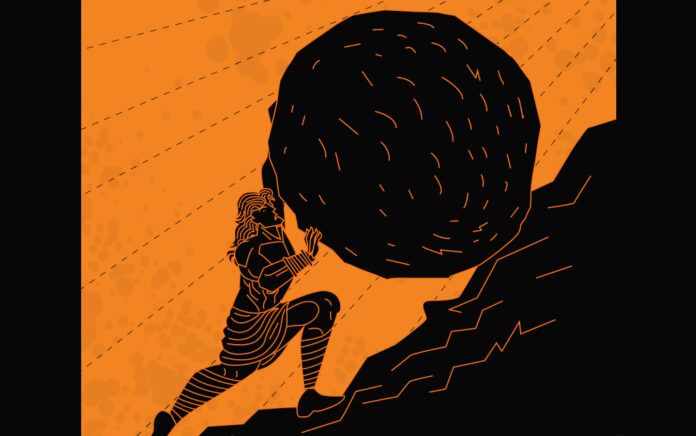
The Forms of Chaos
Chaos can be negative, positive, or neutral. Below are some forms of chaos:
| Chaos to Confront | Work to Do | Life-Giving Order |
| Dirty | Clean Up | Clean |
| Out of Place | Organize | Organized |
| Where you are | Transportation | Where you want to be |
| Sick/injured | Healing | Well |
| Potential | Bring Forth | Actual |
| Wild | Discipline | Tame |
| Nature | Build | Civilization |
| Threat | Protective Measures | Security |
| Evil | Repent | Goodness |
| Ugly | Renovate | Beautiful |
| Unknown | Learn/Explore | Known |
| Negative Emotion | Feel/Process | Positive Emotion |
| Inefficient | Simplify | Efficient |
| Confusion | Clear Communication | Clarity |
A teacher or coach work to cultivate the potential in children. A detective will gather evidence to solve mysteries and catch bad guys. A landscaper cuts grass and trims trees to make a yard look beautiful. A truck driver takes objects of value from one place to another. Customer service reps walk with their customers through confusion in order to bring clarity and peace of mind. An artist takes ordinary items and transforms them to invoke awe and wonder. Indiana Jones explored many places to recover items of great value.
A useful thought experiment is asking, “What would happen if I didn’t do my work?” Where would the world be if all janitors quit? What would happen if I stopped changing my son’s diapers? What would happen if I stopped making meals or washing clothes? What would happen if farmers stopped planting and harvesting? As Elon Musk once said on the Joe Rogan Podcast, “If you don’t make stuff, there is no stuff.” “The one who is lazy in his work is brother to a vandal” (Proverbs 18:9). “Because of laziness the roof caves in, and because of negligent hands the house leaks (Ecclesiastes 10:18). If we don’t do our work of confronting chaos, people suffer and die.
When Order Isn’t Life-Giving
As mentioned, chaos isn’t always bad and order isn’t always good. For example, nature is both a beautiful sunset overlooking a mountain lake, and it is a lion that wants to eat you. Similarly, order isn’t always life giving. I think of TV detective Adrian Monk who had debilitating OCD and a fear of germs (among other things). His desire for cleanliness and security cut him off from most love and joy in life. Unhealthy chaos is anarchy, but unhealthy order is tyranny.
Consider the chaos of the unknown. If we never explore ideas or places outside of what we already know, we remain stagnant and become ignorant and arrogant. We need to encounter things we don’t know in order to expand our realm of understanding. If not, you will never try new foods, go new places, or meet new people. That is no way to live.
Below is a helpful chart that gives examples of chaos and order in its productive and unproductive forms:
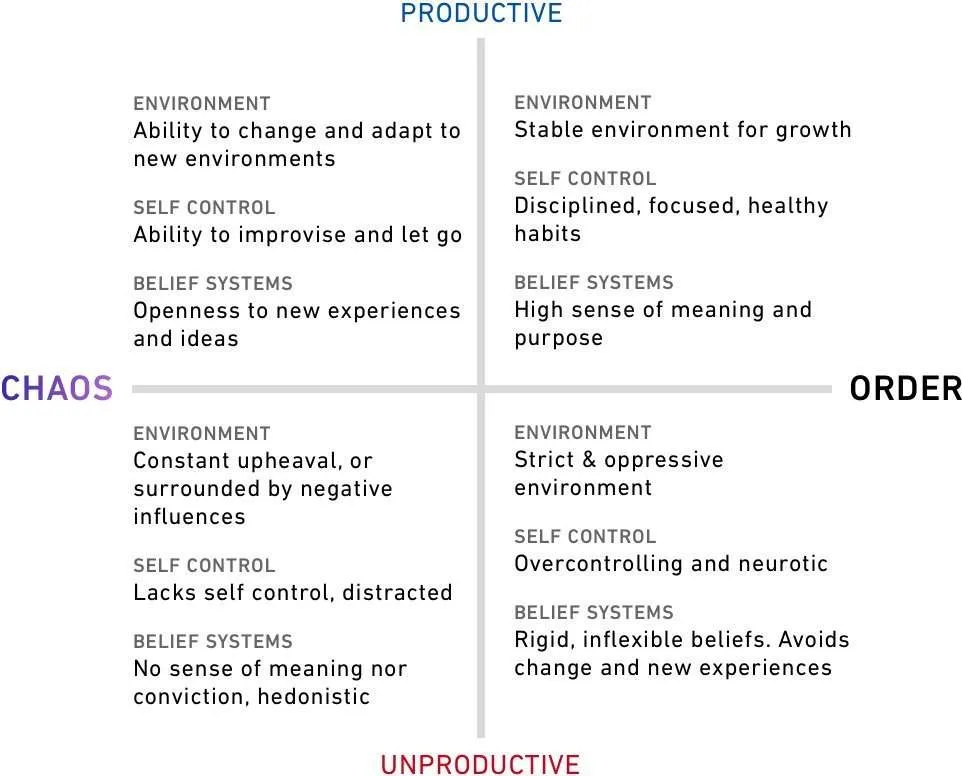
If you find yourself in the lower left quadrant, you should introduce order. If you are in the lower right quadrant, you should introduce some healthy chaos. If you are in the top, you will constantly need wisdom to know whether you need to “stick to your guns” or to be open to other ideas. “There is a time to tear down (chaos) and a time to build (order)” (Ecclesiastes 3:3). We need to wisdom to know which to do at the proper time.
The End of Work
Not all work is good work. Imagine two chemists working in a lab. Both are meticulous in measuring out the proper elements, diligent in timing and temperature, in order to create a high-quality product. However, one of them was making medicine while the other was making meth. They may have been doing the same activity, but the end result was opposite. One chemist made something that heals (life-giving order) while the other made something that destroys (destructive chaos).
When it is all said and done, the end of all work needs to be love. During Minnesota winters, we love our neighbors by shoveling and salting the sidewalks. If we don’t people can get badly hurt. I change diapers so that my son can stay healthy and comfortable. I’m writing this so that you might be informed and encouraged. Work becomes destructive when people are motivated by greed, pride, people-pleasing, or fear.
Jesus’ main commands were to repent and believe in the gospel (Mark 1:15) and to love God and love others (Matthew 22:36-40). A key way we love others is through our work. “For we are God’s handiwork, created in Christ Jesus to do good works, which God prepared in advance for us to do” (Ephesians 2:10). When we do our work well we honor God and bring goodness to the lives of others.
What is the chaos you need to confront today?
 Cultural Eulogy