The last couple years I have been getting into the minimalism movement. The Minimalists put out great content, Joshua Becker has many thoughtful insights on his website, and Marie Kondo has a series on Netflix that shows how tidying up can legitimately change lives. All of these people and more have given me practical steps for owning less, organizing, and making space for what matters most in life. However, I only recently saw how minimalism and tidying up connects directly to God. Let’s go back to the first words of the bible.
“In the beginning God created the heavens and the earth. Now the earth was formless and empty and darkness was over the surface of the deep, and the Spirit of God was hovering over the waters” (Genesis 1:1-2).
The Problem of Chaos
In the beginning there was only God and chaos (symbolized by darkness and the waters). Chaos is disorder and the unknown. It contains great potential, but it can also drown you. How does this apply to our homes and possessions? What does it mean for a home to be in chaos? Clutter, mess, and disorder.
William Morris, an English textile designer in the 1880’s said, “Have nothing in your houses that you do not know to be useful or believe to be beautiful.” That is how I would define clutter. Anything in your life that is not useful or beautiful. Similarly, the Minimalists define clutter as anything that doesn’t add value to your life.

According to an ABC News article, cluttered homes lead to increased stress, decreased focus and productivity, and more unhealthy eating. As Tyler Durden said in Fight Club, “The things you own end up owning you.” Just looking at the picture above stresses me out, but often rooms in my house don’t look much better. How can we imitate God in bringing order out of the chaos of our homes?
Separate into Broad Categories
“And God said, ‘Let there be light,’ and there was light. God saw that the light was good, and he separated the light from the darkness” (Genesis 1:3-4). On day one of creation God separated light from darkness. On day two he separated the sky and the sea. On day three he separated the sea from the land.
Step one for dealing with the clutter of your home is to separate your possessions into broad categories. Maybe you separate items by room. For example, if dishes are in your bedroom, that is a good indicator that chaos is winning. Marie Kondo’s method is to go through clothes first, then books, then paper, then miscellaneous household items, and finally sentimental items. You feel the effects of when things are not in their proper place, so putting things into broad categories is a great first step in creating order out of chaos.
Separate According to Their Kinds
After God separated the land from the sea, he created vegetation: plants bearing seed according to their kinds and trees bearing fruit with seed in it according to their kinds (emphasis added). The phrase “according to their kinds” is used ten times in Genesis 1. God made different birds and fish “according to their kinds,” and all sorts of land animals “according to their kind.” On days 1-3 of creation God created the realm/category and on days 4-6 he filled each realm (see the image below).
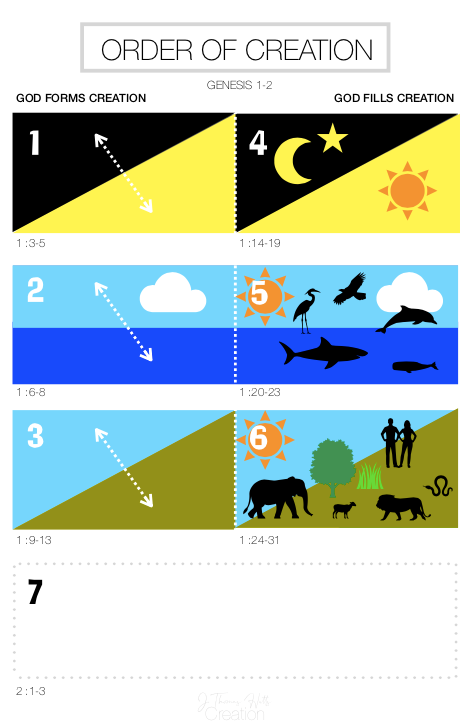
In your home, after you broadly separate your possessions, you can then differentiate more specifically. In the bathroom you could put together hair products (brush, hair dryer, hair spray, and hair ties), mouth products (toothbrush, tooth paste, mouth wash, and floss), and healing products (bandages, Ibuprofen, and other OTC medicines). You can separate your shirts from your pants, your pots from your pans, your toys from your blankets, and jewelry from old receipts. I recently did this with my son’s toys as we were unpacking boxes in our new apartment. I put all of the stuffed animals together, all the toy vehicles together, all of his books on the bookshelf, and all of his clothes in a pile separate from the toys. I was able to differentiate his stuff “according to their kinds,” but there is still one more step.
Separate the Sheep from the Goats
Matthew 25:31-33 states, “When the Son of Man comes in his glory . . . all the nations will be gathered before him, and he will separate them one from another, just as a shepherd separates the sheep from the goats. He will put the sheep on his right and the goats on his left.” The sheep are blessed and inherit God’s Kingdom while the goats are cursed and set apart for destruction.
I don’t mean to trivialize God’s judgement. It is something we should all take more seriously. However, for the sake of this post I want to apply the principle of sheep and goats to our possessions. We ought to distinguish between what is useful, valuable, and a blessing from what is just taking up space and keeping us from the most important things. Here are some questions to help you discern what is valuable (Many of these come from the book Love People, Use Things by Joshua Fields Milburn and Ryan Nicodemus):
- How much is enough? Be specific. How many shirts? Mugs? Plates? Book?
- Pare down to whatever number you decide.
- If this object was to spontaneously combust, would you feel relieved?
- If yes, you can feel freedom to remove it.
- Have you used this in the past 90 days? Will you use it in the next 90 days?
- You are already not using it, why not make the break-up official?
- What are you afraid of?
- Are you afraid of disappointing someone or not having enough? There is power in pressing into your fears.
- Is there someone else who can use this more than me?
- It is better to give than to receive (Acts 20:35).
- Does this item spark joy? (From Marie Kondo)
- If it doesn’t give you joy, why hold on to it?
- If I were shopping now, would I buy it?
- If you wouldn’t buy it again, you probably don’t need it now.
Go through all of your things and discern what is adding value to your life (sheep) and what is not (goats). The goal is to make space in your life for what matters most. The less you own, the less you have to manage, the more time and energy you are able to invest elsewhere. Here is a article of how to start the decluttering process.
We often think of our stuff as an extension of ourselves, which makes it difficult to de-own. One tip is to create a “maybe” box in which you place items you may or may not want to keep. Once you put the items in the box, leave them for for a certain amount of time (anywhere from one to six months). If you don’t miss anything in the box, you can donate it with peace of mind.
Minimalism and tidying up is a process, not a destination. Which brings me to my final point.
Rule with Wisdom, Creativity, and Love
God made males and females in his image so that we would rule over his creation. “God blessed them, and said to them, ‘Be fruitful, multiply, fill the earth, and subdue it. Rule the fish of the sea, the birds of the sky, and every creature that crawls on the earth.'” Psalm 8 goes so far to say that God “put everything under their feet.”
One aspect of imaging God is to “subdue” that which God has put under you. God has given responsibilities to every person. He entrusts his creation to us and expects to have a good return on his investment. He gives money and possessions so that we would put them to good use and be a blessing to others. When we “rule” over our stuff with wisdom we push back against the clutter and chaos of our homes and create a space of warmth, peace, and hospitality. Do you feel like you are ruling over your stuff or is your stuff ruling over you?
God placed Adam in the Garden of Eden to work it and watch over it (Genesis 2:15). If you’ve ever planted a garden, you know that you can’t just plant your seeds and leave it alone. You have to work the soil, water, and pull weeds. If you don’t intentionally maintain your garden, it won’t be fruitful. The weeds and rabbits will stop the growth. Similarly, if we aren’t diligent in taking daily steps to declutter, organize, and maintain our things, the chaos will start to choke out the life we are trying to create in our homes. God has given us all we need to create beauty, life, and peace out of the chaos of our home. What is holding you back?
P.S.
Here is another article by Joshua Becker about daily decluttering routines.
 Cultural Eulogy