The other day I imagined coaching my son’s youth sports team and I wondered what team rules would resonate with small children. The two rules that came to mind are listen well and do your best. As I pondered these more, I realized that you can get pretty far in life by living by these two rules. Let’s explore what these look like in practice.
Listen Well
A quote from the movie Fight Club sums up a lot of conversations: “Most people don’t listen when you talk, they are just waiting for their turn to speak.” Listening well is a great life skills that will help you in every area of life. Here are some ways in which you can listen well:
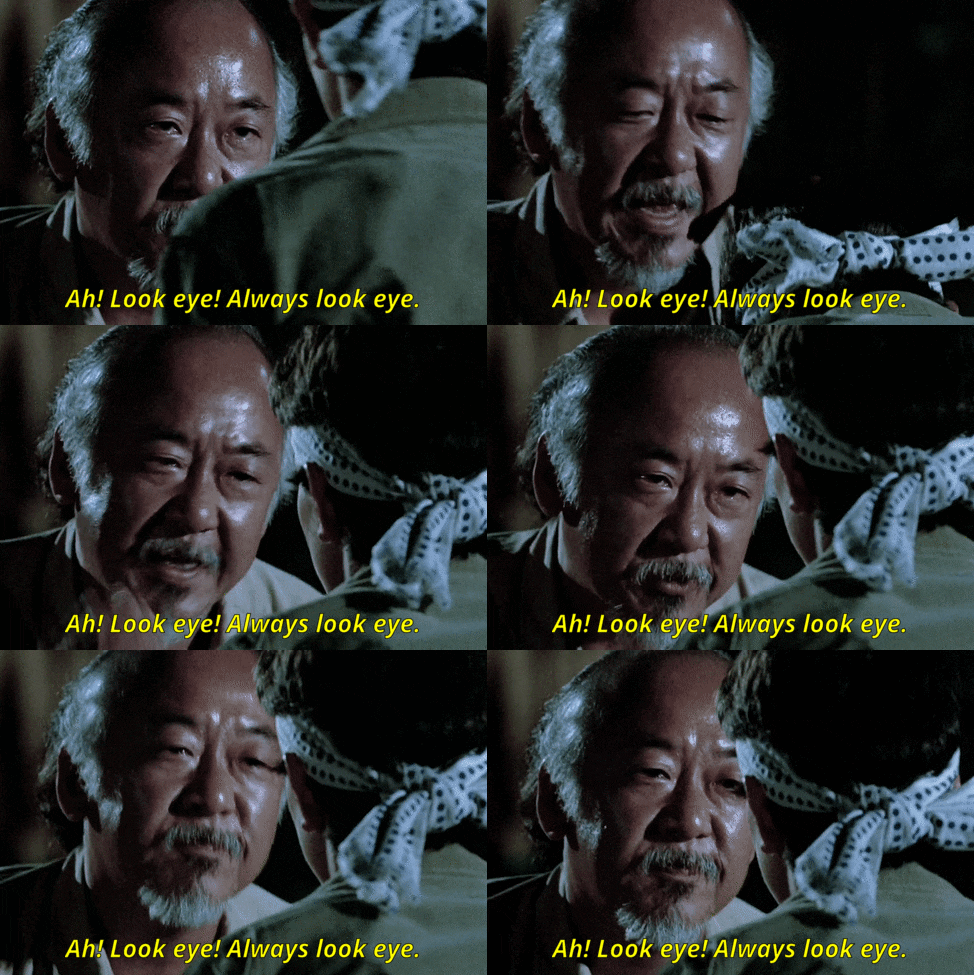
- Maintain eye contact- In sports this might look like not messing with a ball or your equipment when the coach is talking. In life it might look like putting your phone away during conversations.
- Don’t interrupt or talk when the other person is talking– It’s impossible to talk and listen at the same time.
- Ask questions until you understand– Curiosity is a much better default than assuming.
- Repeat back what the other person said to confirm that you heard correctly– I think this is especially important when conversing with someone who has different beliefs and opinions. Pastor Tim Keller suggests that we represent and engage with our opponents’ position in the strongest form. We should “do all the work necessary until [we] can articulate the views of [our] opponent with such strength that he says, ‘I couldn’t have said it better myself.’”
- Assume that they know something that you don’t (Credit to Jordan Peterson)- This requires the humility to admit that you don’t have all the answers and truth can be found in unlikely places.
- If possible, take notes– Our minds tend to wander and we are quick to forget. Taking notes helps with both.
- Take action– Jesus said that anyone who hears his words yet doesn’t act on them is like a foolish man who builds his house on the sand. When storms come, the house collapsed (Matthew 7:26-27). Imagine a parent who told their kid to clean their room, ony to find the room still a pigsty at the end of the day. The child might’ve heard the parent, but they did not listen.
Do Your Best
There is an amusing story from my childhood when I asked my mom what would happen if I ever got an F in a class.
She said, “I would be disappointed because didn’t do your best.”
I asked, “What if I tried my hardest and the best I could do was an F?”
“That wouldn’t happen.”
“But what if it did?”
“It wouldn’t.”
“But what if it did?”
As you can imagine, this conversation could have gone on forever without getting anywhere. But it brings up a good question to reflect on whenever a task is completed: Did I genuinely give it my best?
A hidden blessing of failures is that it requires us to examine what went wrong. In sports, you can beat a bad team without giving it your best effort. You can also do everything in your power and still lose to a better team. When you win, you tend not to question the results. When you lose, you are forced to ask yourself difficult questions. Here are some questions to ponder whenever it is time to review:
- How was my preparation?– Imagine a football team that goes into a game without watching any of their opponent’s film. They might try their hardest during the game, but they didn’t do the necessary preparations. There is truth in the saying, “Failing to prepare is preparing to fail.”
- How did I respond to adversity (internal and external)?– Mike Tyson said, “Everyone has a plan until they get punched in the mouth.” How do you respond when things didn’t go according to plan? Did you respond with hope and courage, or did you give up and lose heart?
- Did I give in to fear?– Fear can keep us from taking meaningful action. I had teammates in high school who held back in practice and games because they were afraid of giving everything they had and feeling the disappointment of failure. Failure doesn’t hurt as much when you don’t invest your whole heart. The definition of courage isn’t being fearless, rather it is persevering in the face of fear. I think there is value in naming your fears. It’s harder to fight an enemy that you can’t see.
- What things were outside of my control?– Sometimes life happens. You get sick. Your car breaks down. There is a family emergency. During high school track I got sick with mono. Giving it my best effort looked a lot different after I was sick. That doesn’t mean we should use these as excuses, but I think it is important to name what is and isn’t in our control in order to assess the situation more fairly.
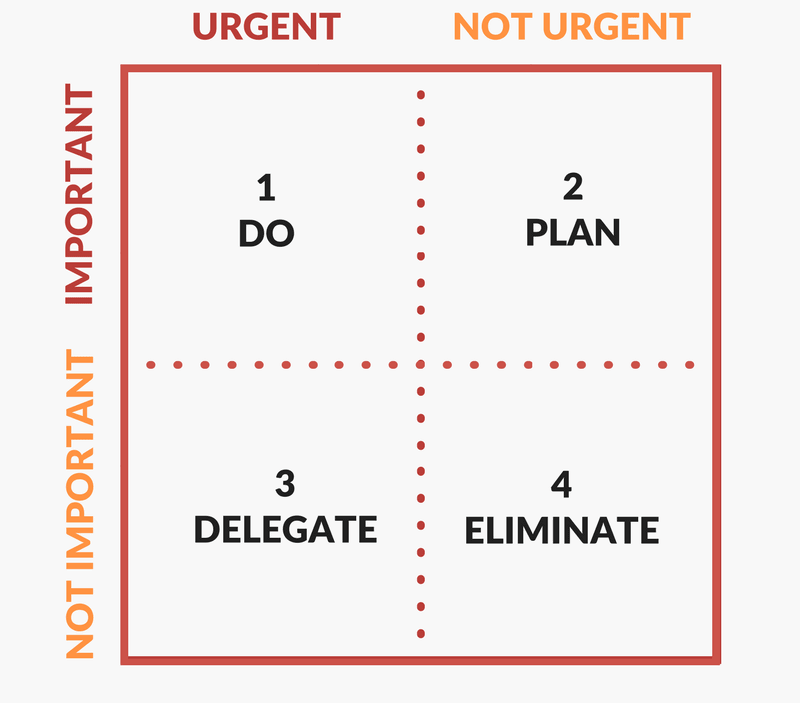
- Did I prioritize the most important things?– We can do a lot of things right, but if good things keep us from the best things, we are still falling short of our calling. (See the matrix below.)
- What distracted me?– This is related to the previous question. If you didn’t prioritize the most important things, what was it that distracted you? Were they urgent things that weren’t important? Were they time-wasters like TV or social media? Did you spend too much time gossiping with coworkers? What kept you from the most important tasks and how can you avoid them in the future?
- Did I ask for help?– I think we often fall short of our goals because we don’t ask for help, either from fear of looking weak, foolish pride that thinks we have all the answers, or maybe you don’t have a network of people you trust. Not asking for help keeps us stagnant. We are created for community and need others. May we have the humility to ask for help when we need it!
Discerning what is Important
One caveat for doing your best is that sometimes we just have to let things be good enough. We can get so fixated on doing things perfectly that we don’t end up getting them done. There are also different responsibilities competing for our time and energy and we have to decide what is most important. A pastor once shared how he preached a sermon without preparing as he normally would because he coached his son’s baseball team the previous day. He didn’t preach his best, but he did the best he could given the circumstances. A way to love his son and the community was to coach the team. To him, the impact he could have coaching outweighed the potential drop in sermon quality.
We must all count the cost. For a college athlete, there might be some weeks that you can’t watch as much film because you have a big paper due. Or maybe you spend less time on a homework assignment because your team was travelling. It would make sense for your quality of work to dip if you are caring for a loved one who is sick. We must constantly be evaluating what are our priorities, and if our actions reflect that they are truly priorities.
Another caveat is that sometimes we don’t have a lot to offer. Every athlete will eventually have a bad game even with great effort and preparation. Sometimes things just go wrong in sports and in life. Everyone will eventually make mistakes and bad decisions. That’s part of being human. I also think of people who suffer with depression or are battling a sickness and have to work extra hard to do seemingly simple tasks. Their best effort looks different depending on how serious their ailment is.
God has given everyone of us great potential and limitations. My potential and limitations will look different than yours or anyone else’s. However, these lines are not set in stone. As we push ourselves to grow, our capacity will increase and our limitations will be pushed further out. May we all have the wisdom and courage to explore those boundaries!
Here is a powerful video about beating perceived limitations and a challenge to give your absolute best.
If you like what you read, subscribe below to stay up to date!
 Cultural Eulogy